MODALS: Modality-agnostic Automated Data Augmentation in the Latent Space
TL;DR
New research presents latent space data augmentation strategies for improving deep learning with small labeled datasets.
Transcript
data augmentation is one of the most popular techniques to prevent overfitting when trying to use deep learning with small labeled data sets for example if you only have a thousand labeled examples it's unlikely that deep learning will work well data augmentation is a great solution to this where we apply transformations to the data to artificially... Read More
Key Insights
- 👍 Data augmentation is a proven solution for overfitting in deep learning, especially crucial with limited labeled datasets that deep neural networks typically struggle to learn from effectively.
- 🤗 The introduction of latent space augmentation opens new avenues for data enhancement beyond traditional image-based methods, providing a framework adaptable to multiple data types.
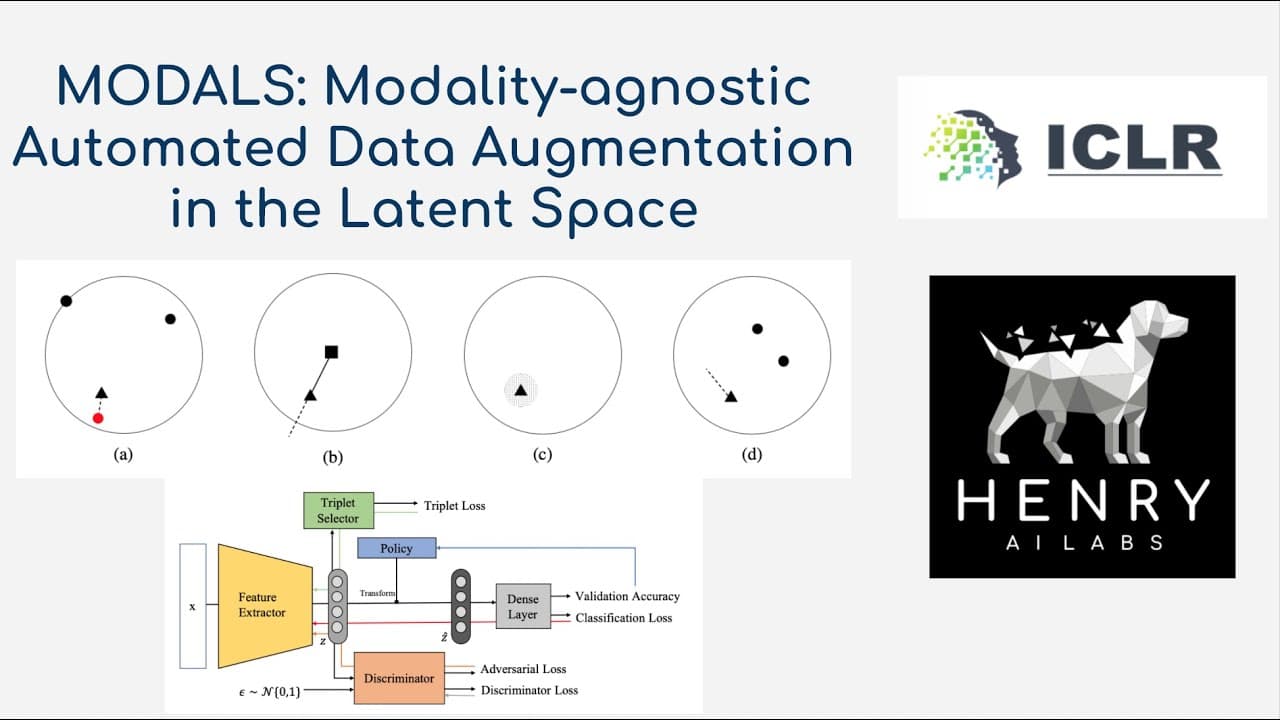
- 🏷️ The four main augmentation strategies—hard example interpolation, hard example extrapolation, Gaussian noise addition, and difference transformation—provide a diverse toolkit for modifying latent representations while maintaining label integrity.
- 👻 Utilizing multiple loss functions allows the model to effectively structure and smooth the latent space, improving the model's ability to navigate complex data distributions.
- ⚾ Population-based augmentation refines hyperparameter tuning by evolving strategies based on performance metrics, enhancing the robustness of data augmentation methodologies.
- 👻 The results from the study suggest that continuous latent space not only aids in performing transformations but allows models to derive meaningful insights from difficult edge cases within their respective classes.
- 💨 This research paves the way for exploring data augmentation techniques in academic competitions and real-world applications beyond images and text, expanding the scope and impact of deep learning technologies.
Install to Summarize YouTube Videos and Get Transcripts
Explore YouTube Video Summarizer or Get YouTube Transcript Extractor
Questions & Answers
Q: What is data augmentation and why is it important in deep learning?
Data augmentation involves creating artificial training examples from existing labeled data to prevent overfitting, particularly in deep learning where models can easily memorize small datasets. By leveraging transformations, such as rotations in images or noise addition in other types of data, augmentation effectively increases the training set size, leading to improved model generalization.
Q: How does data augmentation differ between images and text data?
While it's relatively straightforward to apply augmentations to images while preserving their labels, such as rotations or flips, text data presents challenges. Modifying text can often change its meaning or remove crucial information, making it harder to maintain label integrity. Therefore, careful techniques are required to augment textual data without compromising classification accuracy.
Q: What are the key innovations from the recent research presented in the ICLR 2021 paper?
The research introduces several novel data augmentation strategies that operate in the latent space rather than the input space, improving the generalizability of augmentation techniques across data forms. It establishes new loss functions to ensure smooth transformations in the latent space and implements population-based augmentation to optimize hyperparameters effectively.
Q: How does hard example interpolation enhance data augmentation in latent spaces?
Hard example interpolation is a strategy in which the feature vector is adjusted towards a more challenging example on the edge of the class boundary. This approach helps create augmented examples that are more representative of the challenging aspects of the data, promoting better performance in classification tasks by exploring the decision boundaries of the model.
Q: What role does population-based augmentation play in data augmentation strategies?
Population-based augmentation is an approach that maintains a population of configurations for hyperparameters used in data augmentation. It allows for the evolution of these parameters over time to find optimal transformation strategies. This concept works efficiently alongside the modal strategies to enhance the robustness of models trained on small datasets.
Q: Why is continuous latent space crucial for data augmentation?
A continuous latent space allows for smooth transitions between data points, enabling consistent and meaningful transformations. This continuity is essential for ensuring that augmented examples do not deviate sharply from their original forms, which is particularly important in achieving reliable and generalizable model outputs.
Q: How did the researchers validate their augmented methods in the study?
The researchers conducted experiments across different datasets, including various text classification tasks, and compared the performance of their modal strategies against standard techniques like easy data augmentation. The results showed significant improvements over baseline methods, highlighting the efficacy of their proposed augmentation techniques.
Q: What are some potential applications for the developed data augmentation techniques outside of images and text?
The modal strategies hold promise for various modalities such as healthcare data, time series data, and non-image-based sensor data where traditional augmentation techniques may fail. This versatility can support advancements in areas like medical diagnosis models, financial forecasting systems, or any domain struggling with limited labeled examples.
Summary & Key Takeaways
-
Data augmentation is vital in deep learning, especially when working with small labeled datasets, as it mitigates overfitting by artificially increasing training examples using transformations, primarily applicable to images.
-
Traditional data augmentation techniques struggle with non-image data like text or health data since it's difficult to maintain label integrity while modifying the data, motivating the exploration of augmenting data within the latent space.
-
The research introduces four innovative augmentation strategies that operate in the latent space, incorporating unique loss functions and a population-based augmentation strategy, showing promising results in enhancing classification tasks across various data types.
Read in Other Languages (beta)
Share This Summary 📚
Summarize YouTube Videos and Get Video Transcripts with 1-Click
Try YouTube Summary with ChatGPT & Claude or YouTube Transcript Generator
Explore More Summaries from Connor Shorten 📚
Summarize YouTube Videos and Get Video Transcripts with 1-Click
Try YouTube Summary with ChatGPT & Claude or YouTube Transcript Generator