4.2.8 Worked Examples: Gates and Boolean Logic
TL;DR
This content explains the concept of Boolean gates and how they can be used to design circuits.
Transcript
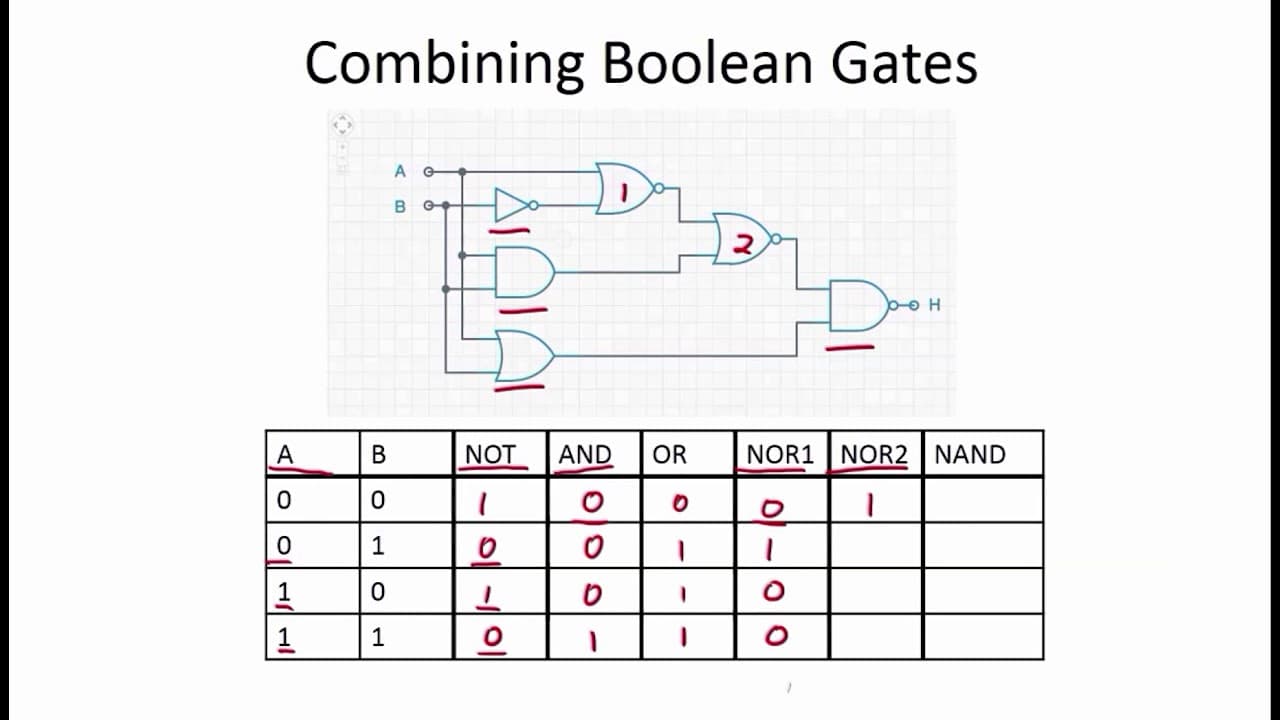
PROFESSOR: Instead of building all of our logic functions directly in CMOS, it is easier for us to create a higher level of abstraction known as Boolean gates, which represent CMOS gates. Each gate is assigned a symbol, which can then be used in schematic diagrams that combine multiple logic gates together. In order to be able to understand what fu... Read More
Key Insights
- ✋ Boolean gates provide a higher level of abstraction, making circuit design easier.
- 🔬 Basic gates like the inverter, AND, and OR gates have defined truth tables that determine their logic.
- 🔬 NAND and NOR gates are inverting gates and can be implemented as a single CMOS gate.
- 🔬 Complex functions can be created by combining multiple gates and their outputs.
- 🎨 Circuit designs can be represented using truth tables to determine the output for each combination of inputs.
- 😑 The sum of products notation can be used to express functions as a combination of logic terms.
- 👮 Using inverters and De Morgan's law, circuits can be converted to consist purely of NAND gates.
Install to Summarize YouTube Videos and Get Transcripts
Explore YouTube Video Summarizer or Get YouTube Transcript Extractor
Questions & Answers
Q: What is the purpose of using Boolean gates in circuit design?
Boolean gates provide a higher level of abstraction, making it easier to design and understand complex logic functions by utilizing symbols to represent CMOS gates.
Q: Can AND and OR gates be implemented as a single CMOS gate?
No, AND and OR gates require multiple CMOS gates, whereas NAND and NOR gates are inverting gates and can be implemented as a single CMOS gate, making them more convenient for circuit design.
Q: How can complex functions be created using multiple gates?
By combining multiple gates, such as using the output of one gate as the input to another gate, more complex functions can be achieved, allowing for a wider range of logic operations in circuit design.
Q: What is the advantage of using NAND gates in circuit implementation?
NAND gates are considered universal gates as they can be used to implement any logic function. Additionally, each NAND gate can be implemented as a single CMOS gate, making them efficient for circuit design.
Summary & Key Takeaways
-
Boolean gates are a higher level of abstraction that represents CMOS gates, making it easier to build logic functions.
-
Basic gates include the inverter (producing the inverse of its input), AND gate (outputting 1 only if all inputs are true), OR gate (outputting 1 if at least one input is true), NAND gate (inverse of AND gate), NOR gate (inverse of OR gate), and exclusive or gate (outputting 1 if exactly one input is true).
-
Complex functions can be created by combining multiple gates, and circuit designs can be represented using truth tables.
Read in Other Languages (beta)
Share This Summary 📚
Summarize YouTube Videos and Get Video Transcripts with 1-Click
Try YouTube Summary with ChatGPT & Claude or YouTube Transcript Generator
Explore More Summaries from MIT OpenCourseWare 📚



Summarize YouTube Videos and Get Video Transcripts with 1-Click
Try YouTube Summary with ChatGPT & Claude or YouTube Transcript Generator