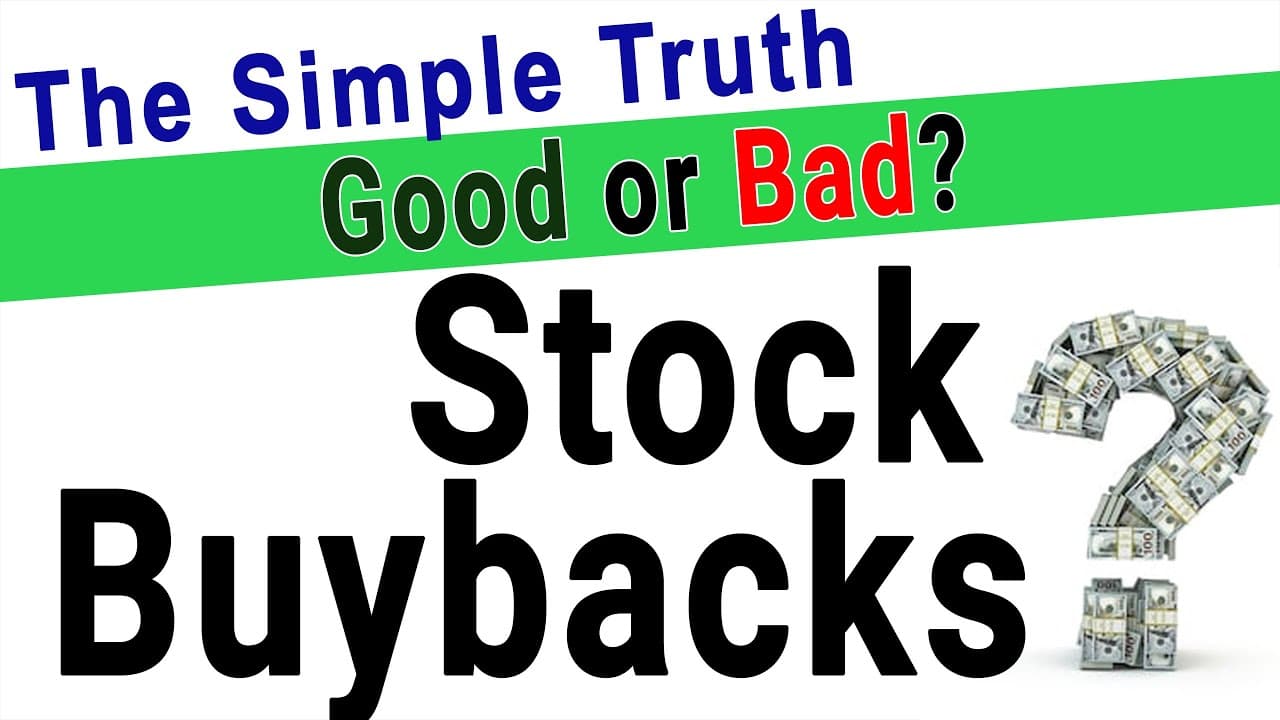
Stock Buybacks - Good or Bad? Are Share Repurchases a Bad Thing for Investors? Stock Buyback Basics
TL;DR
Stock buybacks can boost earnings per share, but funding method matters for shareholder value.
Transcript
Hi I'm Jimmy in this video we're looking at stock buybacks how they work and if they're really a good thing for us investors and what should we watch for. If we're analyzing a company that is doing a stock buyback. OK. Let's jump right in. So ultimately a stock buyback is when a company buys shares of their own company generally from the public. No... Read More
Key Insights
- ❓ Stock buybacks involve companies repurchasing their own shares, potentially boosting earnings per share.
- ℹ️ The funding source for buybacks, whether cash or debt, can impact their effectiveness on shareholder value.
- 😘 Higher leverage ratios from buybacks may lead to lower stock price multiples, affecting investor perceptions.
- 🖐️ Capital allocation plays a crucial role in deciding between buybacks and dividends for maximizing shareholder value.
- ❓ Evaluating each buyback in isolation is essential to determine its mathematical sense and benefit for investors.
- ❓ Market dynamics and investor sentiment can influence the impact of buybacks on stock prices.
- 🍂 Stock buybacks may be favored in situations where a company's stock price falls significantly, increasing earnings yield.
Install to Summarize YouTube Videos and Get Transcripts
Explore YouTube Video Summarizer or Get YouTube Transcript Extractor
Questions & Answers
Q: What is a stock buyback and how does it impact earnings per share?
Stock buybacks involve a company repurchasing its own shares, which can boost earnings per share by reducing the number of outstanding shares, theoretically leading to higher EPS.
Q: How does the funding source for buybacks, whether cash or debt, affect their impact on shareholder value?
Funding buybacks with debt can raise financial leverage ratios, impacting stock price multiples, while cash buybacks may directly boost earnings per share if the cash isn't earning high returns elsewhere.
Q: What factors should investors consider when evaluating the benefits of stock buybacks for a company?
Investors should analyze how a buyback is funded, the company's financial leverage, potential impact on EPS, and whether it aligns with maximizing shareholder value in the long term.
Q: Why do some investors prefer stock buybacks over dividends, and how does capital allocation play a role in this decision?
Some investors view buybacks as tax-efficient and trust company management to allocate capital effectively, potentially generating higher returns than traditional dividends.
Summary & Key Takeaways
-
Stock buybacks involve companies repurchasing their own shares, typically from the public through methods like open market purchases.
-
While buybacks can increase earnings per share, the funding source, whether cash or debt, impacts their effectiveness.
-
Higher leverage from buybacks may not always result in proportional stock price increases due to market dynamics.
Read in Other Languages (beta)
Share This Summary 📚
Summarize YouTube Videos and Get Video Transcripts with 1-Click
Try YouTube Summary with ChatGPT & Claude or YouTube Transcript Generator
Explore More Summaries from Learn to Invest - Investors Grow 📚





Summarize YouTube Videos and Get Video Transcripts with 1-Click
Try YouTube Summary with ChatGPT & Claude or YouTube Transcript Generator