L05.3 Probability Mass Functions
TL;DR
A probability mass function (PMF) describes the likelihood of different values for a discrete random variable, with examples and calculations provided.
Transcript
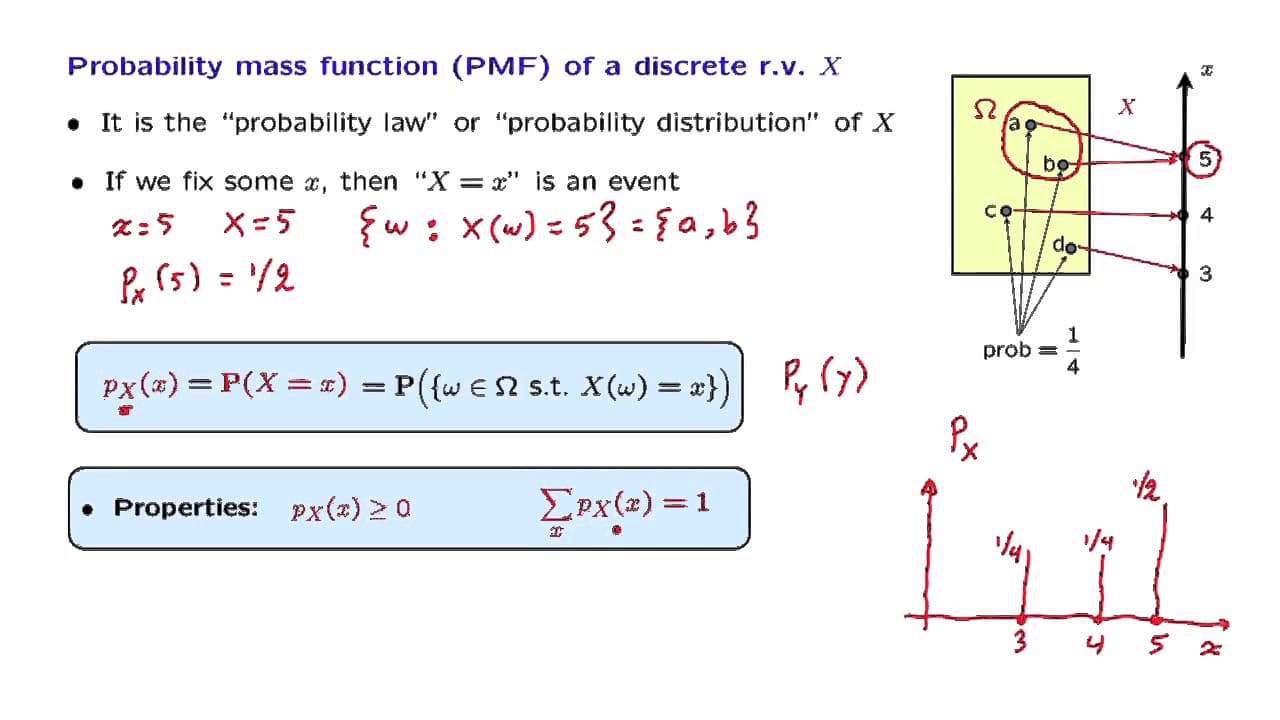
A random variable can take different numerical values depending on the outcome of the experiment. Some outcomes are more likely than others, and similarly some of the possible numerical values of a random variable will be more likely than others. We restrict ourselves to discrete random variables, and we will describe these relative likelihoods in ... Read More
Key Insights
- ⚾ A random variable can take different numerical values based on the outcome of an experiment.
- 💆 The probability mass function (PMF) describes the probabilities of these values.
- ❓ The PMF is a function that assigns probabilities to each possible value of the random variable.
- 🪜 The probabilities of all possible values of the random variable should add up to 1.
- 🚱 The PMF is always non-negative since probabilities are non-negative.
- ❓ The PMF can be plotted to visualize the probabilities of different values.
- 🪜 The PMF is calculated by considering each possible value of the random variable and adding the probabilities of the corresponding outcomes.
Install to Summarize YouTube Videos and Get Transcripts
Explore YouTube Video Summarizer or Get YouTube Transcript Extractor
Questions & Answers
Q: What is a random variable?
A random variable is a variable that takes on different numerical values based on the outcome of an experiment or event. It represents uncertainty in the outcome.
Q: What does the probability mass function (PMF) describe?
The PMF describes the probabilities assigned to each possible value of a random variable in a discrete probability distribution.
Q: How is the PMF calculated?
To calculate the PMF, we consider each possible value of the random variable one at a time and find the outcomes for which the random variable takes on that specific value. We then add the probabilities of those outcomes.
Q: What are the properties of the PMF?
The PMF is non-negative for all values of the random variable. Additionally, the sum of the probabilities for all possible values of the random variable should be equal to 1.
Summary & Key Takeaways
-
A random variable can take different numerical values based on the outcome of an experiment, and the PMF describes the probability of these values.
-
The PMF is a function that assigns probabilities to each possible value of the random variable.
-
The probabilities of all possible values should add up to 1.
Read in Other Languages (beta)
Share This Summary 📚
Summarize YouTube Videos and Get Video Transcripts with 1-Click
Try YouTube Summary with ChatGPT & Claude or YouTube Transcript Generator
Explore More Summaries from MIT OpenCourseWare 📚



Summarize YouTube Videos and Get Video Transcripts with 1-Click
Try YouTube Summary with ChatGPT & Claude or YouTube Transcript Generator