Session 2: Sampling in Statistics
TL;DR
Populations and samples play a crucial role in statistics, allowing us to gather data efficiently and make inferences about larger groups.
Transcript
welcome to this the second session in my 15 session statistics class in this session i'm going to talk about something that most people find boring but i think i find fascinating which is populations and samples let me back up a population includes the universe of every single instance of an object or phenomenon trying to examine let me get to spec... Read More
Key Insights
- ❓ Population refers to every instance of an object or phenomenon, while sampling involves studying a subset of the population.
- 😵 Time series and cross-sectional sampling are two common methods used in statistical analysis.
- ⌛ Sampling is necessary due to practicality, cost, and time constraints.
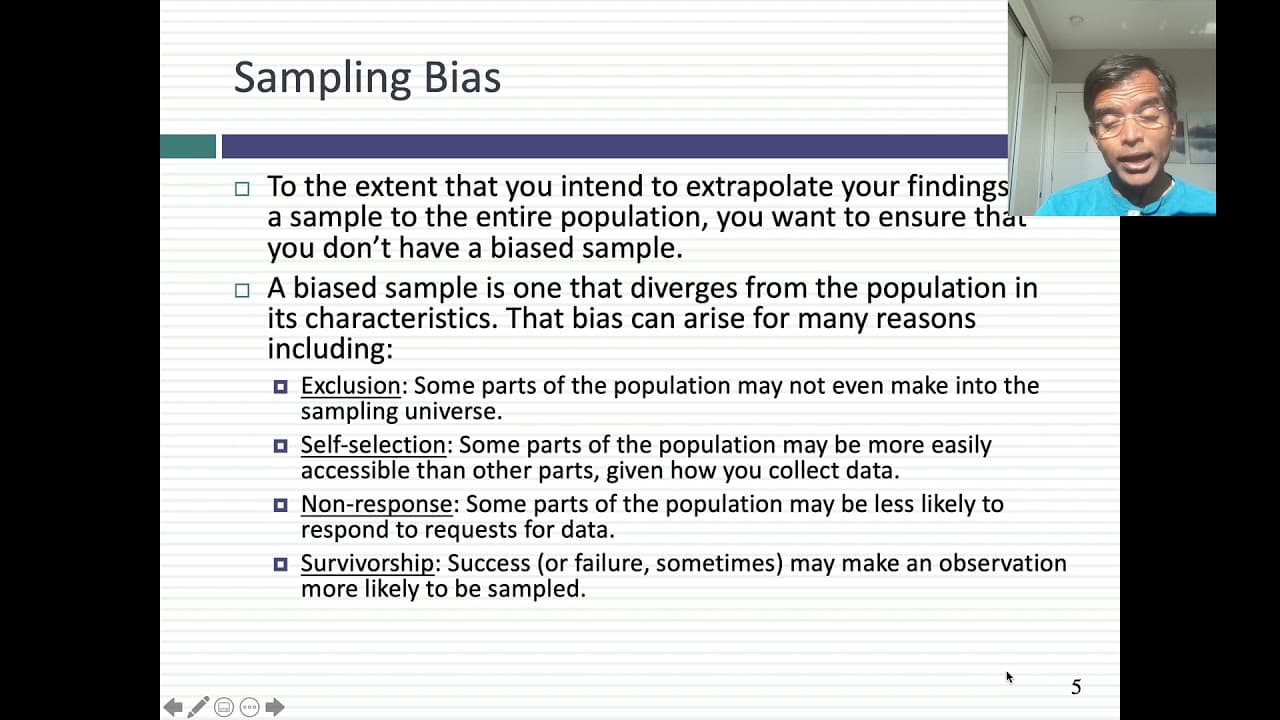
- 🤳 Biases, such as exclusion, self-selection, non-response, and survivorship bias, can affect the validity of sample results.
- ❓ Independence and identical distributions are important assumptions for accurate statistical analysis.
- 🌥️ The law of large numbers states that larger sample sizes lead to more accurate estimates of population parameters.
- 👻 The central limit theorem allows us to make statements about populations, even if the underlying distribution is not normal.
Install to Summarize YouTube Videos and Get Transcripts
Explore YouTube Video Summarizer or Get YouTube Transcript Extractor
Questions & Answers
Q: Why do we use samples instead of studying the entire population?
The main reasons for using samples are practicality, cost, and time constraints. It is often impossible or too expensive to collect data on the entire population, so sampling allows us to make inferences about the larger group.
Q: What are the two ways to sample data?
The two ways to sample data are time series sampling and cross-sectional sampling. Time series sampling looks at data over a specific time period, while cross-sectional sampling selects a subset based on specific criteria, such as market cap.
Q: What are some common biases in sampling?
Bias can occur due to exclusion of certain population groups, self-selection of participants, non-response to surveys or polls, and survivorship bias. These biases can lead to misleading conclusions if not accounted for in the analysis.
Q: How do we reduce sampling noise in statistical analysis?
Increasing the sample size reduces sampling noise or error. The law of large numbers states that as the sample size grows, the sample average will approach the population average. Stating findings with appropriate ranges also helps account for sampling noise.
Summary & Key Takeaways
-
A population includes every instance of an object or phenomenon, making it difficult to collect data on the entire population.
-
Sampling involves selecting a subset of a population to study, which can be more practical and cost-effective.
-
There are two ways to sample data: time series sampling and cross-sectional sampling, depending on the research question.
Read in Other Languages (beta)
Share This Summary 📚
Summarize YouTube Videos and Get Video Transcripts with 1-Click
Try YouTube Summary with ChatGPT & Claude or YouTube Transcript Generator
Explore More Summaries from Aswath Damodaran 📚



Summarize YouTube Videos and Get Video Transcripts with 1-Click
Try YouTube Summary with ChatGPT & Claude or YouTube Transcript Generator