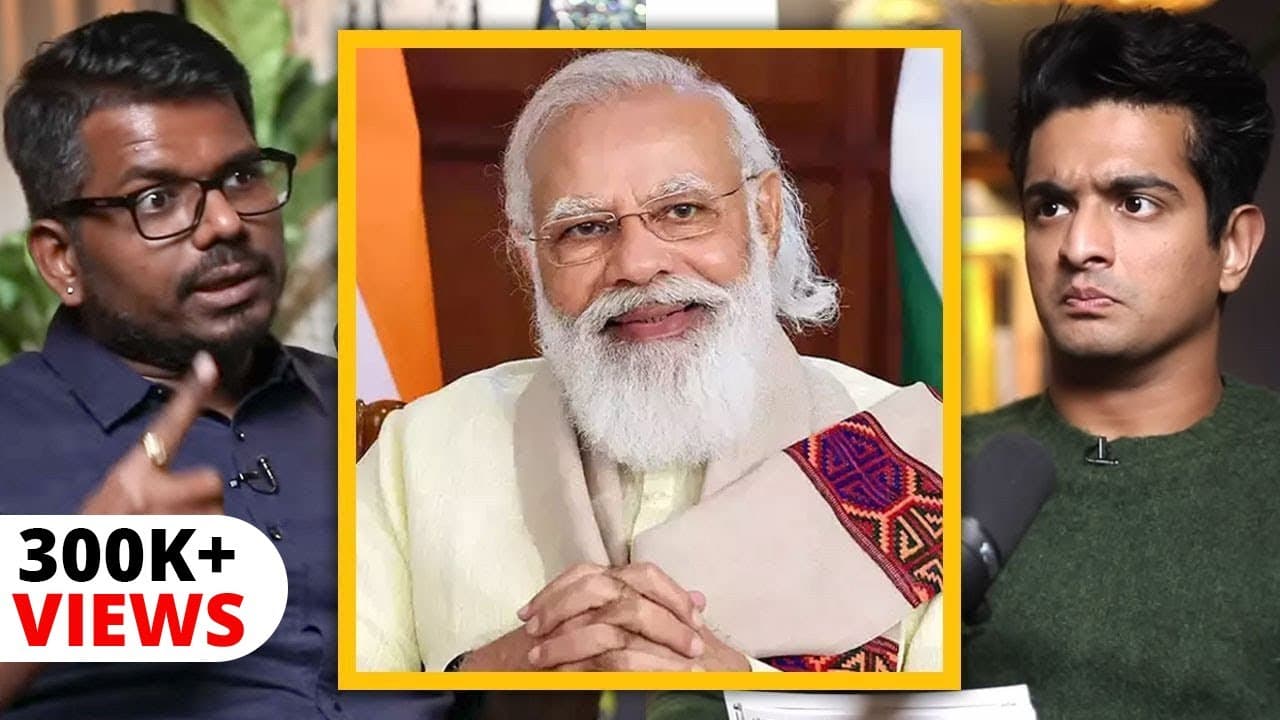
BJP's REAL Power - J Sai Deepak Explains "Single Party State" Possibility For India
TL;DR
A discussion on India's political trajectory points to the potential for a single-party state influenced by weak opposition.
Transcript
your friends are scrolling through short content but you my friend you're here to learn welcome to the honest clips why don't you draw a bit of a trajectory of the current government over the rest of the 20s as well as the 30s both based on interior narratives and exterior narratives because um I think we had Rajiv Malhotra on the show who suggeste... Read More
Key Insights
- 🤨 The perception of a weak opposition in India raises worries about the country evolving into a single-party state, reminiscent of others like China.
- 🥳 Historical parallels are vital for understanding present challenges and predicting future political landscapes, suggesting that evolution within political parties is essential.
- ⛔ Identity politics tend to overshadow critical policy discussions, limiting democratic discourse and public engagement on relevant issues.
- 🔉 Media narratives significantly shape perceptions of Indian politics, often reducing complex discussions to simplified partisan battles that divert attention from substantive concerns.
- 🖐️ The need for a “balanced” democratic model, where both public sentiment and expert insights play a significant role in policymaking, is highlighted.
- 🥳 The concept of “enlightened democracy” suggests a need for evolution in how governance is approached, without strict adherence to existing party frameworks.
- 🌐 Cultural narratives and stereotypes portrayed by foreign media challenge India's global image and require a nuanced discussion to reshape perceptions.
Install to Summarize YouTube Videos and Get Transcripts
Explore YouTube Video Summarizer or Get YouTube Transcript Extractor
Questions & Answers
Q: How do current political conditions in India resemble a single-party state?
Current discussions suggest that India's political environment is increasingly dominated by the BJP, with limited effective opposition. Critics liken this to characteristics of single-party states where alternative voices are marginalized. This allows the governing party to shape policies without robust challenges, raising concerns about democracy's health and the potential for authoritarian governance in the future.
Q: What historical parallels can be drawn to understand India's political trajectory?
The discussion references historical instances where factions within political parties led to significant changes, such as the rise of the Swaraj Party in the early 20th century. This historical context is important in understanding how internal opposition can emerge and influence the broader political landscape, emphasizing that politics is often shaped by past events.
Q: How significant is the role of media narratives in shaping public perception of Indian politics?
Media narratives significantly impact public perception, as they often frame political discourse through various lenses, such as cultural stereotypes or partisan biases. The participants highlight the need to shift focus from a binary BJP versus Congress narrative to more substantive discussions about democracy, policy, and societal issues to better educate and engage the public.
Q: What is the potential for opposition parties to revive and challenge the BJP?
The discussion suggests that the current opposition lacks cohesion and effectiveness, making significant challenges to the BJP unlikely in the near term. However, political dynamics can shift quickly, and grassroots movements or new parties might emerge in response to public dissatisfaction with current governance, leading to a reconfiguration of the political landscape.
Summary & Key Takeaways
-
The conversation highlights concerns about the current political landscape in India, suggesting the possibility of a single-party state due to a weak opposition, predominantly represented by the BJP.
-
It emphasizes the importance of historical context in predicting future political developments and notes the need for diverse political voices within parties to counterbalance growing authoritarianism.
-
The dialogue also critiques media narratives and emphasizes the necessity of focusing on substantive issues rather than identity politics in order to foster democratic discourse.
Read in Other Languages (beta)
Share This Summary 📚
Summarize YouTube Videos and Get Video Transcripts with 1-Click
Try YouTube Summary with ChatGPT & Claude or YouTube Transcript Generator
Explore More Summaries from TRS Clips 📚

Summarize YouTube Videos and Get Video Transcripts with 1-Click
Try YouTube Summary with ChatGPT & Claude or YouTube Transcript Generator