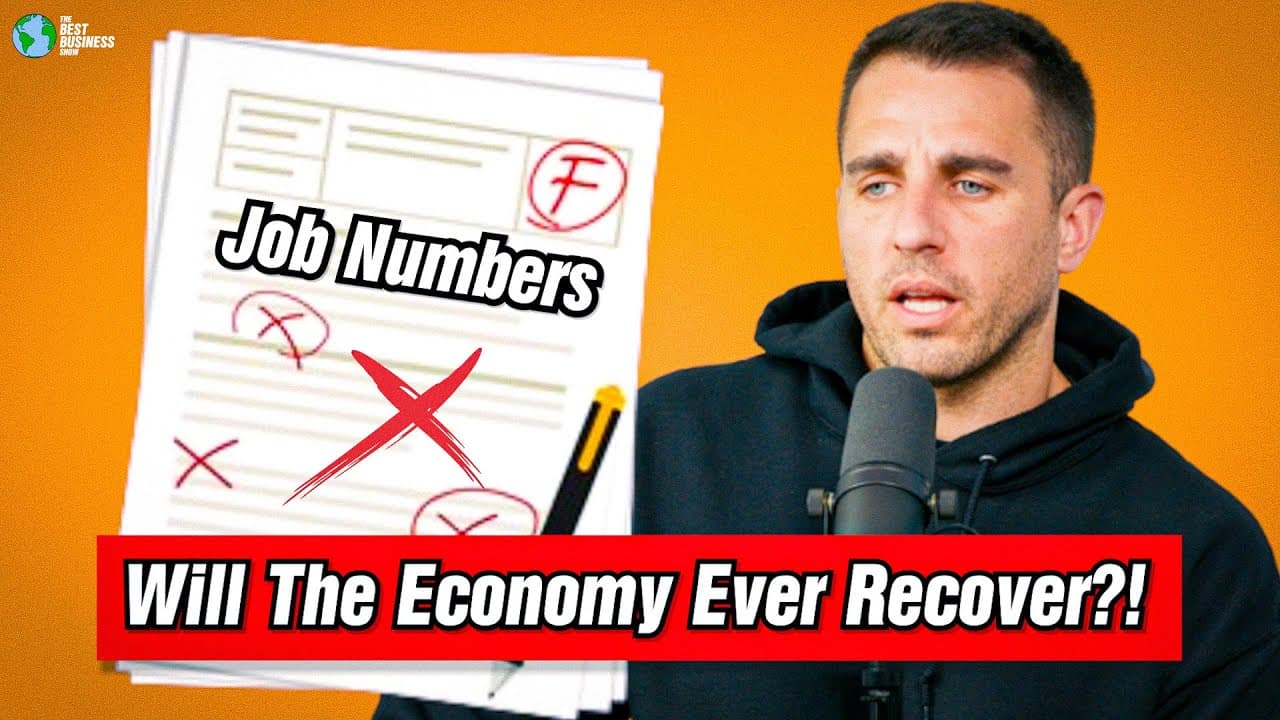
Breaking News: Jobs Created In September. Way Worse Than Expected.
TL;DR
U.S. job growth estimates are frequently inaccurate, causing confusion in economic decision-making.
Transcript
we have talked about it non-stop on this show economists are no better than casino gamblers we just got the non-farm payroll numbers the estimate was that we were going to get 500 000 new jobs we got under 200 000 less than 50 percent what is going on the u.s labor september non-farm payroll the consensus the entire market had agreed on the estimat... Read More
Key Insights
- 💝 The latest non-farm payroll report highlights a significant shortfall in job growth expectations, calling into question the accuracy of economic predictions.
- 🛟 Ineffective economic forecasting can have real-life repercussions for both institutional and retail traders impacting their financial decisions and market behavior.
- 🙈 The gap of nine million jobs needed post-pandemic underscores the severity of the current labor market crisis mirroring conditions not seen since 2008.
- 🤗 The presence of 11 million open jobs contradicts high unemployment claims, suggesting systemic issues in workforce engagement and job market dynamics.
- ❓ Continuous reliance on faulty data for fiscal and monetary policy indicates a manipulation of economic conditions rather than a realistic representation of market forces.
- 🇨🇫 The dual challenges of public health and economic recovery can erode public confidence, leading to increased despondency among job seekers and businesses alike.
- 🛄 Economic interventions aimed at stabilizing the market may inadvertently yield unpredictable consequences, creating further disconnect between economic theory and practical realities.
Install to Summarize YouTube Videos and Get Transcripts
Explore YouTube Video Summarizer or Get YouTube Transcript Extractor
Questions & Answers
Q: What were the actual non-farm payroll job numbers reported, and how did they compare to estimates?
The latest non-farm payroll report revealed fewer than 200,000 new jobs added, significantly falling short of the anticipated 500,000. This discrepancy highlights ongoing challenges within economic forecasting where actual results were less than 50% of the consensus estimate, raising concerns about data reliability and forecasting accuracy.
Q: Why are economists criticized in this context, and how do their predictions affect financial decision-making?
Economists are criticized for failing to deliver accurate forecasts consistently, often aligning their predictions closer to chance than informed estimates. This inaccuracy affects market participants who rely on these numbers for decision-making regarding asset purchases or sales, risking significant financial implications for less sophisticated retail traders.
Q: What explanations are offered for the ongoing job growth slowdown following the pandemic?
Some economists attribute the slowdown to “seasonal” job patterns and government employment fluctuations. Critics, however, dismiss these as inadequate justifications for persistent underperformance and point to the staggering gap of nine million jobs needed to reach expected growth levels, similar to figures seen during the 2008 recession.
Q: How does the current economic environment reflect on public health and job recovery simultaneously?
The economic challenges are compounded by a public health crisis, as the death toll from COVID-19 in 2021 outpaced 2020. This situation adds a layer of complexity, as recovery in job numbers remains sluggish despite a record number of open jobs, leading to societal despair and financial instability without a clear plan for resolution.
Q: What implications arise from the disconnect between open job positions and unemployment rates?
The disconnect indicates a misalignment in the labor market where, despite 11 million job openings, unemployment remains over five percent. One interpretation is that market interventions have skewed normal functioning, leading to a manipulated economy that fails to connect job seekers with roles effectively and lacks accountability for discrepancies.
Q: What are the potential consequences of ongoing inaccurate labor estimates?
Persistent inaccuracies in labor estimates could undermine confidence in economic indicators, potentially leading to escalated market volatility and misguided investment strategies. Inaccurate data can lead to flawed monetary policy, discouraging businesses from hiring or expanding, ultimately exacerbating economic stagnation and public sentiment.
Summary & Key Takeaways
-
Recent labor data showed a stark discrepancy between expected job growth of 500,000 and actual growth of under 200,000, raising questions about the credibility of economic forecasts.
-
Critics argue that continuous inaccuracies in job estimates reflect poorly on economists, likening their predictions to casino luck rather than informed analysis, leading to financial miscalculations.
-
Despite massive job openings, an increasing unemployment rate indicates a severe economic disconnect, as public health issues and financial instability persist without a clear resolution in sight.
Read in Other Languages (beta)
Share This Summary 📚
Summarize YouTube Videos and Get Video Transcripts with 1-Click
Try YouTube Summary with ChatGPT & Claude or YouTube Transcript Generator
Explore More Summaries from Anthony Pompliano 📚

Summarize YouTube Videos and Get Video Transcripts with 1-Click
Try YouTube Summary with ChatGPT & Claude or YouTube Transcript Generator