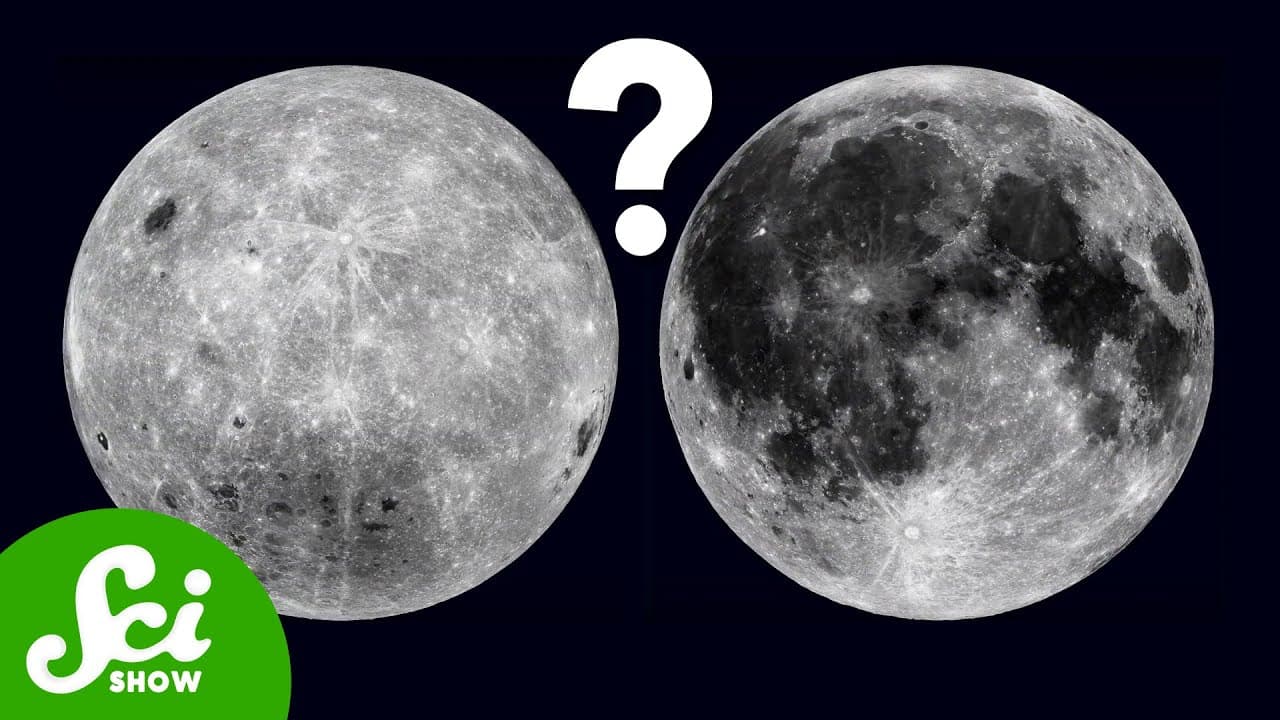
Why Is Our Moon Two-Faced?
TL;DR
The Moon's two-faced appearance is due to factors like radioactivity, convection currents, and collisions with other celestial bodies.
Transcript
Thanks to Brilliant for supporting this SciShow video! As a SciShow viewer, you can keep building your STEM skills with a 30 day free trial and 20% off an annual premium subscription at Brilliant.org/SciShow. [♪ INTRO] In 1959, humanity learned that the giant gray orb hanging in our sky is two-faced. The near side of the Moon, the one fac... Read More
Key Insights
- 😀 The Moon's two-faced nature can be attributed to factors like radioactivity, convection currents, and collision events with other celestial bodies.
- 🤢 Radioactive elements like KREEP on the Moon's near side impact the crust's properties and formation of lava seas.
- 🥺 Tilted convection currents could have led to the differential distribution of materials, contributing to the Moon's unique appearance.
- 💥 Collisions with smaller moons in the past may have influenced the Moon's crust composition and thickness.
- 🥹 NASA's Artemis missions hold promise for uncovering more answers about the Moon's formation with new lunar samples.
- ❓ Understanding the Moon's history and composition involves unraveling complex scientific hypotheses and observations.
- 💠 The Moon's appearance is a testament to the dynamic processes that shaped our celestial neighbor over billions of years.
Install to Summarize YouTube Videos and Get Transcripts
Explore YouTube Video Summarizer or Get YouTube Transcript Extractor
Questions & Answers
Q: How does radioactivity from KREEP impact the Moon's crust?
Radioactive elements in KREEP lower melting points, release heat, and could have led to the solidification of the Moon's maria on the near side.
Q: What is tilted convection, and how does it explain the Moon's two-faced nature?
Tilted convection could have caused uneven material distribution, resulting in a thinner crust with KREEP on one side and a thicker crust on the other.
Q: How does the collision hypothesis explain the Moon's appearance?
The idea that the Moon could have formed from the collision of multiple celestial bodies, including a smaller moon, could explain its asymmetrical features.
Q: How will the upcoming Artemis missions contribute to understanding the Moon's mystery?
NASA's Artemis missions will bring back new lunar samples, allowing scientists to delve deeper into the Moon's composition and formation processes.
Summary & Key Takeaways
-
The near side of the Moon has a thin crust with frozen lava seas, while the far side has a thicker crust with almost no lava seas.
-
Hypotheses include radioactivity from elements like KREEP, tilted convection currents, and collisions with smaller moons.
-
Scientists still seek answers through lunar samples and upcoming Artemis missions.
Read in Other Languages (beta)
Share This Summary 📚
Summarize YouTube Videos and Get Video Transcripts with 1-Click
Try YouTube Summary with ChatGPT & Claude or YouTube Transcript Generator
Explore More Summaries from SciShow 📚


Summarize YouTube Videos and Get Video Transcripts with 1-Click
Try YouTube Summary with ChatGPT & Claude or YouTube Transcript Generator