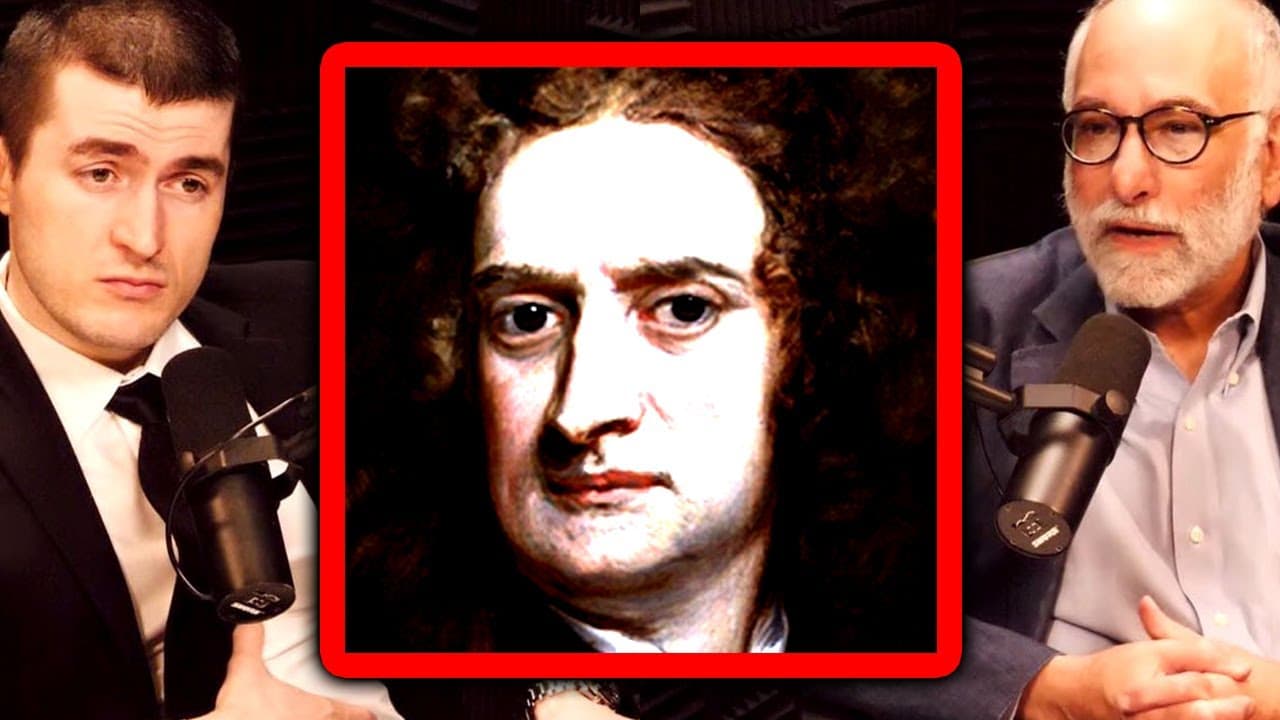
Isaac Newton's traumatic childhood | Jed Buchwald and Lex Fridman
TL;DR
Isaac Newton, a renowned scientist, was born in 1642 and made significant contributions to the world, including the development of calculus. His childhood trauma and complicated father-son relationship may have shaped his abilities as a scientist.
Transcript
who was isaac newton what are the things he contributed to this world in the space of ideas wow who was he he was born in 1642 in and near the small town of grantham in england in fact the house he was born in and that his mother died in is still there and can be visited his father died before he was born and his mother eventually remarried a man n... Read More
Key Insights
- 🖐️ Isaac Newton's childhood trauma and complicated family relationships may have played a role in shaping his determination and drive as a scientist.
- 🤘 Newton showed early signs of intelligence and curiosity, engaging in activities like flying kites, which highlighted his aptitude for experimentation and invention.
- 🥺 His time at Cambridge University exposed him to new philosophical ideas and helped him develop a deep understanding of mathematics, leading to his groundbreaking contributions in physics.
- 💨 Newton's contributions, including his laws of motion and the development of calculus, revolutionized our understanding of the natural world and paved the way for modern physics, mathematics, and engineering.
Install to Summarize YouTube Videos and Get Transcripts
Explore YouTube Video Summarizer or Get YouTube Transcript Extractor
Questions & Answers
Q: How did Isaac Newton's childhood trauma influence his career as a scientist?
Newton's absent father and complicated relationship with his stepfather may have fueled his determination and drive to prove himself. This drive likely played a role in his relentless pursuit of knowledge and his groundbreaking contributions to science.
Q: What were some of Isaac Newton's notable contributions to the world?
Newton's most famous contributions include his laws of motion, the development of calculus, his experiments with light and optics, and his advancements in the field of astronomy. These contributions revolutionized the understanding of the natural world and laid the foundation for modern physics.
Q: How did Isaac Newton's time at Cambridge University contribute to his intellectual development?
At Cambridge, Newton immersed himself in the intellectual atmosphere and was exposed to different philosophical ideas. He engaged with the works of prominent thinkers like Descartes and developed a deep understanding of mathematics and its application to the study of nature.
Q: How did Isaac Newton's study of calculus revolutionize scientific investigation?
Newton built upon previous mathematical investigations to create a comprehensive system for studying continuously changing processes. This approach, known as calculus, allowed for precise analysis of motion, acceleration, and rates of change, enabling significant advancements in fields like physics, engineering, and economics.
Summary & Key Takeaways
-
Isaac Newton was born in 1642 in Grantham, England, and faced a complicated childhood due to the absence of his father and his mother's remarriage.
-
Despite his challenging upbringing, Newton showed early signs of intelligence and curiosity, engaging in activities like flying kites.
-
Newton eventually attended Cambridge, where he pursued his studies and developed groundbreaking ideas in physics, mathematics, and philosophy, including the foundations of calculus.
Read in Other Languages (beta)
Share This Summary 📚
Summarize YouTube Videos and Get Video Transcripts with 1-Click
Try YouTube Summary with ChatGPT & Claude or YouTube Transcript Generator
Explore More Summaries from Lex Clips 📚




Summarize YouTube Videos and Get Video Transcripts with 1-Click
Try YouTube Summary with ChatGPT & Claude or YouTube Transcript Generator