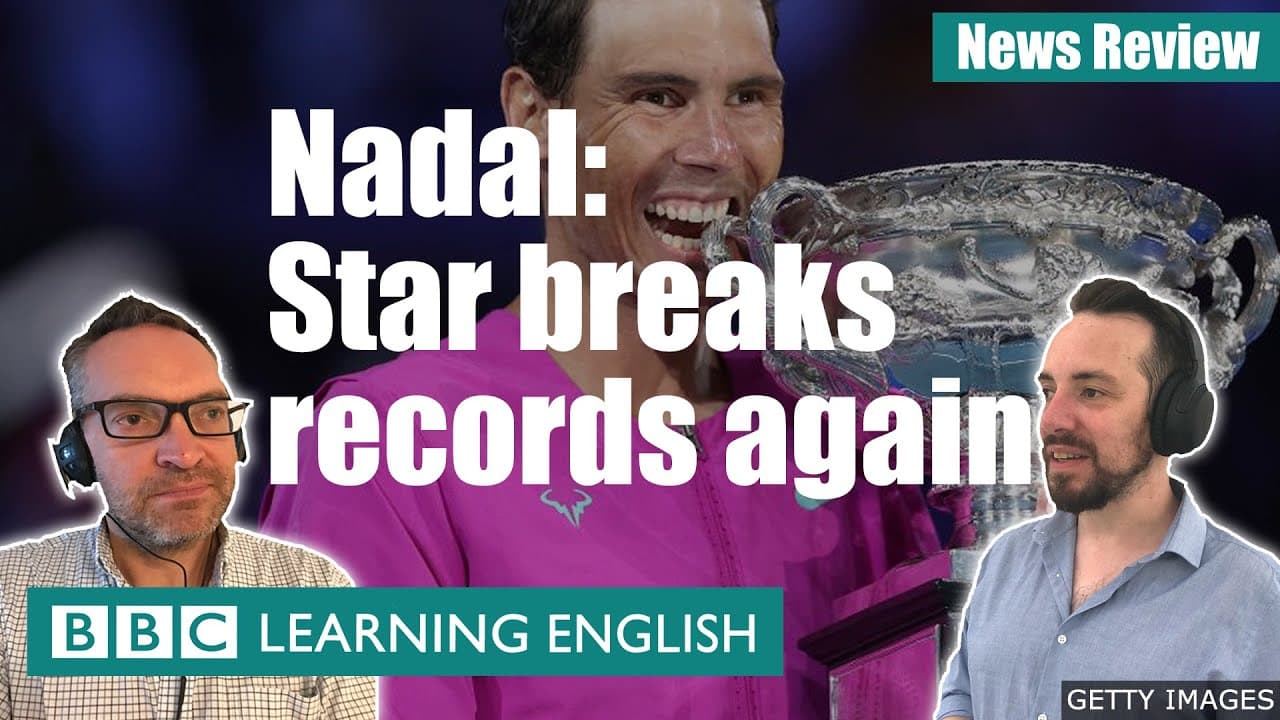
Nadal: Star breaks records again: BBC News Review
TL;DR
This video explains Rafael Nadal's historic achievement of winning a record 21st Grand Slam singles title, surpassing his rivals Roger Federer and Novak Djokovic. The discussion highlights Nadal's remarkable comeback victory in the Australian Open final against Daniil Medvedev and introduces vocabulary such as 'comeback', 'Herculean', and 'GOAT' to help viewers discuss this event.
Transcript
Rafael Nadal has won a record 21st Grand Slam singles title in Australia. Hello, welcome to News Review from BBC Learning English. I'm Rob and joining me to talk about this story is Roy. Hello Roy. Hello Rob and hello everybody. If you would like to test yourself on the vocabulary around this story, all you need to do is head to our website bbclear... Read More
Key Insights
- Rafael Nadal achieved a historic milestone by winning his 21st Grand Slam singles title, surpassing Roger Federer and Novak Djokovic.
- Nadal's victory in the Australian Open final against Daniil Medvedev was a dramatic comeback, as he was initially losing the match.
- The term 'comeback' refers to winning after being in a losing position, exemplified by Nadal's performance in the final.
- The word 'Herculean' describes tasks requiring great effort, as Nadal's victory demanded immense physical and mental strength.
- The acronym 'GOAT' stands for 'greatest of all time', a title often attributed to exceptional athletes like Nadal.
- The video discusses the difference between 'come' and 'go', focusing on their usage in different contexts.
- The concept of a 'comeback' is not limited to sports; it can refer to returning to success in any field.
- The discussion includes vocabulary and expressions to help viewers articulate and discuss significant sporting events.
Install to Summarize YouTube Videos and Get Transcripts
Explore YouTube Video Summarizer or Get YouTube Transcript Extractor
Questions & Answers
Q: What is the significance of Rafael Nadal's victory mentioned in the video?
Rafael Nadal's victory in the Australian Open is significant because it marks his 21st Grand Slam singles title, setting a new record and surpassing his rivals Roger Federer and Novak Djokovic. This achievement highlights Nadal's exceptional skill and resilience, solidifying his status as one of the greatest tennis players of all time.
Q: How is the term 'comeback' used in the context of the video?
In the video, the term 'comeback' is used to describe Nadal's victory in the Australian Open final, where he was initially losing but managed to win the match. 'Comeback' refers to winning after being in a losing position, showcasing Nadal's determination and ability to overcome challenges during the game.
Q: What does the term 'Herculean' mean as explained in the video?
The term 'Herculean', as explained in the video, is used to describe tasks or efforts that require great strength, energy, or difficulty. It is derived from the mythological figure Hercules, known for his incredible strength. In the context of Nadal's victory, it highlights the immense effort needed to secure his win.
Q: How is the acronym 'GOAT' relevant to Rafael Nadal's achievement?
The acronym 'GOAT', which stands for 'greatest of all time', is relevant to Nadal's achievement as it is often used to describe individuals who have reached an unparalleled level of success in their field. Nadal's record-breaking 21st Grand Slam title positions him as one of the greatest tennis players ever, justifying the use of 'GOAT'.
Q: What vocabulary is introduced in the video to discuss sporting achievements?
The video introduces vocabulary such as 'comeback', 'Herculean', and 'GOAT' to help viewers discuss sporting achievements. 'Comeback' refers to winning after being in a losing position, 'Herculean' describes efforts requiring great strength, and 'GOAT' stands for 'greatest of all time', highlighting exceptional success.
Q: What is the difference between 'come' and 'go' as discussed in the video?
In the video, 'come' and 'go' are explained in terms of travel and perspective. 'Go' is used for traveling to another place where neither the speaker nor the listener is present. 'Come' involves traveling to a place where either the speaker or listener is present. The video clarifies these terms to avoid confusion.
Q: Can 'comeback' be used outside of sports contexts?
Yes, 'comeback' can be used outside of sports contexts. It generally refers to returning to success or an activity after a period of decline or absence. The video mentions its use in various fields, such as entertainment or personal achievements, where individuals or groups regain their former success.
Q: How does the video help viewers improve their vocabulary related to sports?
The video helps viewers improve their sports-related vocabulary by introducing and explaining terms like 'comeback', 'Herculean', and 'GOAT'. It provides context and examples for each term, enabling viewers to better articulate and discuss significant sporting events and achievements, enhancing their language skills.
Summary & Key Takeaways
-
Rafael Nadal's victory in the Australian Open marks his 21st Grand Slam singles title, setting a new record. The video discusses his comeback win against Daniil Medvedev, highlighting key vocabulary such as 'comeback', 'Herculean', and 'GOAT' to help viewers talk about this historic achievement.
-
The video covers Nadal's dramatic win in the Australian Open final, where he overcame a challenging match against Daniil Medvedev. It introduces vocabulary like 'comeback', 'Herculean', and 'GOAT', providing insights into discussing sports achievements.
-
In this video, viewers learn about Nadal's record-breaking 21st Grand Slam title. The discussion includes his epic victory in the Australian Open, alongside vocabulary such as 'comeback', 'Herculean', and 'GOAT' to enhance understanding of the event.
Read in Other Languages (beta)
Share This Summary 📚
Summarize YouTube Videos and Get Video Transcripts with 1-Click
Try YouTube Summary with ChatGPT & Claude or YouTube Transcript Generator
Explore More Summaries from BBC Learning English 📚
Summarize YouTube Videos and Get Video Transcripts with 1-Click
Try YouTube Summary with ChatGPT & Claude or YouTube Transcript Generator