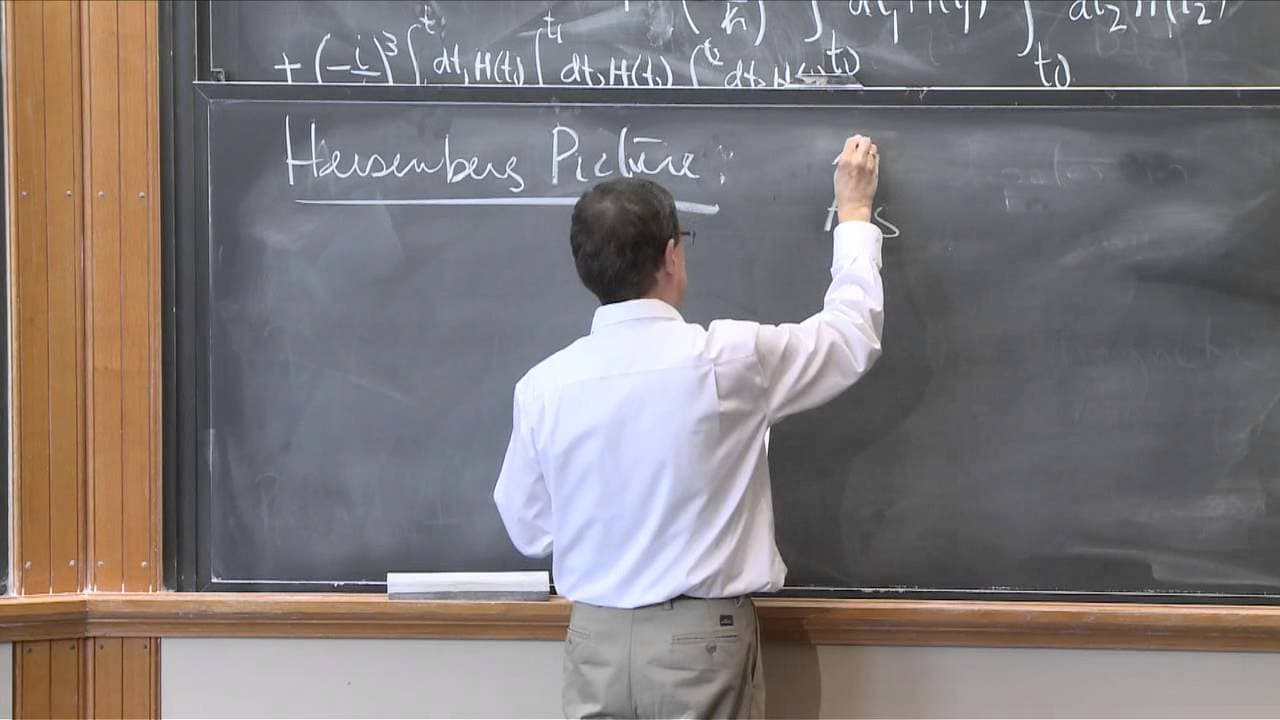
13. Quantum Dynamics (continued) | Heisenberg Picture
TL;DR
The Heisenberg picture of quantum mechanics involves using Heisenberg operators, which are obtained by applying a unitary operator to Schrodinger operators. The Heisenberg Hamiltonian is equivalent to the Schrodinger Hamiltonian.
Transcript
The following content is provided under a Creative Commons license. Your support will help MIT OpenCourseWare continue to offer high quality educational resources for free. To make a donation or to view additional materials from hundreds of MIT courses, visit MIT OpenCourseWare at ocw.mit.edu. PROFESSOR: OK, so let me go back to what we were doing.... Read More
Key Insights
- 🖼️ The Heisenberg picture involves using Heisenberg operators obtained by applying a unitary operator to Schrodinger operators.
- 💼 The Heisenberg Hamiltonian is obtained by applying the unitary operator to the Schrodinger Hamiltonian, and it may be identical to the Schrodinger Hamiltonian in certain cases.
- ⌛ The time dependence of Heisenberg operators can be calculated using the Heisenberg equation of motion.
Install to Summarize YouTube Videos and Get Transcripts
Explore YouTube Video Summarizer or Get YouTube Transcript Extractor
Questions & Answers
Q: What is the Heisenberg picture of quantum mechanics?
The Heisenberg picture involves using Heisenberg operators, obtained by applying a unitary operator to Schrodinger operators, to describe the time evolution of quantum systems.
Q: How is the Heisenberg Hamiltonian related to the Schrodinger Hamiltonian?
The Heisenberg Hamiltonian is obtained by applying the unitary operator to the Schrodinger Hamiltonian. If the Schrodinger Hamiltonian is time-independent or commutes with itself at different times, the Heisenberg Hamiltonian is identical to the Schrodinger Hamiltonian.
Q: How is the time dependence of Heisenberg operators calculated?
The time dependence of Heisenberg operators can be calculated using the Heisenberg equation of motion, which involves the commutation of the Heisenberg operator with the Heisenberg Hamiltonian.
Q: What are conserved operators in the Heisenberg picture?
Conserved operators are those that commute with the Schrodinger Hamiltonian. In the Heisenberg picture, these operators have no explicit time dependence and do not change in time.
Summary & Key Takeaways
-
The Heisenberg picture of quantum mechanics involves using Heisenberg operators, obtained by applying a unitary operator to Schrodinger operators.
-
The Heisenberg Hamiltonian is obtained by applying the unitary operator to the Schrodinger Hamiltonian, and in certain cases, the two Hamiltonians are identical.
-
The time dependence of Heisenberg operators can be calculated using a differential equation, known as the Heisenberg equation of motion.
-
Conserved operators are those that commute with the Schrodinger Hamiltonian, and their Heisenberg versions are time-independent.
Read in Other Languages (beta)
Share This Summary 📚
Summarize YouTube Videos and Get Video Transcripts with 1-Click
Try YouTube Summary with ChatGPT & Claude or YouTube Transcript Generator
Explore More Summaries from MIT OpenCourseWare 📚


Summarize YouTube Videos and Get Video Transcripts with 1-Click
Try YouTube Summary with ChatGPT & Claude or YouTube Transcript Generator