Don't Stop Pretraining!
TL;DR
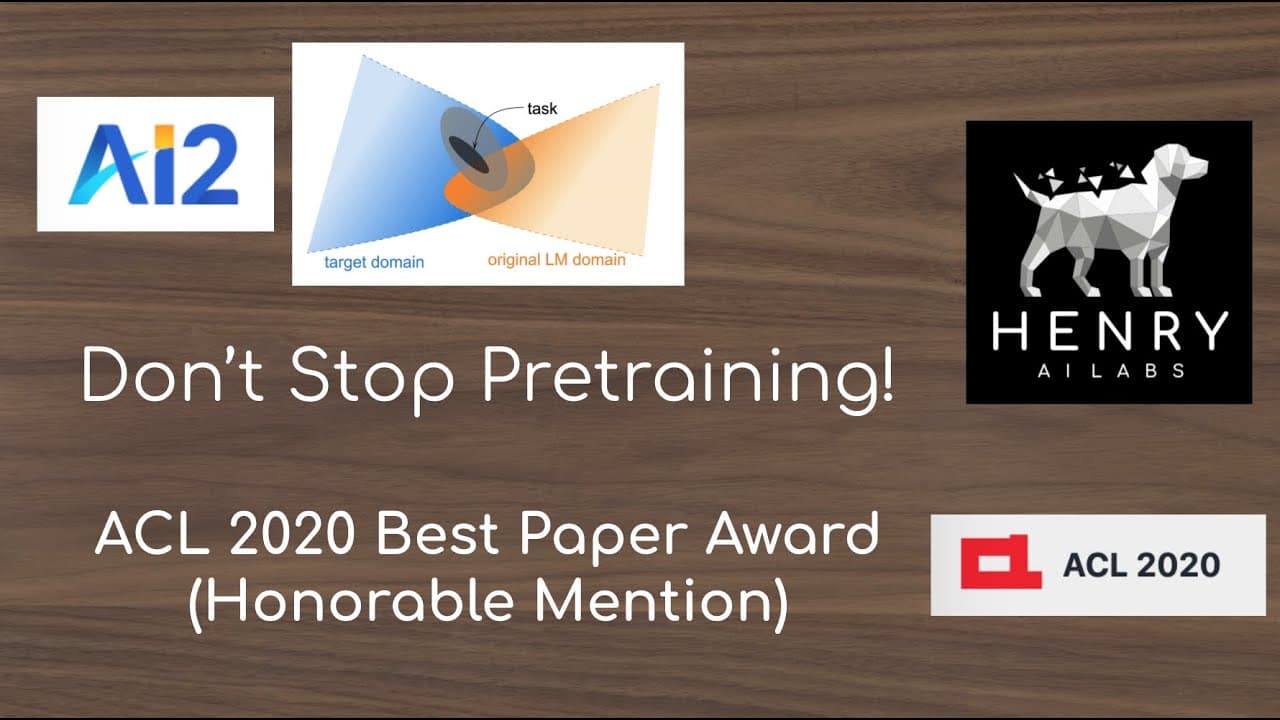
Further pre-training models on domain-specific data improves their performance.
Transcript
models like roberta or gpt are pre-trained by predicting masked out words or tokens on a massive amount of text this text comes from internet dumps like the common crawl corpus or web text or a books corpus or wikipedia and don't stop pre-training researchers explore whether these models still benefit from a second phase of domain-specific pre-trai... Read More
Key Insights
- 😑 Continuous pre-training on domain-specific datasets consistently yields positive impacts on the performance of models like RoBERTa.
- 😑 Second-phase pre-training enhances classification capabilities across various datasets, indicating the significance of specialized training.
- 😑 The study emphasizes the necessity of large pools of unlabeled task data to facilitate effective task-adaptive pre-training, improving performance metrics.
- 😑 Assessing domain similarity through the frequency of word usage aids in optimizing pre-training strategies for better model outputs.
- 😑 The findings challenge current practices in NLP, suggesting a shift towards domain-adaptive models over generic pre-trained models.
- 🈸 Researchers should prioritize the collection of diverse unlabeled data to maximize model adaptability across different applications.
- 😑 The balance between computational costs and performance gains is crucial, as further pre-training requires significant resources.
Install to Summarize YouTube Videos and Get Transcripts
Explore YouTube Video Summarizer or Get YouTube Transcript Extractor
Questions & Answers
Q: What is the primary purpose of the study "Don't Stop Pre-training"?
The study investigates whether additional phases of pre-training, specifically on domain-specific datasets, can improve language models like RoBERTa after their initial training on massive text corpora. The researchers aim to demonstrate that continuing pre-training can yield substantial performance gains across multiple classification tasks in various domains such as biomedical and computer science.
Q: How does the study assess the effectiveness of continuing pre-training?
The effectiveness of continuing pre-training is evaluated through experiments that test four different operational domains: biomedical papers, computer science papers, news articles, and Amazon reviews. For each domain, two classification tasks are performed, and performance metrics are compared against those obtained solely from the original pre-training, providing insights into the relationship between domain similarity and model enhancement.
Q: What are the findings regarding the necessity of task-adaptive pre-training?
The study finds that incorporating task-adaptive pre-training, which uses unlabeled task-relevant data, significantly boosts model performance even after the domain-specific pre-training phase. The results suggest that leveraging additional data curated for the specific tasks can lead to improved model outcomes while also addressing the limitations of labeled datasets.
Q: What methodology did the authors use to measure domain similarity?
The authors developed a heuristic to assess domain similarity by analyzing the overlap of the 10,000 most frequently used words across different domains. This approach helps in understanding how the original model's pre-training corpus relates to the target domain, thereby influencing the effectiveness of additional pre-training phases.
Q: Why is understanding domain-specific needs crucial for future model training?
Understanding domain-specific needs enables researchers to refine language models that are tailored for particular tasks. As the demand for specialized applications in natural language processing grows, the study advocates for the continued exploration of multi-phase pre-training to achieve better contextual understanding and improved model accuracy.
Q: What implications do the study's findings have for future natural language processing projects?
The findings suggest that natural language processing projects should include extensive unlabeled datasets alongside labeled ones to enhance model adaptation through pre-training. This approach could foster the development of highly specialized models that are more effective for specific applications, prompting a shift towards creating domain-sensitive pre-trained models in the field.
Q: How does the study's approach differ from traditional fine-tuning methods?
Unlike traditional methods that focus solely on fine-tuning models on labeled task data, the study advocates for a multi-phase approach. This involves not only fine-tuning but also continuing pre-training on domain-relevant data and utilizing unlabeled datasets to reinforce language understanding, thereby enhancing overall model performance significantly.
Q: What potential challenges did the authors highlight regarding additional phases of pre-training?
The authors acknowledged that implementing additional pre-training phases requires substantial computational resources and time. This process involves increased training steps and necessitates careful selection of data to ensure that the continued training enhances model capability without overfitting or diminishing returns due to resource constraints.
Summary & Key Takeaways
-
The paper "Don't Stop Pre-training" emphasizes the importance of additional pre-training phases on domain-specific data for enhancing language model performance, particularly focusing on models like RoBERTa.
-
Experiments conducted across four domains, including biomedical research and news articles, reveal that second-phase pre-training significantly benefits model effectiveness in various classification tasks.
-
The findings indicate that task-adaptive pre-training utilizing unlabeled task data further refines model accuracy, emphasizing the need for rich unlabeled datasets alongside labeled examples.
Read in Other Languages (beta)
Share This Summary 📚
Summarize YouTube Videos and Get Video Transcripts with 1-Click
Try YouTube Summary with ChatGPT & Claude or YouTube Transcript Generator
Explore More Summaries from Connor Shorten 📚
Summarize YouTube Videos and Get Video Transcripts with 1-Click
Try YouTube Summary with ChatGPT & Claude or YouTube Transcript Generator