What are Superfluids and Why Are They Important?
TL;DR
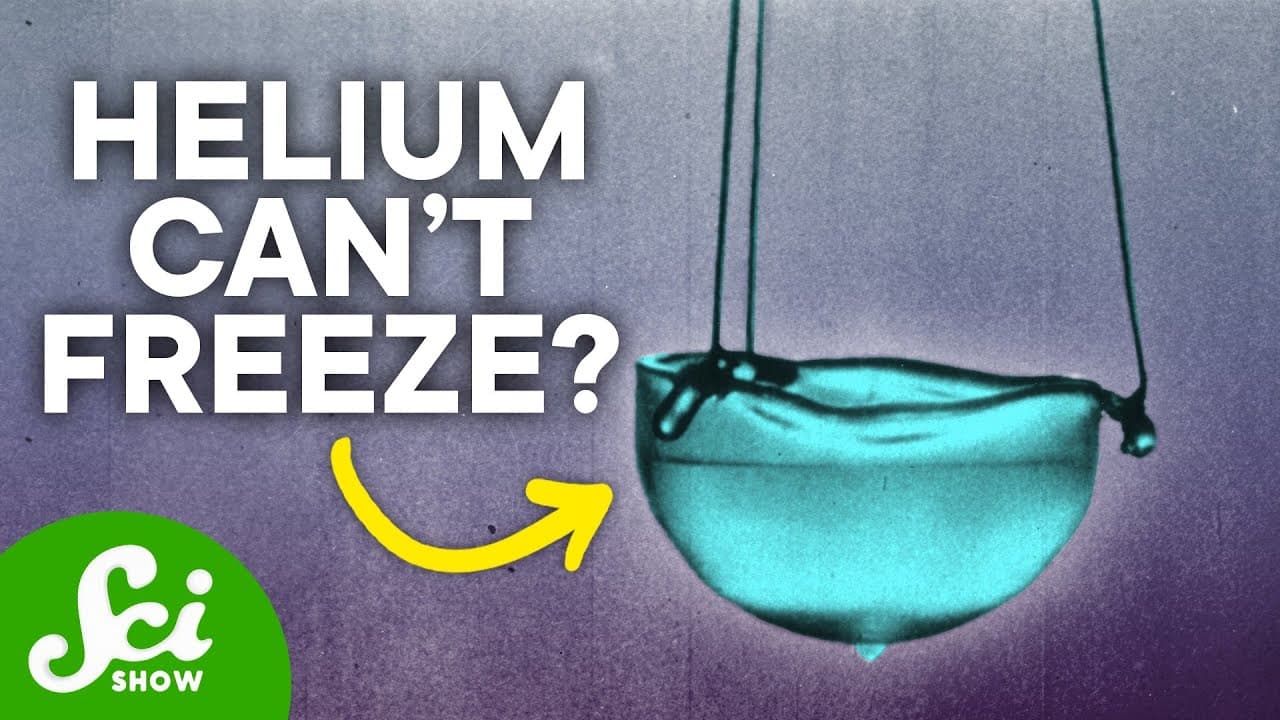
Helium becomes a superfluid at ultracold temperatures, exhibiting strange quantum behavior with no friction, exciting physicists for its potential applications.
Transcript
Thanks to Brilliant for supporting this episode of SciShow. Go to Brilliant.org/SciShow to learn more. [ INTRO ] Imagine you made yourself a cup of tea, stirred it, left it for five minutes… and came back to see that it was still spinning. Now, imagine you picked up that cup, and the tea fell straight through the bottom… while also starting to clim... Read More
Key Insights
- 🫀 Superfluid helium exhibits zero friction due to all atoms behaving collectively.
- 🫀 Helium-4 atoms are crucial for superfluid behavior, forming a Bose-Einstein condensate.
- 🦾 Quantum mechanics at ultracold temperatures enable the strange behavior of superfluid helium.
- 🥶 Helium-3 can form a superfluid through Cooper pairs but requires even colder temperatures.
- 🤩 Superfluidity has implications for superconductors, neutron stars, and potentially spacetime.
- 🙂 Research into superfluidity sheds light on quantum phenomena and fundamental physics.
- 🈸 Practical applications of superfluids include superconductors and potential advancements in technology.
Install to Summarize YouTube Videos and Get Transcripts
Explore YouTube Video Summarizer or Get YouTube Transcript Extractor
Questions & Answers
Q: What conditions are necessary for helium to become a superfluid?
Helium needs to be cooled to ultracold temperatures, specifically around -270°C, for it to exhibit superfluid behavior. At these temperatures, helium-4 atoms behave as bosons, collectively moving as a superfluid.
Q: How does superfluid helium differ from regular liquid helium?
Superfluid helium displays zero friction, allowing it to flow endlessly, slip past container walls, and climb them. This behavior is a result of quantum effects at ultracold temperatures that lead to collective movement.
Q: Why is superfluid helium important in physics research?
Superfluid helium's unique properties have practical implications, such as for superconductors, neutron star cores, and potential applications in quantum computing. Understanding superfluidity could contribute to a broader theory of everything.
Q: How does helium-4 differ from helium-3 in forming a superfluid?
Helium-3 can also form a superfluid through the formation of Cooper pairs, but it requires colder temperatures than helium-4. Helium-4 is more common and readily forms a superfluid at above 2 Kelvin.
Summary & Key Takeaways
-
Liquid helium at ultracold temperatures becomes a superfluid due to quantum effects.
-
Superfluid helium exhibits zero friction, climbs walls of containers, and behaves collectively.
-
Helium-4 atoms, behaving as bosons, form the basis for superfluidity, with implications for physics research.
Read in Other Languages (beta)
Share This Summary 📚
Summarize YouTube Videos and Get Video Transcripts with 1-Click
Try YouTube Summary with ChatGPT & Claude or YouTube Transcript Generator
Explore More Summaries from SciShow 📚


Summarize YouTube Videos and Get Video Transcripts with 1-Click
Try YouTube Summary with ChatGPT & Claude or YouTube Transcript Generator