Circular Wave Guide | Group velocity, Phase velocity, Guide wavelength & Wave impedance| MWE| Lec-36
TL;DR
This video explains parameters like group velocity, phase velocity, and impedance in circular wave guides.
Transcript
hi everyone in this video let us see what are the different parameters associated with respect to Circular wave such as group velocity phase velocity guide wavelength wave impedence all these parameters we have seen in the case of rectangular wave G the same and similar Expressions we will be having in the case of circular wave also so just let us ... Read More
Key Insights
- 👋 Group velocity represents the velocity of wave packets traveling inside a wave guide, essential for understanding signal propagation.
- 👋 Phase velocity signifies the speed at which individual wave phases move, a critical factor in analyzing wave behavior.
- 👋 Guide wavelength characterizes how a wave oscillates within a wave guide, differing in measurement from free space wavelength.
- 👋 Wave impedance provides a valuable ratio of electric to magnetic fields, which can inform about how waves behave in various media.
- 😑 Both group and phase velocities are mathematically derivable using comparable expressions in both circular and rectangular wave guides.
- 👋 The principles outlined for circular waves also extend to rectangular wave guides, showcasing the universal nature of these electromagnetic principles.
- 🦻 Understanding these parameters aids in efficiently calculating outcomes in examinations related to electromagnetic theory and applications.
Install to Summarize YouTube Videos and Get Transcripts
Explore YouTube Video Summarizer or Get YouTube Transcript Extractor
Questions & Answers
Q: What is group velocity in the context of wave guides?
Group velocity refers to the velocity at which the overall shape of the wave's amplitudes—known as the envelope—travels through a wave guide. It is particularly relevant in both circular and rectangular wave guides, and it is calculated using the formula VG = C * √(1 - FC/F)², where FC is the cutoff frequency.
Q: How does phase velocity differ from group velocity?
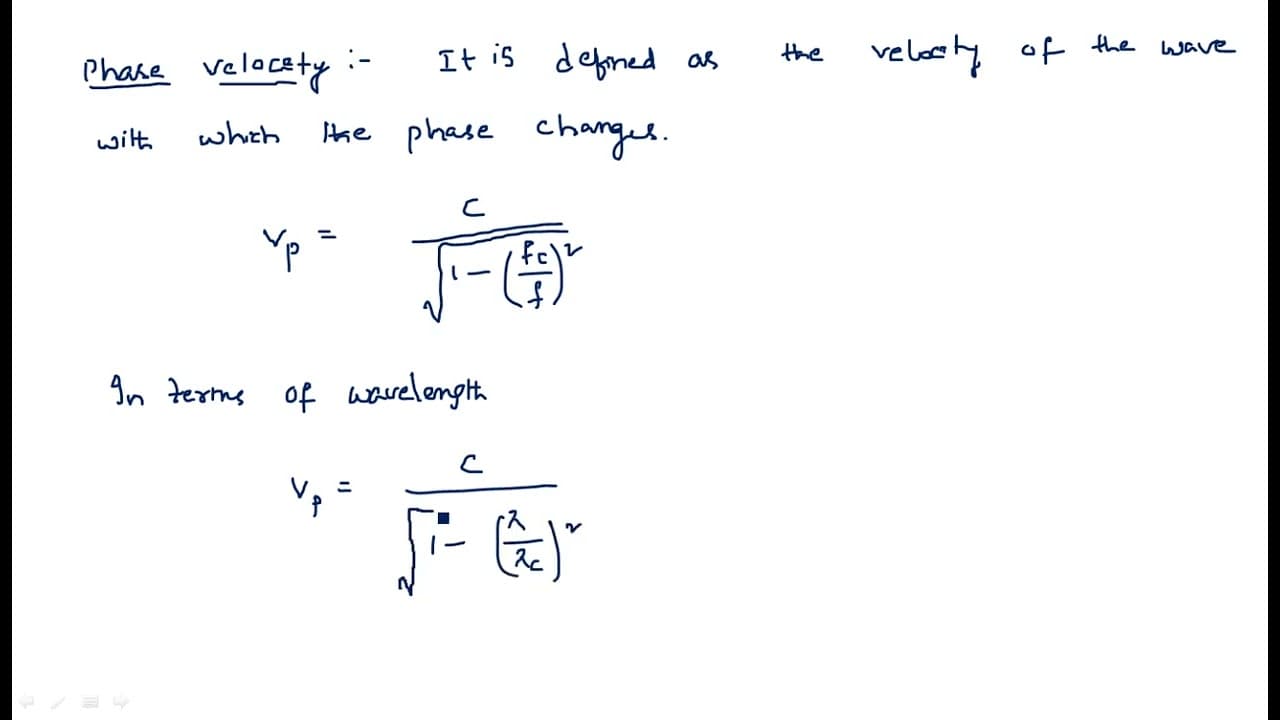
Phase velocity is the speed at which a single phase of the wave travels, while group velocity pertains to the speed of the envelope of multiple waves. Specifically, phase velocity can be expressed as VP = C / √(1 - FC/F)², representing a more instantaneous perspective of wave propagation compared to group velocity.
Q: What is guide wavelength, and how is it defined?
Guide wavelength refers to the wavelength of a wave propagating within a wave guide, representing the length over which the wave propagates a full cycle (2 pi radians). It can be calculated using the formula λG = λ / √(1 - λ/λC)², where λ is the free space wavelength and λC is the cutoff wavelength.
Q: What is wave impedance and its significance in wave guides?
Wave impedance measures the ratio of electric to magnetic fields at a specific point in a wave guide, offering insight into how waves interact with the medium. It is vital for understanding how waves will propagate in different materials and can be expressed as J = E/H, highlighting the relationship between these components.
Summary & Key Takeaways
-
The video discusses key parameters associated with circular waves, such as group velocity, phase velocity, guide wavelength, and wave impedance, providing a comprehensive overview of their definitions and calculations.
-
Group velocity is defined as the speed at which a wave travels inside a wave guide, while phase velocity refers to how quickly the phase of the wave changes within the same medium.
-
The video also explains guide wavelength, the wavelength of a wave propagating inside a wave guide, and wave impedance, which measures the ratio of electric and magnetic field components.
Read in Other Languages (beta)
Share This Summary 📚
Summarize YouTube Videos and Get Video Transcripts with 1-Click
Try YouTube Summary with ChatGPT & Claude or YouTube Transcript Generator