Armature Reaction | GNA & MNA | DC machines | Lec-32
TL;DR
Armature reaction involves geometrical and magnetically neutral axes affecting DC machine performance.
Transcript
hello everyone in the last session we will discuss about the armature reaction now we will continue the armature reaction here in the last session we discussed about how the magnetization and demagnetization is possible and how the flux and the flux density waveforms will be disa distorted now we will continue the next things so before understandin... Read More
Key Insights
- 🎰 The armature reaction mainly influences flux characteristics, affecting both magnetization and demagnetization processes in DC machines.
- 😥 The GNA serves as a crucial reference point for designing the arrangement of brushes in DC machinery, which directly impacts current collection.
- ❓ MNA alignment with GNA signifies optimal performance at no load, while shifts under load can indicate potential operational challenges.
- 🎰 The behavior of the GNA and MNA under changing load conditions is vital for understanding DC machine dynamics and efficiency.
- 💈 The leading pole trip results in demagnetization from opposition of armature flux, while trailing pole trip enhances magnetization through additive effects.
- 🎰 Explained saturation effects highlight why there is a limit to the flux increase, influencing overall machine productivity and performance.
- 🎰 Distinctions between strengthening and weakening effects reveal the delicate balance of flux in maintaining machine operational efficiency.
Install to Summarize YouTube Videos and Get Transcripts
Explore YouTube Video Summarizer or Get YouTube Transcript Extractor
Questions & Answers
Q: What is the geometrical neutral axis (GNA) and its significance?
The geometrical neutral axis (GNA) is an essential reference in DC machines, representing the axis perpendicular to the main field flux. It plays a crucial role in the design and operation of DC motors and generators, ensuring proper current collection through brushes arranged along this axis, facilitating efficient commutation and power transfer.
Q: How does the magnetically neutral axis (MNA) differ from the GNA?
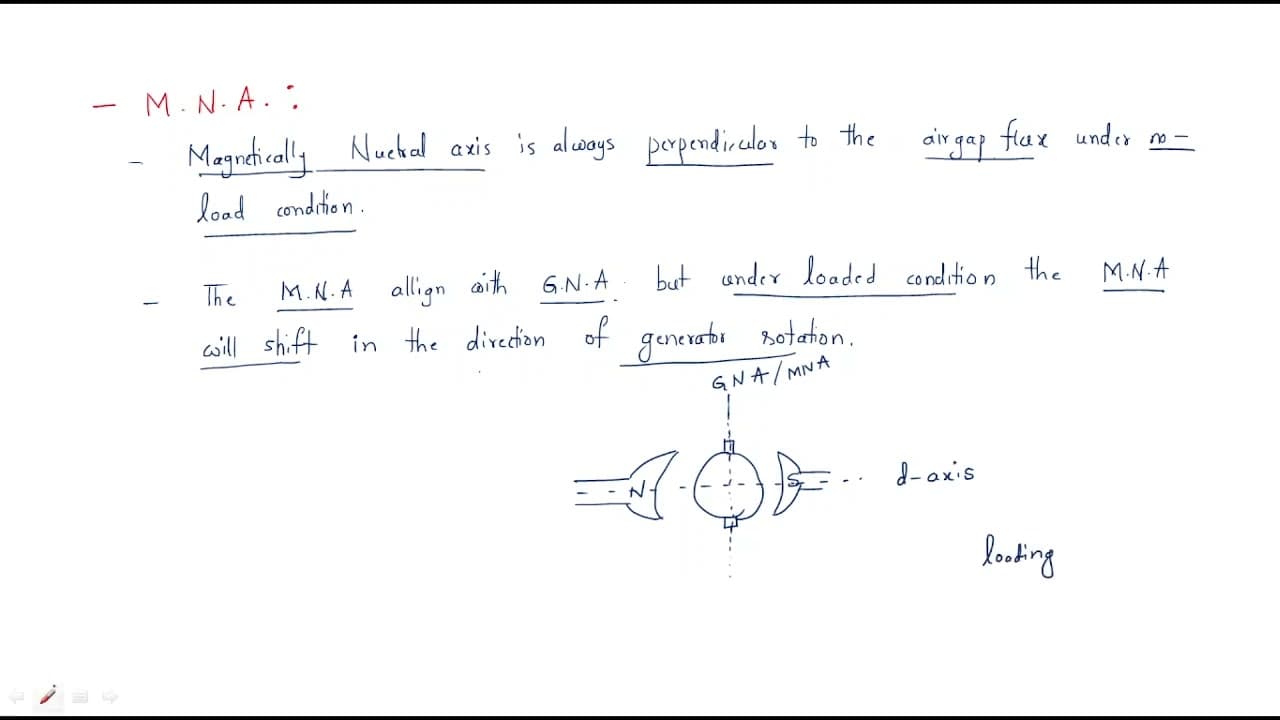
The magnetically neutral axis (MNA) is always perpendicular to the air gap flux and may shift in position under load conditions. While the GNA aligns with MNA at no load, MNA typically shifts in the direction of generator rotation during load, affecting the machine's operational characteristics and efficiency.
Q: What happens to the armature flux during a leading and trailing pole trip?
During a trailing pole trip, the armature flux aids the main field flux, leading to magnetization and increased overall flux. Conversely, in a leading pole trip, the armature flux opposes the main field, resulting in demagnetization and a decrease in magnetic flux, which can diminish operational effectiveness.
Q: What is the significance of commutation in DC machines?
Commutation is vital in DC machinery as it converts alternating current to direct current in generators, and vice versa in motors. This process ensures that energy is effectively transferred without significant losses, particularly when linked to the geometrical and magnetic neutral axes, which are critical for optimal function.
Summary & Key Takeaways
-
The armature reaction impacts magnetization and demagnetization within DC machines, relating to flux and flux density distortions.
-
Two critical axes are discussed: the geometrical neutral axis (GNA) and magnetically neutral axis (MNA), which play roles in current collection and commutation processes.
-
At no load, GNA and MNA align, but under load conditions, MNA shifts direction, altering machine performance and efficiency.
Read in Other Languages (beta)
Share This Summary 📚
Summarize YouTube Videos and Get Video Transcripts with 1-Click
Try YouTube Summary with ChatGPT & Claude or YouTube Transcript Generator