Epsilon Production | Elimination | CFG | TOC | Lec-67 | Bhanu Priya
TL;DR
This content explains the step-by-step process of eliminating epsilon productions in context-free grammar.
Transcript
hi students welcome back now coming to the next continuation of deserve simplification of context-free grammar in the previous video to reduce the given grammar we have to do three things one is the removal of useless symbols and elimination of epsilon productions or elimination of unit productions this we had to do now coming to the second one the... Read More
Key Insights
- 🥶 Epsilon productions are very important in context-free grammar, and their correct handling is necessary for precise parsing.
- 🪡 Identifying nullable non-terminals is the first crucial step in the epsilon elimination process, determining which productions need to be modified.
- ❓ The process involves removing epsilon directly from the grammar while creating equivalent productions to retain the language generated.
- 😚 It is vital to keep the original meaning of the grammar intact to avoid losing valid derivations during the elimination process.
- 💄 Incorrect removal of epsilon productions risks changing the language generated by the grammar, making it ineffective for its intended applications.
- 🦻 Practical examples aid in understanding the elimination steps and the implications of changes made to the grammar.
- 🏆 In a grammar, every change should be tested against the string generation criteria to ensure all valid strings remain recognizable.
Install to Summarize YouTube Videos and Get Transcripts
Explore YouTube Video Summarizer or Get YouTube Transcript Extractor
Questions & Answers
Q: What are epsilon productions in context-free grammar?
Epsilon productions are grammar rules where a non-terminal can derive the empty string, represented by epsilon. They are crucial in understanding grammar simplification, as they can complicate parsing and should be eliminated from the grammar where possible. Identifying these productions involves checking which non-terminals can derive epsilon.
Q: How do you identify nullable non-terminals?
Nullable non-terminals are non-terminals that can derive epsilon through their productions. To identify them, examine each non-terminal and its production rules. If a production directly leads to epsilon or a sequence of productions derives epsilon, label the non-terminal as nullable. This step is essential for successful epsilon elimination.
Q: What steps should be followed to remove epsilon productions?
The first step involves identifying all nullable non-terminals. Next, for each production containing a nullable non-terminal, create new productions by omitting the nullable non-terminal. Finally, combine these new productions with the existing ones while ensuring that the grammar's original meaning is preserved.
Q: Can you provide an example of epsilon production elimination?
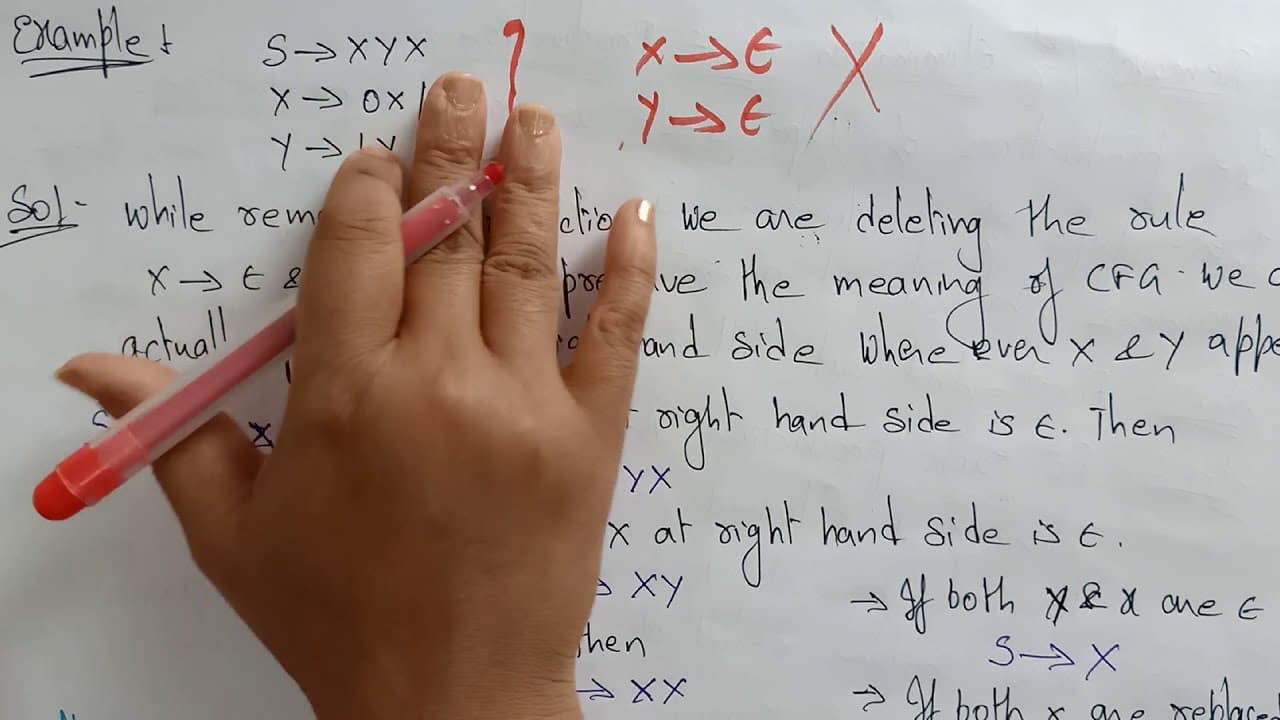
Consider a production rule S → XY where X can produce epsilon. If X derives epsilon, we would generate a new rule S → Y. If Y is also nullable, the new rule would result in S producing epsilon. It’s crucial to ensure that you still retain the ability to generate all valid strings from the original grammar while eliminating epsilon.
Q: What is the importance of preserving the meaning of context-free grammar during elimination?
Preserving the meaning of a context-free grammar is critical because it ensures that the grammar can still generate the same language without the epsilon productions. If modifications lead to the loss of valid string derivations, the grammar could become invalid, altering its original purpose and function in parsing.
Q: What happens if epsilon productions are removed incorrectly?
Incorrectly removing epsilon productions can lead to loss of language validity, meaning certain valid strings that should be recognized by the grammar may no longer be produced. This can severely impact applications relying on accurate grammar representation, such as compilers and parsers.
Q: How does one replace epsilon in generated productions?
To replace epsilon in productions, identify where nullable non-terminals appear on the right-hand side of the production rules. Then, create alternative rules by replacing those occurrences with terminal symbols or the remaining non-terminals. This substitution maintains the integrity of the grammar while eliminating epsilon.
Q: Why is it important to work through examples while learning this process?
Working through examples is essential for grasping the nuances of epsilon production elimination. Practical examples illustrate theoretical concepts, providing clarity on how to apply the rules correctly. They help reinforce learning and prepare students to tackle real-world grammar challenges confidently.
Summary & Key Takeaways
-
The content details the process of removing epsilon productions in context-free grammar, emphasizing the importance of not disturbing the grammar's meaning during elimination.
-
It provides rules for identifying nullable non-terminals and constructing new productions to replace deleted epsilon productions effectively.
-
Practical examples illustrate how to handle epsilon productions while preserving the grammar's original characteristics, ultimately leading to a revised production set.
Read in Other Languages (beta)
Share This Summary 📚
Summarize YouTube Videos and Get Video Transcripts with 1-Click
Try YouTube Summary with ChatGPT & Claude or YouTube Transcript Generator