Wheatstone bridge | Circuit | Electrical Instruments ( EIM ) | Lec - 39
TL;DR
Bridges are electrical circuits used to measure unknown quantities such as resistance, capacitance, and inductance.
Transcript
hi everyone in this video i am going to start the concept of bridges so what do you mean by bridge what is the purpose of bridge bridge is consisting of four arms four arms that may be a pure resistance or it may be a reactance that means it may be an impedance or it may be a resistance what do you mean by impedance it may be a combination of resis... Read More
Key Insights
- 👻 Bridges serve a vital role in electronic measurements, allowing the precise determination of various electrical properties.
- 🌉 Understanding the distinction between DC and AC bridges enables effective selection based on the measurement requirements.
- 🌉 The balance condition is essential for accurate readings in bridges, particularly in the Wheatstone configuration.
- 🌉 Each bridge type caters to specific measurement needs, significantly enhancing the efficiency of resistance, capacitance, and inductance assessments.
- 🌉 The operational principles of bridges revolve around balancing known and unknown values to derive accurate measurements.
- 💦 Familiarity with bridge circuits is crucial for anyone working in electronics, as it underlies many experimental setups and applications.
- 🌉 Practical application of bridge circuits requires careful consideration of the input type, focusing on either DC for resistance or AC for inductance and capacitance measurements.
Install to Summarize YouTube Videos and Get Transcripts
Explore YouTube Video Summarizer or Get YouTube Transcript Extractor
Questions & Answers
Q: What is the primary purpose of a bridge in electrical circuits?
The primary purpose of a bridge in electrical circuits is to measure unknown electrical quantities such as resistance, capacitance, and inductance by comparing them against known values. Bridges enable precise measurement by exploiting the principles of electrical balance, where various parameters can be derived from the relationship between these known and unknown components.
Q: How do DC and AC bridges differ in function and application?
DC bridges use direct current input for measurements and are primarily focused on resistance, while AC bridges apply alternating current and can measure inductance, capacitance, and frequency. This distinction allows for different types of measurements and applications, tailored to the specific characteristics of DC versus AC circuits.
Q: What are the Wheatstone, Kelvin, and Megohm bridges used for?
The Wheatstone bridge measures resistance in kiloohms, the Kelvin bridge measures low resistances in ohms, and the Megohm bridge is designed to measure high resistances in megohms. These bridges operate under specific conditions where the quantity being measured can be determined by balancing the bridge’s inputs and outputs.
Q: Why is the balanced condition important in a Wheatstone bridge?
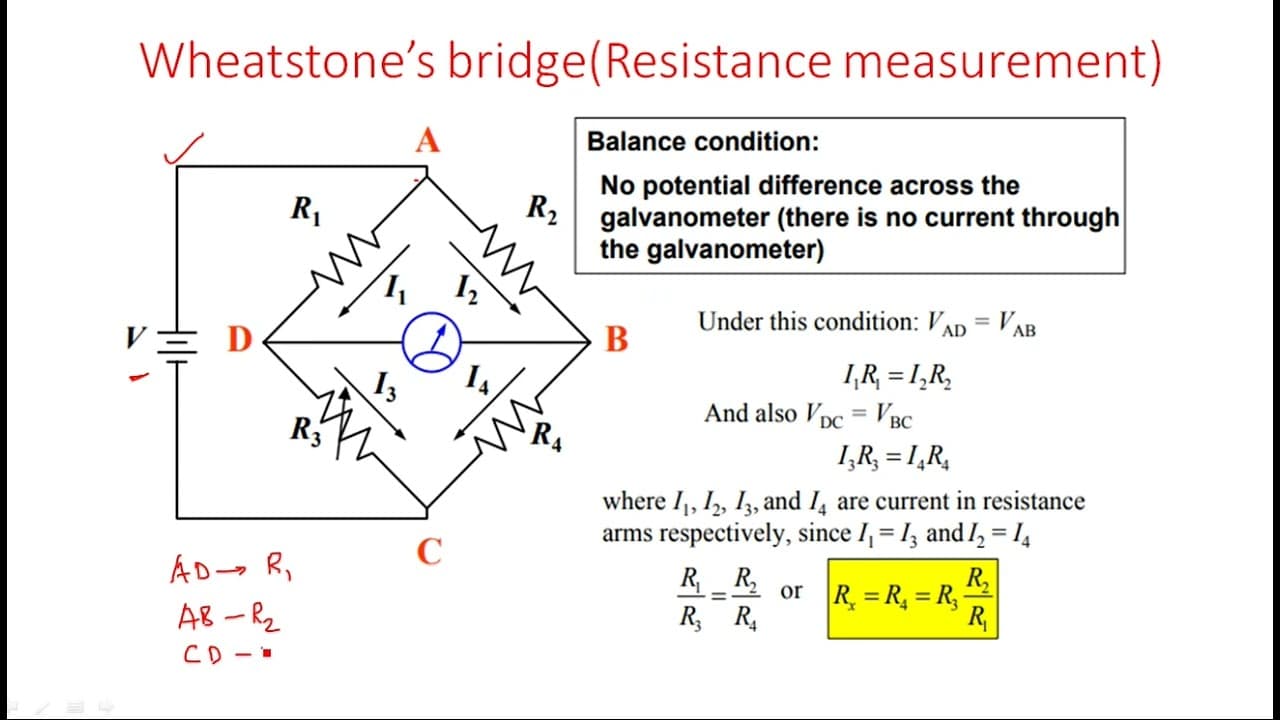
The balanced condition in a Wheatstone bridge is crucial because it allows for the measurement of unknown resistance without interference from other components. In this state, there is no current flowing through the galvanometer, indicating no potential difference, which simplifies calculations and ensures accurate measurements.
Q: Can you explain the formula used to calculate unknown resistance in a Wheatstone bridge?
The formula to calculate an unknown resistance in a Wheatstone bridge is expressed as R4 = (R2 * R3) / R1, where R4 is the unknown resistance, and R1, R2, and R3 are the known resistances. This equation holds true only when the bridge is in a balanced condition, ensuring that the readings are accurate and the relationship between the resistances is maintained.
Q: What happens if the Wheatstone bridge is not in a balanced condition?
If the Wheatstone bridge is not in a balanced condition, the current will flow through the galvanometer, indicating an imbalance that complicates measurements. In such cases, the basic formula for calculating unknown resistance becomes invalid, and alternative analytical methods, such as Thevenin's equivalent circuit analysis, must be utilized to determine the unknown value.
Summary & Key Takeaways
-
Bridges are essential components in electrical measurements, designed to determine unknown quantities like resistance, capacitance, and inductance through comparison with known values.
-
Two primary categories of bridges exist: DC bridges, which measure resistance, and AC bridges, capable of measuring inductance, capacitance, and frequency, with specific types for each application.
-
The Wheatstone bridge is detailed as a fundamental circuit used for resistance measurement, operating under a balanced condition to find unknown resistances using a specific formula.
Read in Other Languages (beta)
Share This Summary 📚
Summarize YouTube Videos and Get Video Transcripts with 1-Click
Try YouTube Summary with ChatGPT & Claude or YouTube Transcript Generator