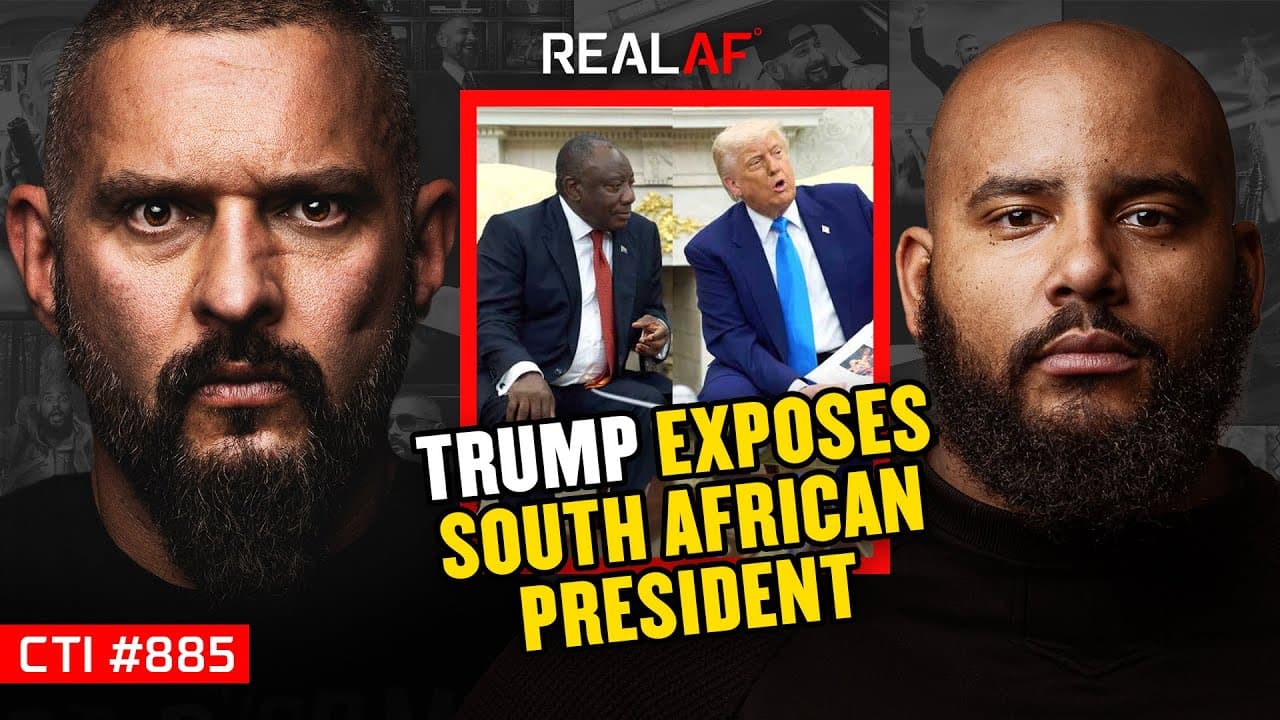
Trump Calls Out South African President Over White Farmer Genocide - Ep 885 CTI
TL;DR
Trump confronts South African President on white farmer genocide.
Transcript
over a thousand of white farmers and those cars are lined up to pay love on a Sunday morning each one of those white things you see is across and it's a terrible sight i've never seen anything like it i'd like to know where that is because this I've never seen dude I've seen it i'm in the middle of country halfway across the world dude I've seen th... Read More
Key Insights
- The discussion highlights tensions in South Africa regarding the alleged genocide of white farmers, with Trump confronting the South African President directly.
- There is a significant focus on the media's portrayal of events, suggesting a discrepancy between reported facts and reality.
- The conversation touches on the broader issue of how media and governments handle sensitive topics, particularly around race and international relations.
- Concerns are raised about the perceived lack of accountability and honesty in media narratives, especially concerning international conflicts.
- The podcast discusses the potential manipulation of public perception through media, emphasizing the importance of questioning mainstream narratives.
- The hosts express frustration with societal tolerance of perceived injustices and the influence of powerful figures in shaping public opinion.
- There is a critique of how issues like trans rights and identity politics are handled in public discourse, with a call for more balanced and less biased discussions.
- The conversation reflects a broader dissatisfaction with current political and social dynamics, advocating for more transparency and accountability from leaders.
Install to Summarize YouTube Videos and Get Transcripts
Explore YouTube Video Summarizer or Get YouTube Transcript Extractor
Questions & Answers
Q: What was the main topic of discussion regarding South Africa?
The main topic was Trump's confrontation with the South African President over the alleged genocide of white farmers, questioning the media's portrayal and the government's response to these allegations.
Q: How do the hosts view the media's role in international conflicts?
The hosts are critical of the media, suggesting that there is often a discrepancy between reported facts and reality, and they emphasize the importance of questioning mainstream narratives to uncover the truth.
Q: What concerns are raised about societal tolerance?
The hosts express frustration with societal tolerance of perceived injustices, particularly in how powerful figures and governments handle sensitive issues, advocating for more accountability and honesty in public discourse.
Q: How do the hosts view the handling of identity politics?
They critique the handling of trans rights and identity politics, calling for discussions that are less biased and more balanced, and criticizing the current approach as overly judgmental and propagandistic.
Q: What is the broader dissatisfaction expressed by the hosts?
There is a broader dissatisfaction with current political and social dynamics, with a call for more transparency and accountability from leaders, and a critique of how media and governments manipulate public perception.
Q: What insights are provided on the influence of powerful figures?
The hosts discuss the influence of powerful figures in shaping public opinion, emphasizing the need for individuals to critically assess information and not blindly follow mainstream narratives.
Q: What is the perspective on the media's portrayal of events?
The perspective is that the media often presents a biased view of events, particularly in international conflicts, and there is a call for more accurate and honest reporting to better inform the public.
Q: How do the hosts suggest addressing media bias?
They suggest that individuals should question mainstream narratives, seek alternative sources of information, and hold media outlets accountable for biased or inaccurate reporting to ensure a more informed public discourse.
Summary & Key Takeaways
-
The episode discusses Trump's confrontation with the South African President over the alleged genocide of white farmers, highlighting the media's role in shaping narratives.
-
The hosts critique the handling of trans rights and identity politics, calling for less biased and more balanced public discussions.
-
There is a broader discussion on the influence of powerful figures in shaping public opinion and the need for more transparency and accountability from leaders.
Read in Other Languages (beta)
Share This Summary 📚
Summarize YouTube Videos and Get Video Transcripts with 1-Click
Try YouTube Summary with ChatGPT & Claude or YouTube Transcript Generator
Explore More Summaries from Andy Frisella 📚

Summarize YouTube Videos and Get Video Transcripts with 1-Click
Try YouTube Summary with ChatGPT & Claude or YouTube Transcript Generator