Graph Embeddings and PyTorch-BigGraph
TL;DR
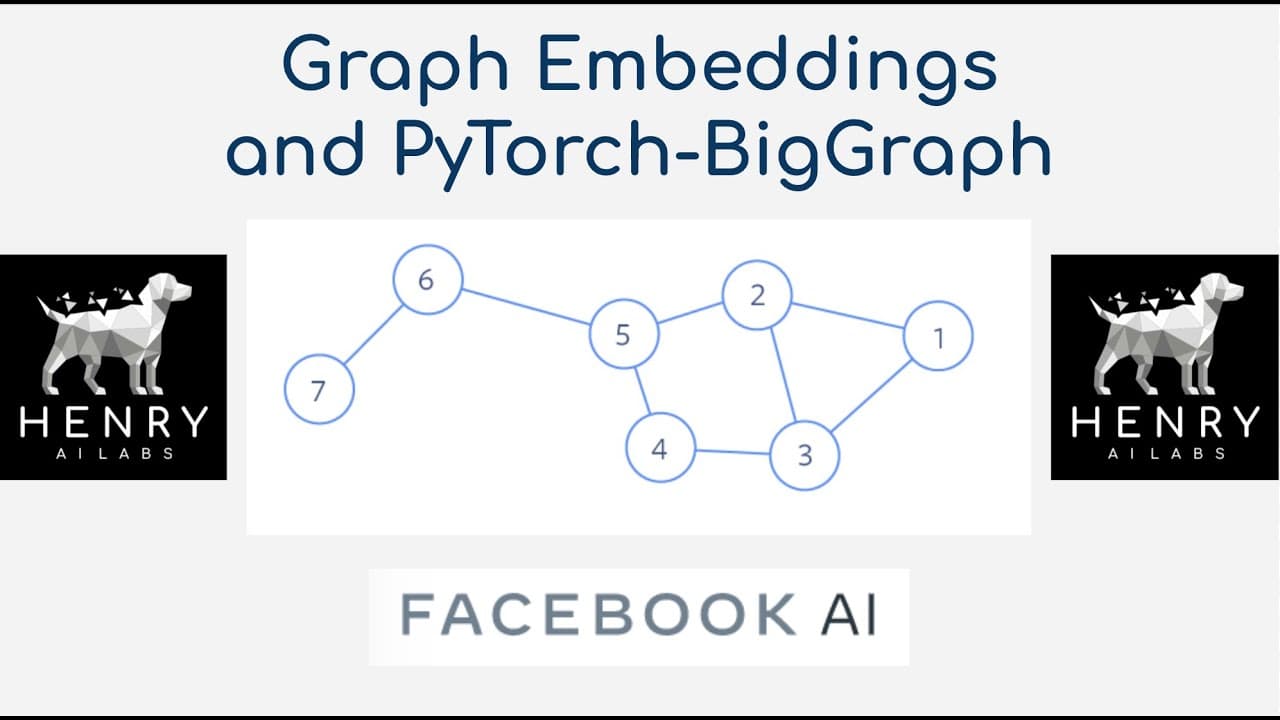
The video explores graph embedding learning, focusing on vector representations of nodes based on graph connectivity.
Transcript
this video will provide an overview of graph embedding learning this is where we learn Vector representations of nodes in a graph based on the connectivity of the graph and maybe having different kinds of relations in the graphs as well so for example in Wikipedia knowledge graphs we have different kinds of relations that connect the source and des... Read More
Key Insights
- 🉐 Graph embedding learning provides a robust framework for representing nodes through their interconnections, offering significant advantages over traditional text-based methods.
- 🌍 Real-world applications, including recommendation systems and biological networks, showcase the versatility of graph embeddings in various domains.
- 🍵 PyTorch Big Graph efficiently handles the complexities of large-scale graphs with billions of nodes through memory optimization strategies and distributed computing.
- 📈 Contrastive learning enhances the representation quality by leveraging the similarities and differences in relationships among nodes in the graph.
- 📈 The challenges posed by massive graph sizes necessitate innovative solutions to maintain computational efficiency while ensuring accuracy in embeddings.
- 👻 Multi-relation graphs enrich the learning process, allowing for deeper insights into the structural relationships of nodes and enhancing prediction capabilities.
- 🤩 Knowledge graphs play a key role in embedding learning by providing structured interrelations that improve the semantic depth of data processing.
Install to Summarize YouTube Videos and Get Transcripts
Explore YouTube Video Summarizer or Get YouTube Transcript Extractor
Questions & Answers
Q: What is graph embedding learning, and how does it differ from text-based representation?
Graph embedding learning involves deriving vector representations of nodes based on their connections within a graph. Unlike text-based methods such as GPT-3 and Siamese BERT, which focus on sequential data, graph embedding learns from the relationships and structure inherent within the graph, providing a more nuanced representation of each node's context within interconnected data.
Q: Can you explain some applications of graph embedding in real-world scenarios?
Graph embeddings are useful in various applications such as recommendation systems where users and items form a bipartite graph, social media link prediction where relationships like follows or friendships are represented, and biological networks that track drug interactions and protein connections, thus providing insights into complex relational data.
Q: What is the significance of PyTorch Big Graph in graph embedding learning?
PyTorch Big Graph is crucial for efficiently handling large-scale graph embeddings, which involve billions of nodes and trillions of edges. It uses techniques such as block partitioning to manage data without overloading memory and distributed execution to optimize computations across multiple processors, thereby making large graph embeddings feasible.
Q: How does contrastive learning apply to graph embedding?
In graph embedding, contrastive learning aligns the vector representations of source and destination nodes based on their relationships. By maximizing the similarity between connected nodes and minimizing it for non-connected nodes, it strengthens the structural understanding of the graph and enhances the accuracy of node representations.
Q: What challenges are presented when dealing with massive graphs in embedding learning?
Large graphs pose significant challenges, primarily related to memory constraints, as storing all node representations can require vast amounts of memory. Efficient learning necessitates strategies like block partitioning, which breaks the graph into manageable pieces, and effective negative sampling, to ensure that learning remains computationally feasible.
Q: How do multi-relation graphs enhance the learning process in graph embedding?
Multi-relation graphs, which have different types of connections between nodes, provide richer contextual information. They allow the embedding processes to capture the nuances of relationships, enhancing the similarity measures used in learning and improving the accuracy of predictions and node classifications derived from these embeddings.
Q: What role do knowledge graphs play in graph embedding learning?
Knowledge graphs serve as a structured representation of entities and their interrelations, making them ideal for graph embedding learning. They help derive contextual vector representations that are superior to plain text embeddings, facilitating more accurate data processing for applications in semantic search and information retrieval.
Q: Can tabular data be transformed into graph structures for embedding?
Yes, tabular data can be converted into graph structures by treating features or categories as relationships within a graph. This transformation allows the application of graph embedding techniques to learn representations from a different form of structured data, expanding the utility of graph embeddings beyond traditional graph-based datasets.
Summary & Key Takeaways
-
The video introduces graph embedding learning, explaining how vector representations of nodes are derived from their connections and relationships within a graph, diverging from traditional text data representation methods.
-
It delves into various real-world applications of graph embeddings including recommendation systems, social media interactions, and biological networks, emphasizing how these structures influence the creation of better node representations.
-
The content highlights the PyTorch Big Graph framework, explaining its role in managing large-scale graphs effectively through strategies like block partitioning and distributed execution models, ultimately optimizing graph embedding learning tasks.
Read in Other Languages (beta)
Share This Summary 📚
Summarize YouTube Videos and Get Video Transcripts with 1-Click
Try YouTube Summary with ChatGPT & Claude or YouTube Transcript Generator
Explore More Summaries from Connor Shorten 📚
Summarize YouTube Videos and Get Video Transcripts with 1-Click
Try YouTube Summary with ChatGPT & Claude or YouTube Transcript Generator