Governing and Mental Health Policy: Addiction, Poverty, Guns and Prisons
TL;DR
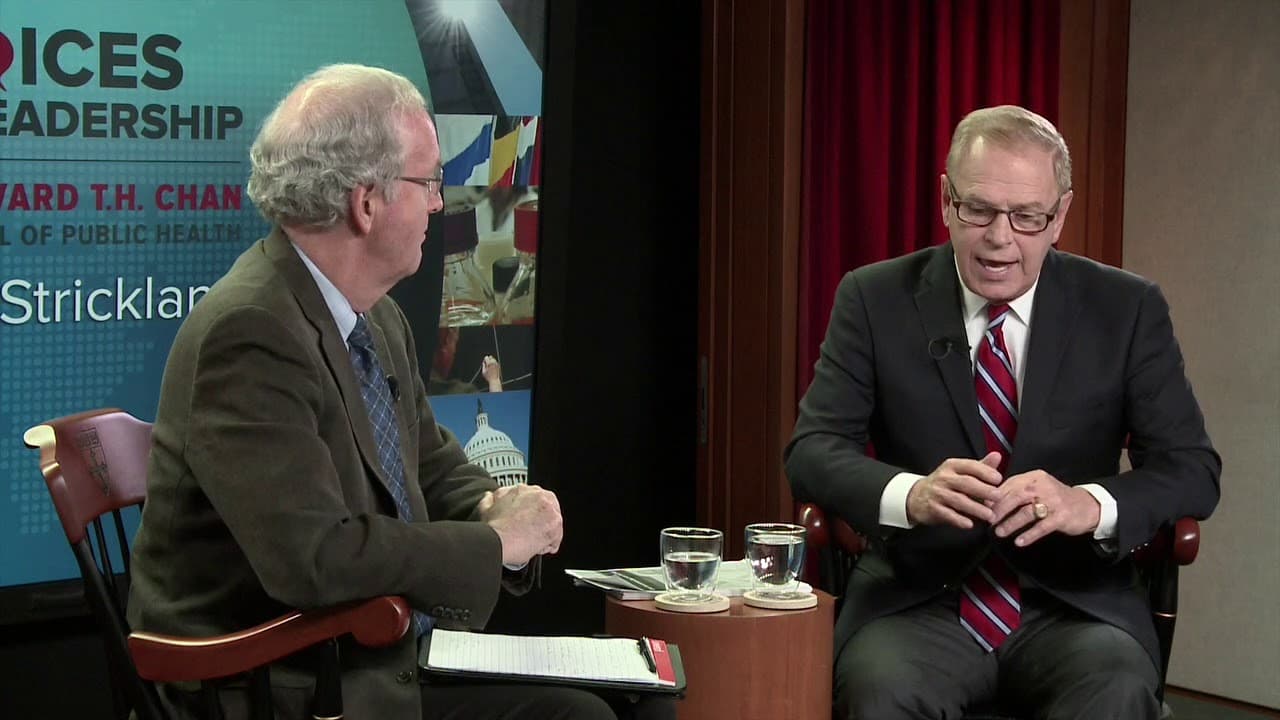
Former governor and psychologist Ted Strickland shares his experiences in public office, discussing topics such as leadership, the opioid crisis, mental health, and gun control.
Transcript
I'm Betty Johnson assistant dean for faculty and staff diversity development and leadership at the Harvard th Chan School of Public Health where we are committed to solving serious health and social problems faced in the world our success in addressing these issues has huge implications for the future no factor is more important to this pursuit tha... Read More
Key Insights
- 🤩 Persistence and resilience are key traits for effective leadership in public life.
- 🧑⚕️ The opioid crisis developed gradually, and addressing it requires a multifaceted approach involving law enforcement, public health, and treatment measures.
- ✊ Governors have more decision-making power and can directly impact their states through initiatives like investing in infrastructure.
- 💉 Mental health parity has improved, but there is still a need to reduce stigma and further integrate behavioral health into overall medical care.
- 🤑 Unregulated money in politics poses a significant challenge to fair elections and political outcomes.
- 🗯️ Progress has been made in areas such as healthcare coverage and women's rights, but setbacks can occur.
- 🤞 Lessons from personal experiences of hope and transformation inform Governor Strickland's optimism for the future.
Install to Summarize YouTube Videos and Get Transcripts
Explore YouTube Video Summarizer or Get YouTube Transcript Extractor
Questions & Answers
Q: What is the most important lesson Governor Strickland learned during his time in public office?
The most important lesson Governor Strickland learned is to never give up on one's goals and to maintain persistence and resilience in the face of challenges. He cites Congressman John Lewis's mantra of "never give up, never give out, never give in" as a guiding principle.
Q: How did Governor Strickland address the opioid crisis in his district and as governor?
As a congressman, he became aware of pill mills and physicians prescribing pain medication irresponsibly. As governor, he formed the Ohio prescription drug task force and implemented 20 recommendations aimed at addressing law enforcement, public health, treatment, and regulatory changes. He emphasizes the need for ongoing efforts to combat the crisis.
Q: What were some of the challenges Governor Strickland faced during the Great Recession as governor?
Governor Strickland faced difficult decisions in balancing the state budget and making cuts to various programs. However, he also highlights the importance of investing in infrastructure, such as building energy-efficient schools, to stimulate the economy and create jobs.
Q: How did Governor Strickland's background as a psychologist inform his approach to criminal justice reform?
Governor Strickland worked with younger individuals in a maximum-security institution before entering politics. He focused on evidence-based practices and advocated for reforms such as improving crime scene investigations, collection/storage of DNA evidence, and conducting unbiased lineups. He believes the criminal justice system needs significant reform to reduce incarceration rates and improve outcomes.
Q: How did Governor Strickland's views on gun control evolve over time?
Initially supportive of the NRA, Governor Strickland became concerned with the increasing radicalization of the gun rights movement. He believes in finding common-sense solutions, such as implementing universal background checks, and advocates for recognizing the seriousness of gun violence while protecting constitutional rights.
Summary & Key Takeaways
-
Governor Strickland emphasizes the importance of persistence and resilience in achieving goals in public life.
-
He witnessed the development of the opioid crisis in his district and implemented measures to address it, including the creation of the Ohio prescription drug task force.
-
As governor, Strickland made difficult decisions during the Great Recession, such as expanding Medicaid and investing in energy-efficient schools.
-
He highlights the need for mental health parity and the importance of finding common-sense solutions to gun violence.
Read in Other Languages (beta)
Share This Summary 📚
Summarize YouTube Videos and Get Video Transcripts with 1-Click
Try YouTube Summary with ChatGPT & Claude or YouTube Transcript Generator
Explore More Summaries from Harvard University 📚




Summarize YouTube Videos and Get Video Transcripts with 1-Click
Try YouTube Summary with ChatGPT & Claude or YouTube Transcript Generator