Are Indoor Vertical Farms the Future of Food Production?
TL;DR
Indoor vertical farms are a promising solution for addressing the challenges of feeding a projected global population of 9.8 billion by 2050. They utilize controlled environment agriculture to maximize space and resources, offering benefits like year-round production, reduced water usage, and improved food safety. However, they face challenges including high energy consumption and costs, driving ongoing innovations for efficiency and integration into urban areas.
Transcript
Translator: Joseph Geni Reviewer: Joanna Pietrulewicz So if you live on planet Earth and you're one of seven billion people that eats food every day, I need you to pay attention, because over the next three decades, we will need to address one of the most critical global challenges of our generation. And I'm not talking about climate change. I'm ta... Read More
Key Insights
- 🌍 Over the next three decades, the global population is projected to reach 9.8 billion, with 68% living in urban city centers. This will require a 70% increase in agricultural output.
- 🥘 One third of all food produced globally is wasted, leading to 1.6 billion tons of food spoilage or disposal. 600 million people get sick from contaminated food each year.
- 💧 The agricultural industry is the largest consumer of fresh water, accounting for 70% of global usage.
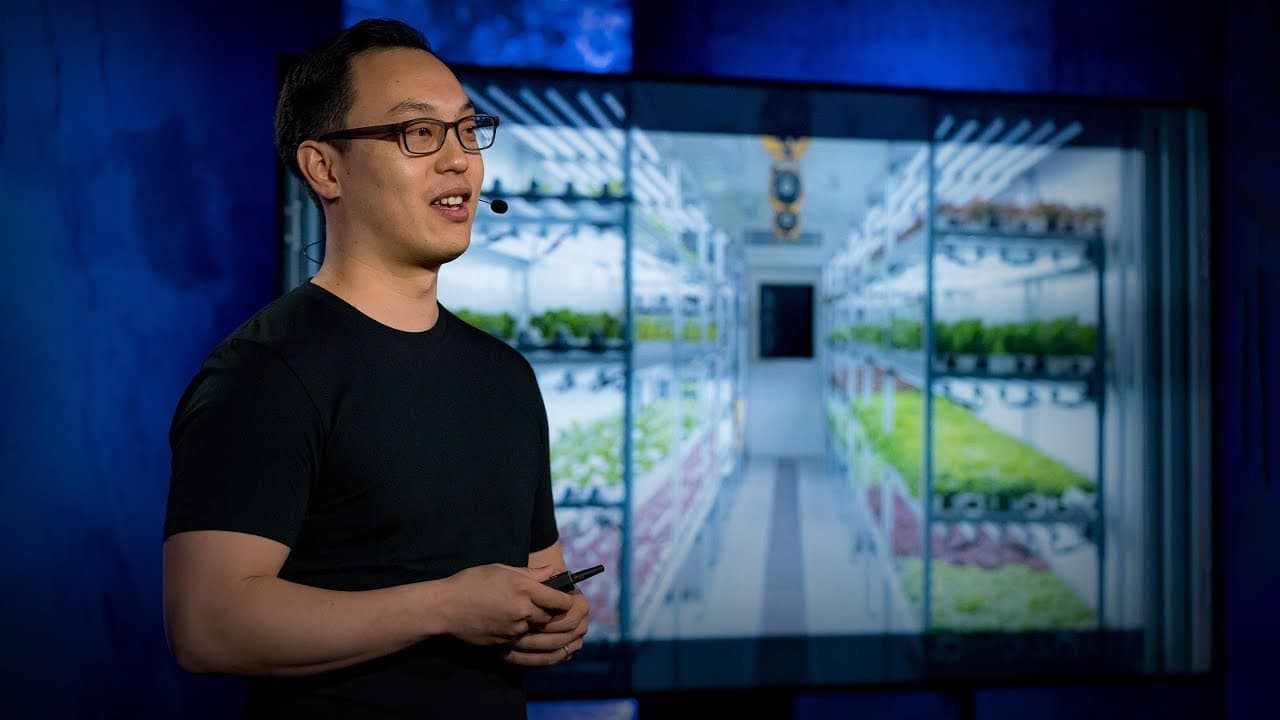
- 🌱 Controlled environment agriculture, such as indoor vertical farming, is a recent innovation being used to address these challenges. It offers weather- or climate-proof farming and utilizes vertical racks to maximize space.
- 🌿 Indoor vertical farming uses artificial lighting like LEDs to replace natural sunlight, and hydroponic or aeroponic systems instead of soil. It also employs precise nutrient formulas and sophisticated monitoring systems.
- ♻️ Indoor vertical farming has year-round production, consistent quality, predictable output, and greatly reduces resource use. It conserves water and fertilizer, eliminates the need for chemical pesticides, and yields significantly more food per square meter.
- ⚡️ However, indoor vertical farming is energy-intensive, has limited variety commercially, and is still relatively costly. Investments are being made to improve energy efficiency, utilize robotics and automation, and integrate farming into urban spaces.
- 🌇 Indoor vertical farming can be seamlessly integrated into urban infrastructure to repurpose unused spaces, improve access to nutritious vegetables, and reduce the agricultural supply chain. It provides opportunities for equity and sustainability.
Install to Summarize YouTube Videos and Get Transcripts
Explore YouTube Video Summarizer or Get YouTube Transcript Extractor
Questions & Answers
Q: What is the projected global population in 2050 and what percentage of people will be living in urban areas?
In 2050, the global population is projected to reach 9.8 billion, with 68 percent of people living in urban city centers.
Q: How much agricultural output will need to increase by in order to feed the projected population in 2050?
In order to feed the projected population in 2050, agricultural output will need to increase by 70 percent over current levels.
Q: How much food is wasted globally and what does this amount to in terms of tons?
Globally, one third of all the food produced is wasted, amounting to 1.6 billion tons of food that either spoils on the way to the market, expires in refrigerators, or is thrown out by supermarkets and restaurants.
Q: What is the current percentage of global fresh water usage by the agricultural industry?
The agricultural industry is the single largest consumer of fresh water, accounting for 70 percent of global usage.
Q: What is controlled environment agriculture and how is it also referred to?
Controlled environment agriculture is a type of food production that is weather- or climate-proof farming. It is also referred to as indoor vertical farming, where food is grown three-dimensionally in vertical racks instead of the traditional two dimensions.
Q: What artificial lighting is used in indoor vertical farms?
Natural sunlight is replaced with artificial lighting, particularly full spectrum LEDs that are optimized for the type of vegetables being grown.
Q: What materials are used instead of soil in hydroponic or aeroponic systems?
Instead of soil, hydroponic or aeroponic systems use substitute materials like polyurethane sponges, biodegradable peat moss, perlite, and clay pellets.
Q: What are some of the benefits of growing food through indoor vertical farming?
Some benefits of indoor vertical farming include year-round vegetable production, consistent quality, predictable output, significant resource use efficiencies (particularly water), complete control of incoming contaminants and pests, and the ability to produce large amounts of food.
Summary & Key Takeaways
-
The global population is projected to reach 9.8 billion people by 2050, and we will need to increase agricultural output by 70 percent to feed this population.
-
The agricultural industry faces challenges such as food waste, food safety issues, and high water consumption.
-
Controlled environment agriculture, such as indoor vertical farming, is a new and innovative solution to address the increasing demand for food production, with benefits including year-round production, resource use efficiencies, and weatherproofing.
Read in Other Languages (beta)
Share This Summary 📚
Summarize YouTube Videos and Get Video Transcripts with 1-Click
Try YouTube Summary with ChatGPT & Claude or YouTube Transcript Generator
Explore More Summaries from TED 📚



Summarize YouTube Videos and Get Video Transcripts with 1-Click
Try YouTube Summary with ChatGPT & Claude or YouTube Transcript Generator