Bode Plot | Corner frequency | Examples | CS | Control Systems | Lec-80
TL;DR
Discusses poles, zeros, slope changes, and drawing border plots in control systems.
Transcript
hello everyone in this session we will discuss some more important points regarding the border plan so in the previous discussion we will consider some points here the first point is initial slope of the plot is given by poles and zeros location at the origin that means poles and zeros location at the origin means one by s zero location at the pole... Read More
Key Insights
- 💈 Poles contribute negatively to the system slope, while zeros contribute positively, with their impact varying based on their respective orders.
- 💈 The initial slope and subsequent changes are determined directly by the locus of poles and zeros concerning the origin in the complex plane.
- 🤩 Drawing a border plot involves recognizing key corner frequencies that represent shifts in system gain and phase.
- 💈 Each corner frequency alters the slope of the plot, with specific rules dictating the changes per pole or zero present.
- 🔠 The final slope of the border plot is essential for predicting system behavior in response to inputs across the frequency spectrum.
- 💈 The phase plot complements the magnitude plot, capturing the angular relationships imparted by poles and zeros during system response.
- ✋ Accurately assessing the influence of high-order poles and zeros is crucial for maintaining desired performance and stability in feedback loops.
Install to Summarize YouTube Videos and Get Transcripts
Explore YouTube Video Summarizer or Get YouTube Transcript Extractor
Questions & Answers
Q: What are poles and zeros, and how do they affect system behavior?
Poles and zeros are critical in control systems; poles are values of s that cause the system's transfer function to become infinite, leading to instability, while zeros are values that make the transfer function zero, contributing to system behavior. Their locations in the complex plane determine the stability, transient response, and frequency response characteristics of the system, such as gain and phase shifts.
Q: How is the initial slope of a border plot determined?
The initial slope of a border plot is dictated by the locations of poles and zeros at the origin. If there is a pole at the origin, it results in a slope of -20 dB/decade; conversely, a zero at the origin will provide a slope of +20 dB/decade. This initial slope lays the foundation for deeper frequency characteristics of the system.
Q: What is the significance of corner frequency in border plots?
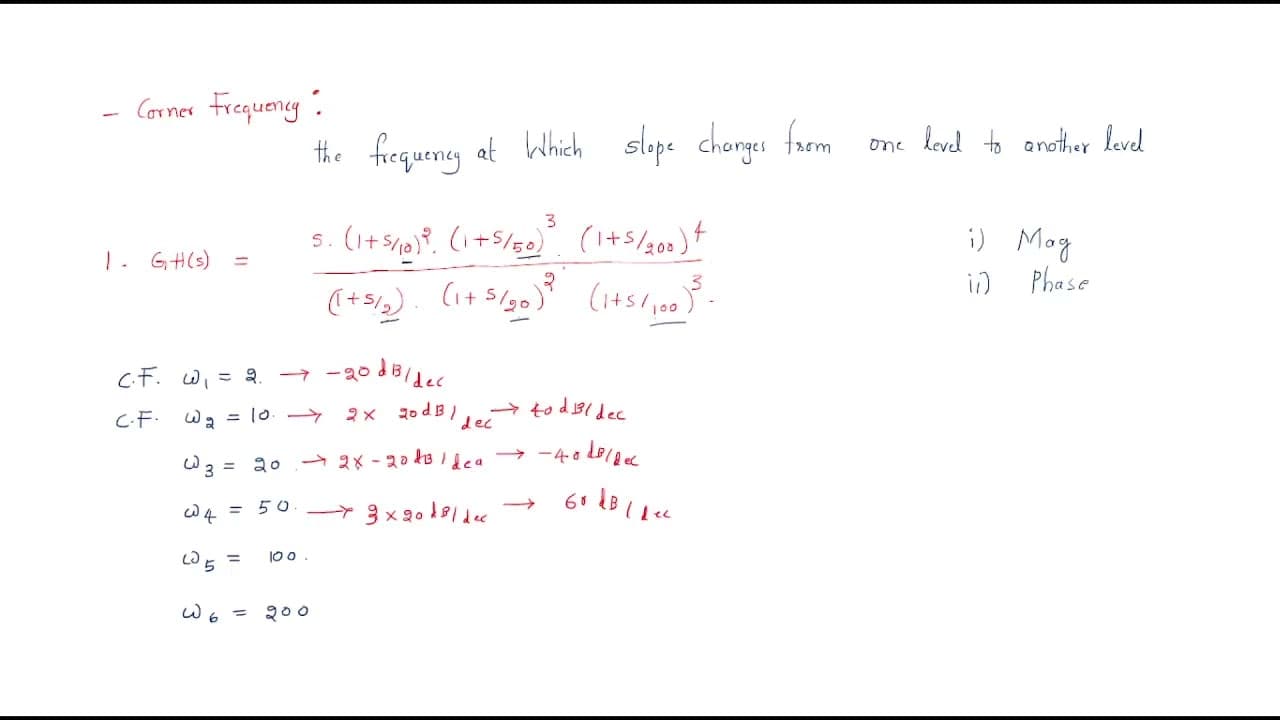
Corner frequency is vital as it signifies the frequency at which the slope of the plot changes. Understanding when the slope changes allows engineers to predict how the gain and phase will behave at different frequencies, which is crucial for system stability and performance optimization in control systems.
Q: How do you calculate corner frequencies from a transfer function?
Corner frequencies can be calculated from a transfer function by identifying the values of s in the polynomial representation of the transfer function. For example, in the given function, corner frequencies at specific points correspond to where the poles and zeros intersect and are usually organized in ascending order to aid in plotting.
Q: What method is used to plot the magnitude and phase of a transfer function?
The magnitude and phase plots are constructed by initially determining the corner frequencies. The initial magnitude at 0 dB is adjusted based on the contributions of poles and zeros across frequency ranges. For phase plots, the angles corresponding to the poles and zeros are summed to assess the overall phase shift across frequencies.
Q: Why is understanding poles and zeros crucial for control systems?
Grasping the significance of poles and zeros is essential for designing stable control systems. Their locations directly influence system behavior, stability margins, transient responses, and frequency responses, which are key factors engineers must control and optimize for desired system performance.
Summary & Key Takeaways
-
The content provides an overview of control system concepts like poles, zeros, corner frequencies, and their effect on slope and phase in border plots.
-
Key concepts include understanding how the initial slope is determined by the positions of poles and zeros, impacting the gain and phase margins.
-
Detailed examples illustrate how to compute corner frequencies and plot magnitude and phase for a given transfer function effectively.
Read in Other Languages (beta)
Share This Summary 📚
Summarize YouTube Videos and Get Video Transcripts with 1-Click
Try YouTube Summary with ChatGPT & Claude or YouTube Transcript Generator