Pythagorus' Theorum - Math Lessons - sides
TL;DR
Learn how to find the shorter sides using Pythagorean Theorem with simple examples.
Transcript
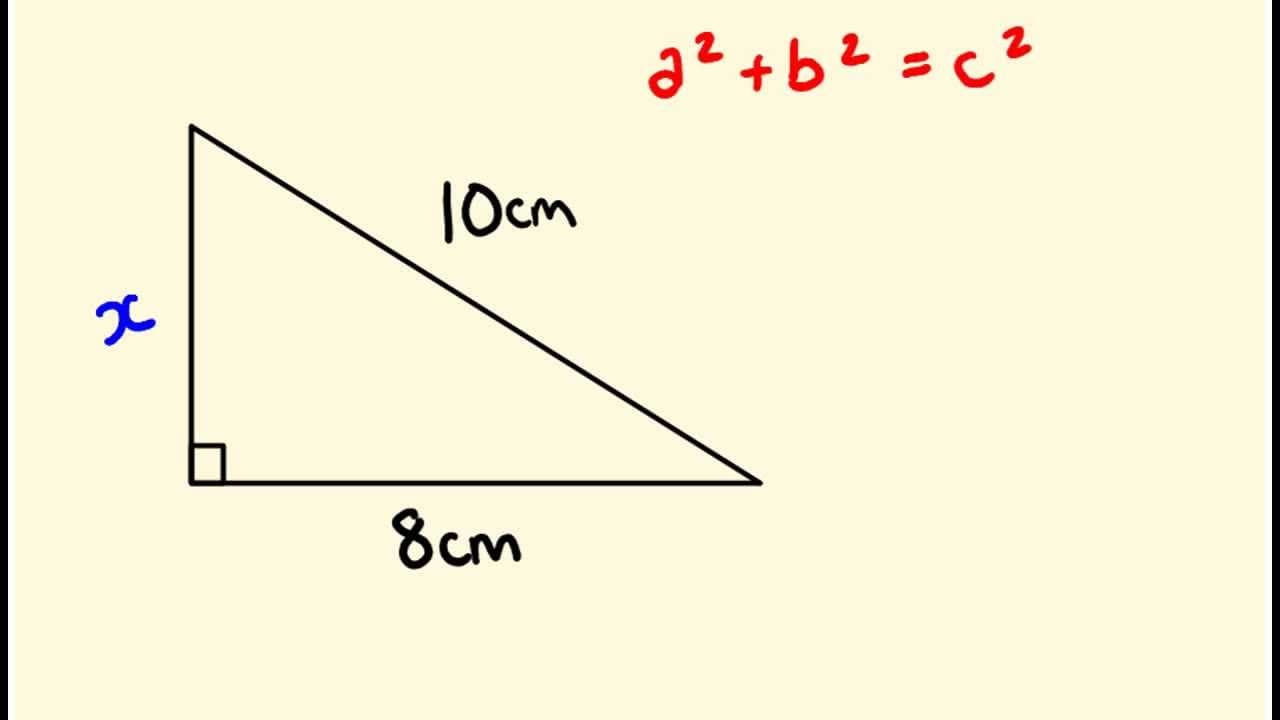
good day and welcome to the tech math Channel what we're going to be having a look at in this video is we're going to be looking at how to find the shorter sides uh these A or B sides when we're using Pythagoras okay so uh the Pythagorean Theorum first off number one we can use it to work out uh well basically what it was stating is the sum of thes... Read More
Key Insights
- ❎ The Pythagorean Theorem relates the squares of the shorter sides to the square of the hypotenuse in a right-angled triangle.
- 🙃 By rearranging the formula a^2 + b^2 = c^2, you can solve for the unknown sides (A or B).
- 🎟️ Practical examples demonstrate how to apply the Pythagorean Theorem to find missing side lengths accurately.
- ❎ Understanding the concept of squares and square roots is essential in utilizing the Pythagorean Theorem.
- ❓ The step-by-step process of substitution, calculation, isolation, and solution is crucial in finding unknown side lengths.
- 🌍 Pythagorean Theorem is a fundamental concept in mathematics and has various applications in real-world scenarios.
- ❓ By practicing multiple examples, you can enhance your skills in using the Pythagorean Theorem effectively.
Install to Summarize YouTube Videos and Get Transcripts
Explore YouTube Video Summarizer or Get YouTube Transcript Extractor
Questions & Answers
Q: What does the Pythagorean Theorem state?
The Pythagorean Theorem states that the square of the hypotenuse is equal to the sum of the squares of the two shorter sides (a^2 + b^2 = c^2), allowing us to calculate unknown side lengths in right-angled triangles.
Q: How do you find the unknown side using the Pythagorean Theorem?
To find the unknown side (A or B), substitute the known values into the formula a^2 + b^2 = c^2, rearrange the equation to isolate the unknown side, and solve for its value by taking the square root of the difference.
Q: What steps are involved in calculating the unknown side?
The process involves substituting the known values into the Pythagorean Theorem formula, simplifying the equation, isolating the unknown side, and solving for its value by taking the square root of the resulting number.
Q: Can the Pythagorean Theorem be used in practical examples?
Yes, the Pythagorean Theorem is commonly used in real-world scenarios, such as construction and engineering, to calculate distances, diagonals, and lengths in right-angled triangles.
Summary & Key Takeaways
-
The video explains how to find the shorter sides (A or B) using the Pythagorean Theorem, which states that the sum of the squares of the two shorter sides equals the square of the hypotenuse.
-
By using the formula a^2 + b^2 = c^2, you can calculate the unknown side (A or B) by rearranging the equation and solving for the missing value.
-
Three examples demonstrate the step-by-step process of finding the unknown side using the Pythagorean Theorem and calculating the final value.
Read in Other Languages (beta)
Share This Summary 📚
Summarize YouTube Videos and Get Video Transcripts with 1-Click
Try YouTube Summary with ChatGPT & Claude or YouTube Transcript Generator
Explore More Summaries from tecmath 📚



Summarize YouTube Videos and Get Video Transcripts with 1-Click
Try YouTube Summary with ChatGPT & Claude or YouTube Transcript Generator