Step potential probability current
TL;DR
Scattering states and stationary states have energy but are not normalizable. Probability currents provide insight into the behavior of wave functions.
Transcript
PROFESSOR: I've put on the blackboard here the things we were doing last time. We began our study of stationary states that are not normalizable. These are scattering states. Momentum eigenstates were not normalizable, but now we have more interesting states that represent the solutions of the Schrodinger equation, that are stationary states with s... Read More
Key Insights
- ❓ Scattering states are not normalizable and cannot directly represent the behavior of a particle.
- 👋 The wave function can be represented as a stationary solution with a wave coming from the left and some time dependence.
- 🥳 Continuity conditions at x=0 can be used to determine the ratios of coefficients in the wave function.
- 👋 Probability currents reveal the current of probability in the wave function and ensure conservation of probability.
- ☺️ Probability currents are independent of x in both regions, which is important for conservation.
- ❓ Conservation of probability is encoded in Schrodinger's equation and is confirmed by the equality of the probability currents.
- ↔️ Manipulating the left probability current confirms that it is equal to the right probability current.
Install to Summarize YouTube Videos and Get Transcripts
Explore YouTube Video Summarizer or Get YouTube Transcript Extractor
Questions & Answers
Q: What are scattering states in quantum mechanics?
Scattering states are stationary states with energy but are not normalizable. They cannot directly represent the behavior of a particle and are used in calculating wave packets.
Q: How can the wave function be represented as a stationary solution?
The wave function can be represented as a stationary solution with a wave coming from the left and some time dependence, given by ae^(ikx)e^(-iet/hbar).
Q: What conditions are used to determine the ratios of coefficients in the solution?
The conditions of continuity of the wave function and its derivative at x=0 are used to determine the ratios of c/a and b/a in the solution.
Q: How do probability currents provide insight into wave function behavior?
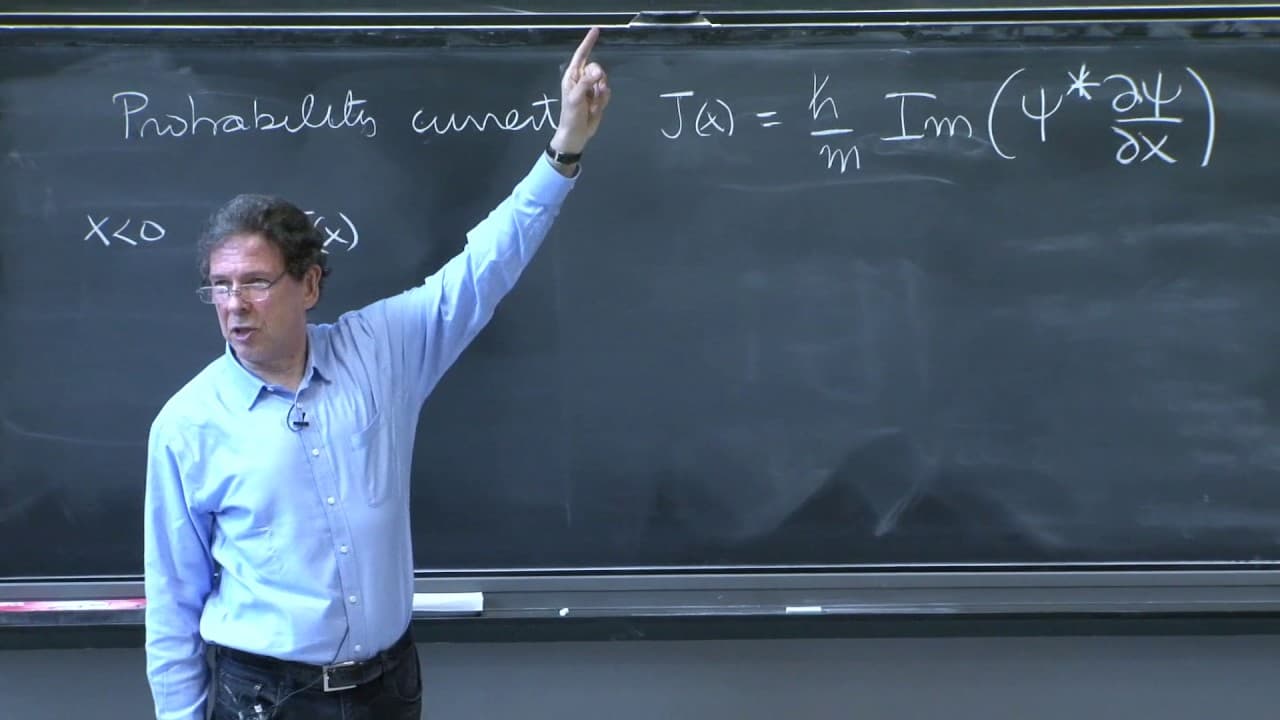
Probability currents, represented by J = (hbar/m)Im(psi* d(psi)/dx), quantify the current of probability in the wave function. They ensure conservation of probability and reveal the behavior of the wave function.
Summary & Key Takeaways
-
Scattering states in quantum mechanics are stationary states with energy but are not normalizable and cannot represent the behavior of a particle.
-
The wave function can be represented as a stationary solution with a wave coming from the left and some time dependence.
-
Continuity conditions of the wave function and its derivative at x=0 can be used to determine the ratios of coefficients in the solution.
Read in Other Languages (beta)
Share This Summary 📚
Summarize YouTube Videos and Get Video Transcripts with 1-Click
Try YouTube Summary with ChatGPT & Claude or YouTube Transcript Generator
Explore More Summaries from MIT OpenCourseWare 📚



Summarize YouTube Videos and Get Video Transcripts with 1-Click
Try YouTube Summary with ChatGPT & Claude or YouTube Transcript Generator