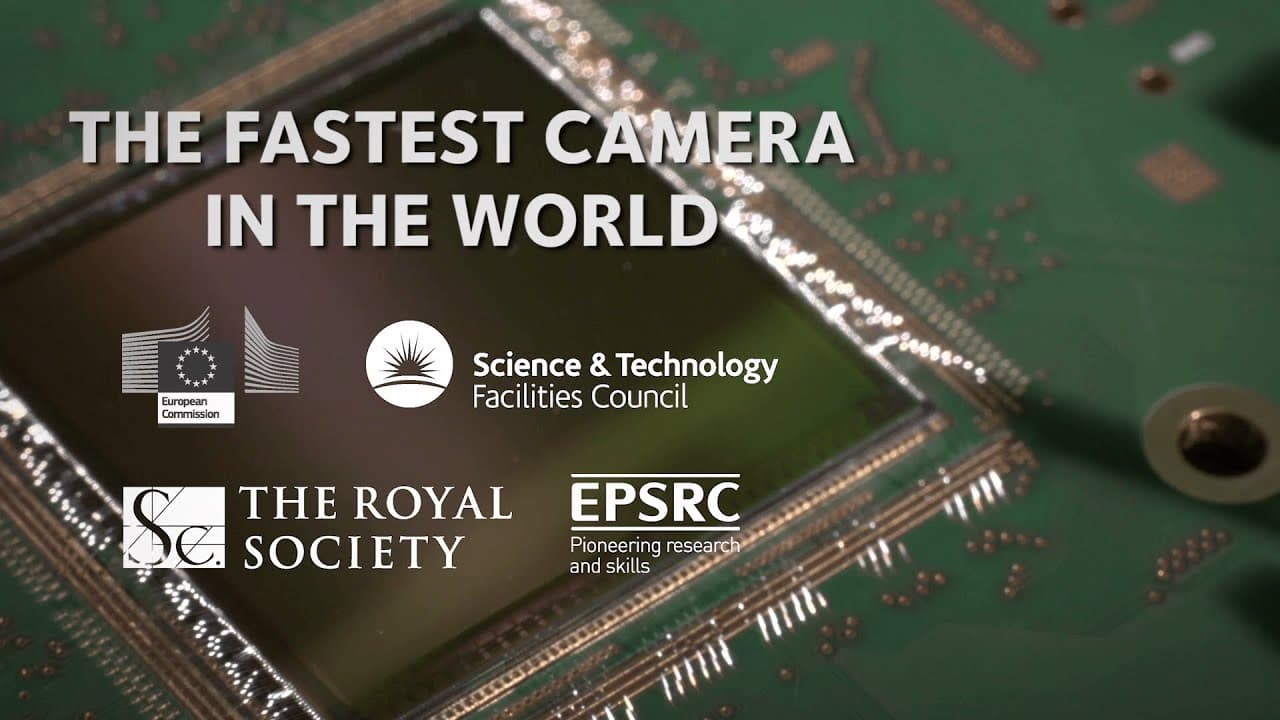
The Fastest Camera in the World: the PImMS sensor
TL;DR
Developing a fast pin sensor camera for mass spectrometry imaging, enabling detailed analysis of multiple ions simultaneously.
Transcript
when you're doing mass spectrometry usually what you do is you take a molecule you fragmented into lots of pieces and then you effectively weigh each piece and so you get a plot out at the end which gives you a peak for every different fragment of your molecule that you've made if you want to combine that with imaging that's quite difficult because... Read More
Key Insights
- 💁 The development of a fast pin sensor camera revolutionizes mass spectrometry imaging by enabling rapid and detailed analysis of multiple ions simultaneously.
- 😑 The camera's unique capabilities include identifying masses, spatial distributions, and velocities of ions in real-time during experiments.
- 💨 Applications of the fast camera span across various fields, from tissue imaging to optimizing yields in agriculture through precise spatial distributions of molecules.
- 🎥 The new camera's speed outperforms traditional framing cameras, making it a cutting-edge tool for mass spectrometry research.
- 🤗 The potential for real-time movies of chemical reactions at the atomic level opens up exciting possibilities for scientific research.
- 👶 Collaborations with different communities and organizations are yielding new ideas and possibilities for the camera's application.
- 🥺 Future advancements include making complex experiments more accessible and less time-consuming, ultimately leading to groundbreaking discoveries in mass spectrometry.
Install to Summarize YouTube Videos and Get Transcripts
Explore YouTube Video Summarizer or Get YouTube Transcript Extractor
Questions & Answers
Q: What is the main challenge in combining mass spectrometry with imaging?
The main challenge lies in capturing numerous fragments arriving at a detector within microseconds, which traditional cameras struggle to do due to their slower frame rates.
Q: How does the pin sensor camera work differently from traditional cameras?
The pin sensor camera has an array of pixels, each with stopwatches that record the position and time of arrival of particles, allowing for rapid and precise imaging of ions.
Q: What are the potential applications of this fast camera in different fields?
The fast camera can enable tissue imaging, spatial distributions in plant biology, and even real-time movies of chemical reactions at the atomic level, offering groundbreaking possibilities in various scientific disciplines.
Q: How does the new camera's speed compare to existing framing cameras?
The new camera is the fastest in the world, capable of recording hundreds of ions at once with detailed spatial and velocity information, surpassing the capabilities of traditional cameras.
Summary & Key Takeaways
-
Mass spectrometry involves fragmenting molecules and weighing each piece to create peaks representing different fragments.
-
Traditional cameras are not fast enough to capture all fragments, so a new pin sensor camera was developed for precise imaging.
-
The new camera can identify masses, spatial distributions, and velocities of ions simultaneously, revolutionizing mass spectrometry imaging.
Read in Other Languages (beta)
Share This Summary 📚
Summarize YouTube Videos and Get Video Transcripts with 1-Click
Try YouTube Summary with ChatGPT & Claude or YouTube Transcript Generator