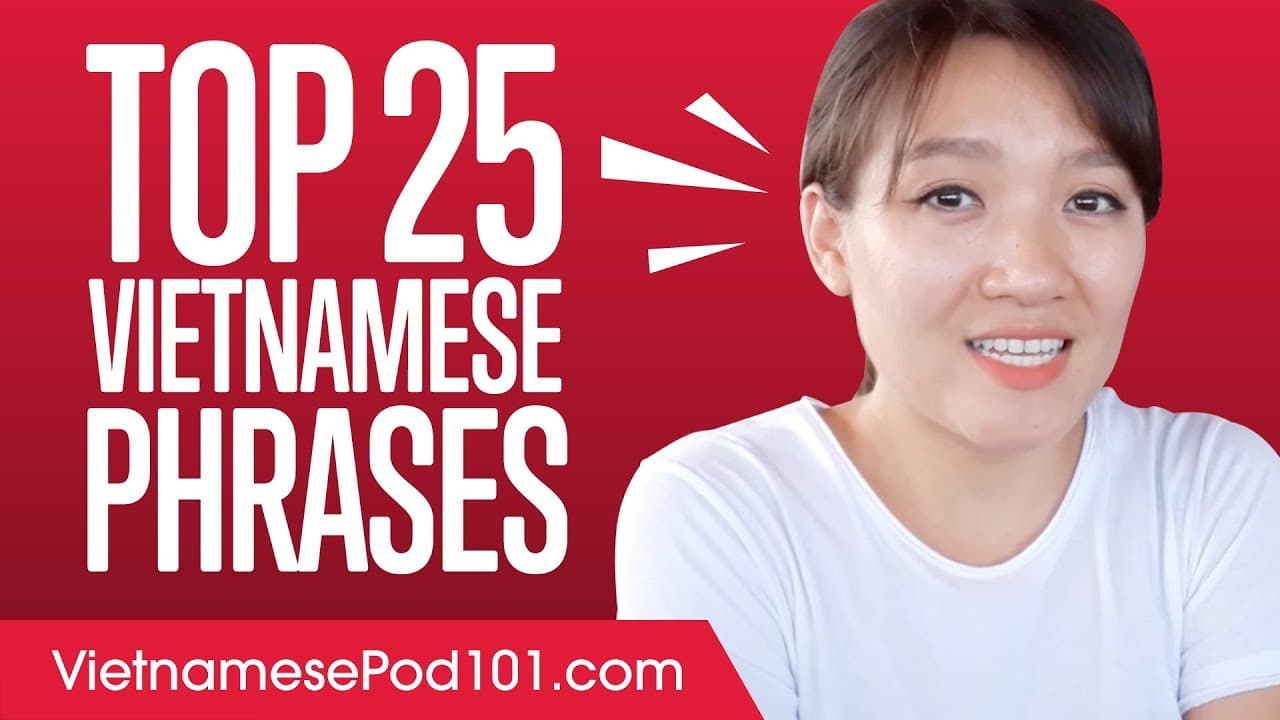
Top 25 Vietnamese Phrases
TL;DR
This tutorial covers the top 25 Vietnamese phrases, providing learners with essential vocabulary for everyday conversations. It is particularly useful for beginners or travelers to Vietnam, offering practical examples and cultural insights to enhance communication skills. The video explains pronunciation nuances and context usage to help viewers grasp these phrases effectively.
Transcript
want to speak real vietnamese from your first lesson sign up for your free lifetime account at vietnamesepod101.com hello everyone this is link and welcome back to vietnamese top words today we will talk about top 25 vietnamese phrases and this is very easy and very useful especially when you travel to vietnam so let's go now xin chao xin ciao hell... Read More
Key Insights
- The video emphasizes the importance of using 'xin chao' as a universal greeting in Vietnamese, suitable for any time of day.
- Pronouns are crucial in Vietnamese greetings to address people appropriately based on their age or relationship to the speaker.
- The phrase 'ten ba la gi' is used to ask someone's name, and the response format is 'toi la' followed by the person's name.
- Vietnamese cultural norms often involve expressing politeness with phrases like 'cam on' for thank you and 'lam on' for please.
- Understanding the difference between 'co' (yes) and 'khong' (no) is essential for basic conversational exchanges.
- The tutorial suggests that Vietnamese people appreciate when foreigners attempt to speak their language, which may lead to social benefits like discounts.
- For emergencies or urgent situations, the phrase 'giup toi voi' is crucial, translating to 'help me'.
- The video highlights the use of 'tam biet' for goodbye, and how 'xin chao' can be versatile for both greetings and farewells.
Install to Summarize YouTube Videos and Get Transcripts
Explore YouTube Video Summarizer or Get YouTube Transcript Extractor
Questions & Answers
Q: What is the significance of 'xin chao' in Vietnamese?
In Vietnamese, 'xin chao' serves as a universal greeting that can be used at any time of the day. Unlike English, where greetings vary with the time, 'xin chao' simplifies interactions by providing a consistent way to say hello. It's versatile and can be used in both formal and informal settings, making it a crucial phrase for anyone learning Vietnamese.
Q: How can one express politeness in Vietnamese conversations?
Politeness in Vietnamese is often conveyed through phrases like 'cam on' for thank you and 'lam on' for please. These expressions are essential in daily interactions, helping to show respect and gratitude. Additionally, using the correct pronouns when addressing others is important, as it reflects the speaker's understanding of social hierarchies and relationships.
Q: Why is it important to learn Vietnamese pronouns?
Learning Vietnamese pronouns is crucial because they determine how you address others based on their age, social status, or relationship to you. Proper use of pronouns shows respect and understanding of Vietnamese culture, helping to avoid misunderstandings. Pronouns precede names and verbs, making them foundational in constructing polite and appropriate sentences.
Q: What should you do if you need help in Vietnam?
If you need assistance in Vietnam, you should use the phrase 'giup toi voi,' which means 'help me.' This phrase is essential in emergencies or when seeking aid from others. Pronouncing it clearly is important to ensure that your request is understood. It's a key phrase that travelers should memorize for safety and convenience.
Q: How does the video suggest handling farewells in Vietnamese?
For farewells, the video suggests using 'tam biet' to say goodbye. This phrase is commonly used to conclude interactions politely. Additionally, 'xin chao' can be used for both greetings and farewells, offering flexibility in conversations. Learning these phrases helps ensure smooth and culturally appropriate exchanges when ending conversations.
Q: What role does pronunciation play in learning Vietnamese phrases?
Pronunciation is crucial when learning Vietnamese phrases because it affects how well you are understood by native speakers. Vietnamese has unique sounds and tones that can change the meaning of words. The video emphasizes practicing pronunciation to improve clarity and communication, which is particularly important for phrases like 'giup toi voi' and 'tam biet.'
Q: Why might Vietnamese people appreciate foreigners speaking their language?
Vietnamese people often appreciate when foreigners attempt to speak their language because it shows respect for their culture and a willingness to engage. This effort can lead to positive social interactions and even benefits like discounts in markets. Speaking Vietnamese can enhance the travel experience by fostering goodwill and understanding between cultures.
Q: How does the video address the challenge of pronunciation for English speakers?
The video acknowledges that certain Vietnamese sounds, like the 'd' in 'tam biet,' may be challenging for English speakers. It encourages learners to practice these sounds slowly and consistently to become familiar with them. The tutorial provides guidance on pronunciation nuances, helping learners overcome these challenges and communicate more effectively.
Summary & Key Takeaways
-
The video tutorial introduces 25 essential Vietnamese phrases, focusing on greetings, polite expressions, and basic conversational exchanges. It offers practical examples and pronunciation tips to help learners communicate effectively in Vietnam.
-
Viewers learn how to ask for names, express gratitude, and request assistance with phrases like 'ten ba la gi' and 'cam on'. The tutorial also covers cultural nuances, such as addressing people with the correct pronouns.
-
The video highlights the importance of understanding basic Vietnamese phrases for travelers, emphasizing the use of 'xin chao' for greetings and 'tam biet' for farewells. It encourages practicing pronunciation to improve communication skills.
Read in Other Languages (beta)
Share This Summary 📚
Summarize YouTube Videos and Get Video Transcripts with 1-Click
Try YouTube Summary with ChatGPT & Claude or YouTube Transcript Generator
Explore More Summaries from Learn Vietnamese with VietnamesePod101.com 📚



Summarize YouTube Videos and Get Video Transcripts with 1-Click
Try YouTube Summary with ChatGPT & Claude or YouTube Transcript Generator