What Is Mechanical Energy and How Is It Conserved?
TL;DR
Mechanical energy is defined as the total of kinetic and potential energy in a system. It remains constant when only conservative forces are acting; any work done by non-conservative forces changes the total mechanical energy. Although mechanical energy can decrease, the overall energy of the system, including non-mechanical energy, is conserved.
Transcript
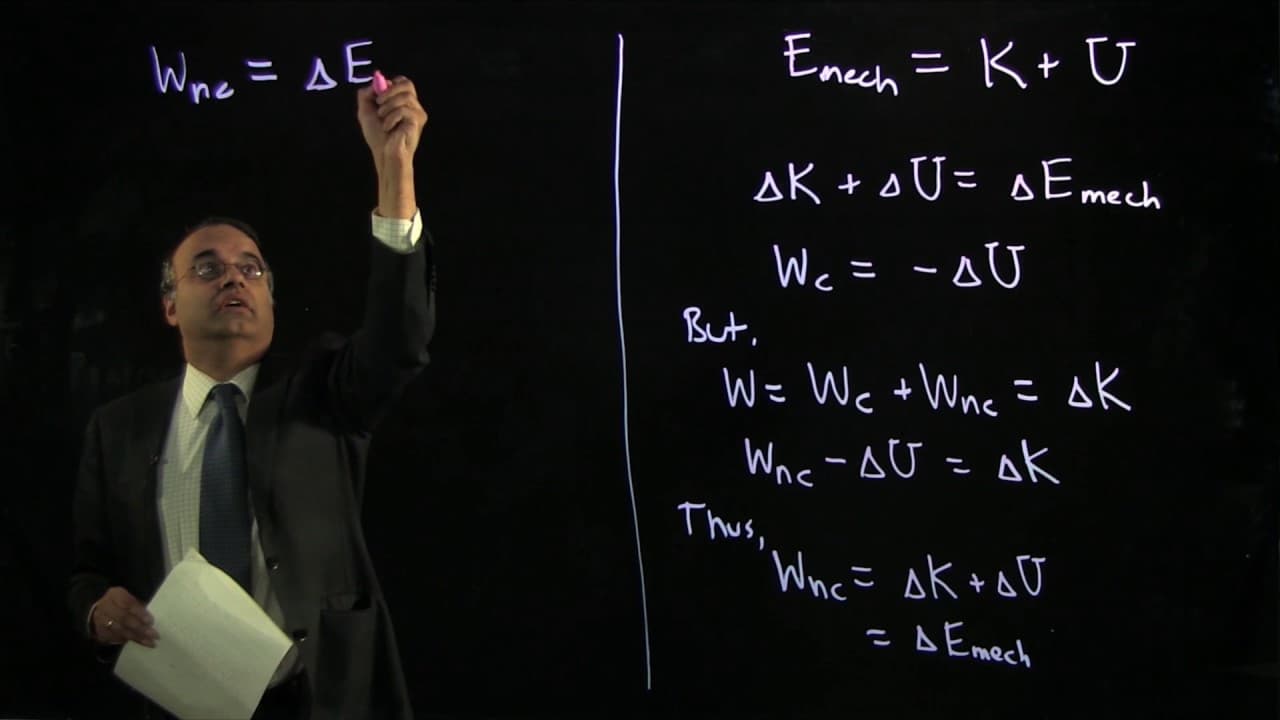
The total mechanical energy, E sub mech is defined as the sum of the kinetic energy and the potential energy, so the sum of K plus U, where U is the potential energy function associated with the conservative force-- with an appropriate choice of zero point. If there are multiple conservative forces acting on the system, then U will be the sum of in... Read More
Key Insights
- 🦾 The total mechanical energy of a system is the sum of its kinetic and potential energy.
- 🦾 For conservative forces, the total mechanical energy remains constant.
- 💦 Non-conservative work on a system changes the total mechanical energy.
- 🚱 Heat generated by non-conservative forces is an example of non-mechanical energy.
- 🦾 The total energy of a system, including mechanical and non-mechanical energy, is conserved, but non-conservative processes are not reversible.
Install to Summarize YouTube Videos and Get Transcripts
Explore YouTube Video Summarizer or Get YouTube Transcript Extractor
Questions & Answers
Q: How is total mechanical energy defined for a system?
Total mechanical energy, E, is the sum of kinetic energy, K, and potential energy, U, and can be represented as E = K + U.
Q: What is the relationship between changes in kinetic and potential energy and the change in total mechanical energy?
The change in total mechanical energy, ΔE, is equal to the change in kinetic energy, ΔK, plus the change in potential energy, ΔU, expressed as ΔE = ΔK + ΔU.
Q: What is the significance of the non-conservative work on a system?
Non-conservative work changes the total mechanical energy of the system, as the non-conservative work is equal to the change in total mechanical energy.
Q: How does the presence of non-conservative forces affect the conservation of mechanical energy?
If non-conservative forces act on the system, there will be a negative change in total mechanical energy, resulting in a loss of mechanical energy from the system.
Summary & Key Takeaways
-
Total mechanical energy, E, is the sum of kinetic and potential energy, and is defined as the sum of K + U.
-
The change in total mechanical energy, ΔE, is equal to the change in kinetic energy, ΔK, plus the change in potential energy, ΔU.
-
For conservative forces, ΔE is zero, indicating that total mechanical energy is conserved.
Read in Other Languages (beta)
Share This Summary 📚
Summarize YouTube Videos and Get Video Transcripts with 1-Click
Try YouTube Summary with ChatGPT & Claude or YouTube Transcript Generator
Explore More Summaries from MIT OpenCourseWare 📚



Summarize YouTube Videos and Get Video Transcripts with 1-Click
Try YouTube Summary with ChatGPT & Claude or YouTube Transcript Generator