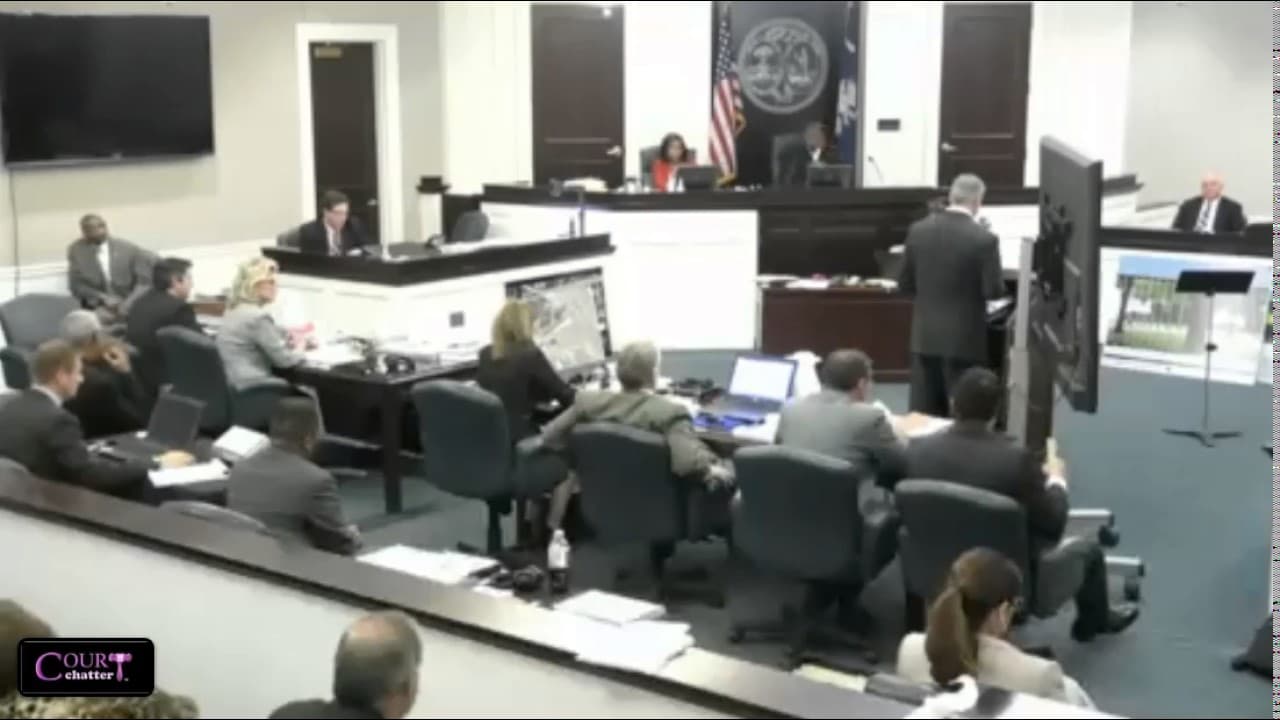
Michael Slager Trial Day 9 Part 3 11/16/16
TL;DR
Descriptive analysis of forensic video reconstruction in a court case.
Transcript
I all right mr. witness where is he I don't think so next time the jury would see would be during the liberation if it's emitted like I don't know I mean you've offered it and I've said it's the variety purposes only at this point and we're in the midst of dealing with the witness so we can talk about it another time I mention bring the jury where'... Read More
Key Insights
- 👤 Detailed process of forensic animation creation using video frames and silhouette figures.
- 🧑🏭 Factors contributing to potential errors in aligning frames, such as blur and cumulative inaccuracies.
- 🧘 Importance of accurate camera placement and object positioning in creating a realistic forensic visualization.
- 🔨 Usage of digital tools like Photoshop for framing, alignment, and layering in forensic animation creation.
- ❓ The role of estimation and visual estimation in overcoming pixel alignment challenges in forensic animation.
- ❓ Impact of discrepancies in presentation on the jury's perception and understanding of forensic evidence.
- ☠️ Considerations for accuracy and error rate management in forensic animation reconstruction.
Install to Summarize YouTube Videos and Get Transcripts
Explore YouTube Video Summarizer or Get YouTube Transcript Extractor
Questions & Answers
Q: How did the witness decide on the starting point for the camera in the forensic animation?
The witness used stationary objects in the video frame and adjusted the camera position until a consistent reference point was found.
Q: Were predictive frames or reference frames used in the animation matching process?
The witness primarily aligned frames based on visual estimation due to blur in the video, with an error margin of about two pixels.
Q: What factors contributed to the cumulative error rate in aligning frames in the forensic animation?
Errors in camera placement, silhouette positioning, and overall alignment accuracy led to a cumulative error rate in creating the animation sequence.
Q: How were lateral and depth offsets accounted for in positioning the figures in the forensic animation?
Lateral offset was adjusted by eyeballing the position, while depth offset was less significant and mainly focused on maintaining a straight path for the figures.
Summary & Key Takeaways
-
Witness testifies on creating a forensic animation based on video evidence in a court case.
-
Detailed explanation of the process used to match frames and create the animation.
-
Issues raised regarding accuracy, pixel alignment, and potential errors in the reconstruction.
Read in Other Languages (beta)
Share This Summary 📚
Summarize YouTube Videos and Get Video Transcripts with 1-Click
Try YouTube Summary with ChatGPT & Claude or YouTube Transcript Generator
Explore More Summaries from Law&Crime Network 📚


Summarize YouTube Videos and Get Video Transcripts with 1-Click
Try YouTube Summary with ChatGPT & Claude or YouTube Transcript Generator