5.2.1 Digital State
TL;DR
This content introduces the concept of sequential logic and memory components, explaining how they are different from combinational logic circuits and discussing the use of capacitors and feedback loops in creating memory devices.
Transcript
In the last lecture we learned how to build combinational logic circuits given a functional specification that told us how output values were related to the current values of the inputs. But here's a simple device we can't build with combinational logic. The device has a light that serves as the output and push button that serves as the input. If t... Read More
Key Insights
- 🔠 Sequential logic circuits can remember past inputs and exhibit behaviors based on the history of their inputs.
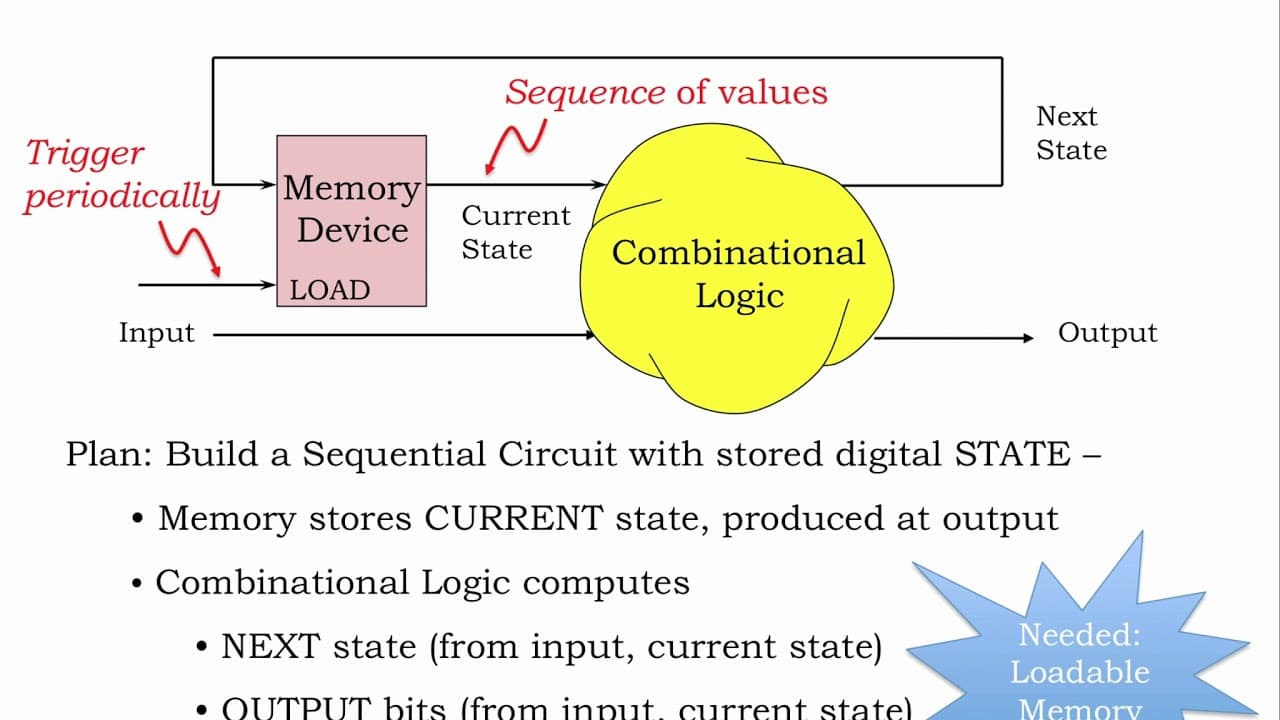
- 🏪 Memory components store the current state of a system and provide the inputs for determining the next state and system outputs.
- 🈂️ Capacitors can be used as storage elements in memory components, with charging and discharging operations representing digital values.
- 😃 Feedback loops with inverters can create bi-stable storage elements that maintain stable configurations.
- 😃 Metastable states in bi-stable storage elements need to be avoided in memory components.
- ✋ Capacitive storage in memory components offers high-density storage but comes with drawbacks such as slow access times and the need for periodic refresh.
Install to Summarize YouTube Videos and Get Transcripts
Explore YouTube Video Summarizer or Get YouTube Transcript Extractor
Questions & Answers
Q: How is the behavior of a sequential logic circuit different from a combinational logic circuit?
Sequential logic circuits have the ability to remember past inputs and use that information to determine their current behavior, while combinational logic circuits only rely on the current inputs to produce outputs.
Q: What is a memory component in a digital system?
A memory component stores the current state of a digital system and provides the inputs for the combinational logic that determines the next state and system outputs.
Q: How can capacitors be used to create a memory device?
By charging or discharging a capacitor to match the voltage of a bit line, information can be written into the memory device. Reading the stored information involves connecting the bit line and capacitor, with the resulting voltage change detected by a sense amplifier.
Q: What are the advantages and disadvantages of capacitive storage in memory components?
Capacitors allow for high-density storage at a low cost per bit. However, access times are relatively slow, and the stored charge can be affected by leakage current and external electrical noise, requiring periodic refresh operations.
Summary & Key Takeaways
-
Combinational logic circuits cannot exhibit behaviors that depend on the history of their inputs, unlike sequential logic circuits.
-
Sequential logic circuits incorporate memory components that store the current state of the system and produce outputs based on the current state and inputs.
-
Memory components can be created using capacitors, which store charge to represent digital values, and through positive feedback loops that create bi-stable storage elements.
Read in Other Languages (beta)
Share This Summary 📚
Summarize YouTube Videos and Get Video Transcripts with 1-Click
Try YouTube Summary with ChatGPT & Claude or YouTube Transcript Generator
Explore More Summaries from MIT OpenCourseWare 📚



Summarize YouTube Videos and Get Video Transcripts with 1-Click
Try YouTube Summary with ChatGPT & Claude or YouTube Transcript Generator