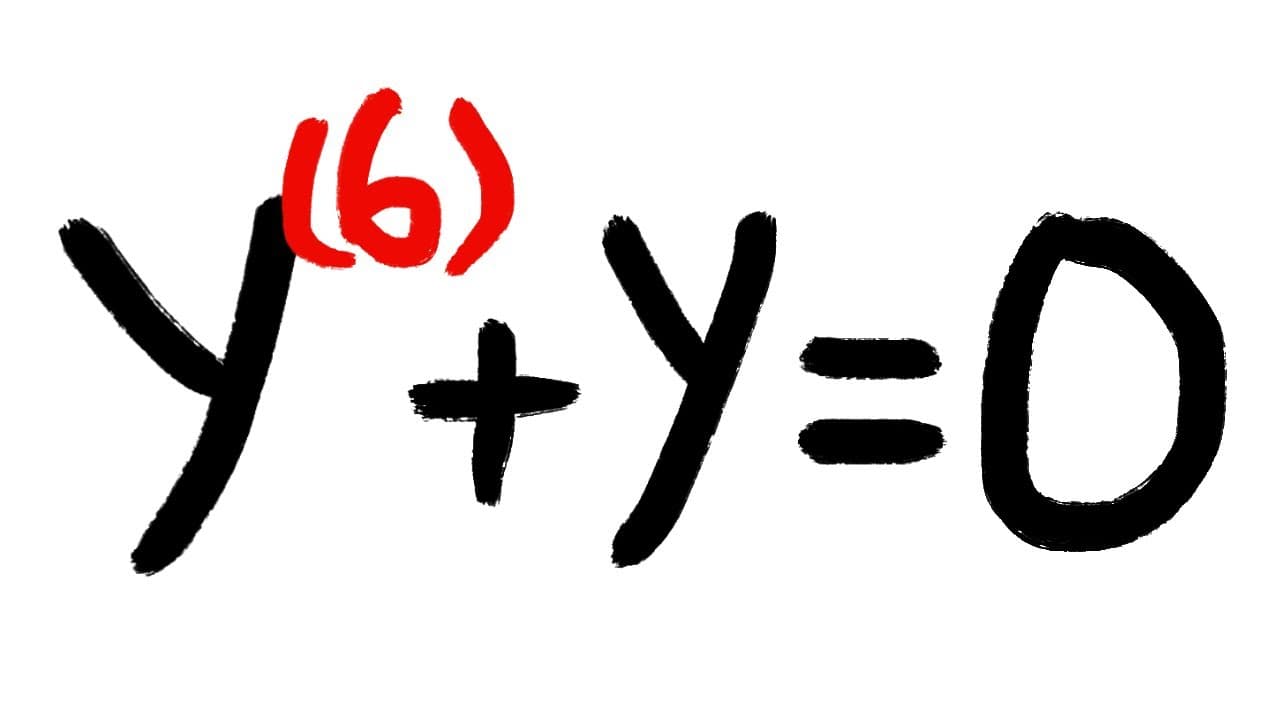
solving a 6th order linear differential equation by using complex numbers
TL;DR
Learn how to solve complex linear differential equations efficiently using complex numbers.
Transcript
okay that's do some math for fun here we're gonna solve this differential question and yes the water right here six because of the sixth derivative however this is actually not a bad because this is linear and also with constant coefficients so serious is not that bad however as always please pause the video and try this first alright hopefully get... Read More
Key Insights
- 🫚 Linear differential equations with constant coefficients can be efficiently solved by finding the roots of the characteristic equation.
- 🖐️ Complex numbers and Euler's formula play a crucial role in simplifying the solutions of complex linear differential equations.
- 👨💼 Trigonometric functions like cosine and sine are integrated into the solutions to capture the oscillatory behavior of the system.
- 💁 Considering the complex conjugate of roots ensures that the solutions are real and cover all possible forms.
Install to Summarize YouTube Videos and Get Transcripts
Explore YouTube Video Summarizer or Get YouTube Transcript Extractor
Questions & Answers
Q: How do you approach solving linear differential equations with constant coefficients?
Linear differential equations with constant coefficients can be solved by finding the roots of the characteristic equation, which involves exponentials of the form e to the RT. These roots can be real or complex, leading to different solutions.
Q: How do complex numbers aid in solving linear differential equations?
Complex numbers provide a more elegant solution to linear differential equations with complex roots. By leveraging Euler's formula, the solutions can be expressed in terms of trigonometric functions that simplify the process.
Q: What role do trigonometric functions play in the solutions of linear differential equations?
Trigonometric functions such as cosine and sine appear in the solutions of complex linear differential equations, reflecting the oscillatory nature of the solutions. They are combined with constants to form the general solution.
Q: Why is it essential to consider the complex conjugate when dealing with complex roots?
The complex conjugate of a root in linear differential equations ensures that the solutions are real and capture all possible forms of the solution. By considering both the root and its conjugate, a comprehensive solution set is obtained.
Summary & Key Takeaways
-
Linear differential equations with constant coefficients can be solved efficiently using the method of finding complex roots.
-
By treating the differential equation as a complex equation, solutions can be derived using Euler's formula.
-
Complex roots yield solutions that involve trigonometric functions and constants which can be combined to form the general solution.
Read in Other Languages (beta)
Share This Summary 📚
Summarize YouTube Videos and Get Video Transcripts with 1-Click
Try YouTube Summary with ChatGPT & Claude or YouTube Transcript Generator
Explore More Summaries from blackpenredpen 📚

Summarize YouTube Videos and Get Video Transcripts with 1-Click
Try YouTube Summary with ChatGPT & Claude or YouTube Transcript Generator