VAE-GAN Explained!
TL;DR
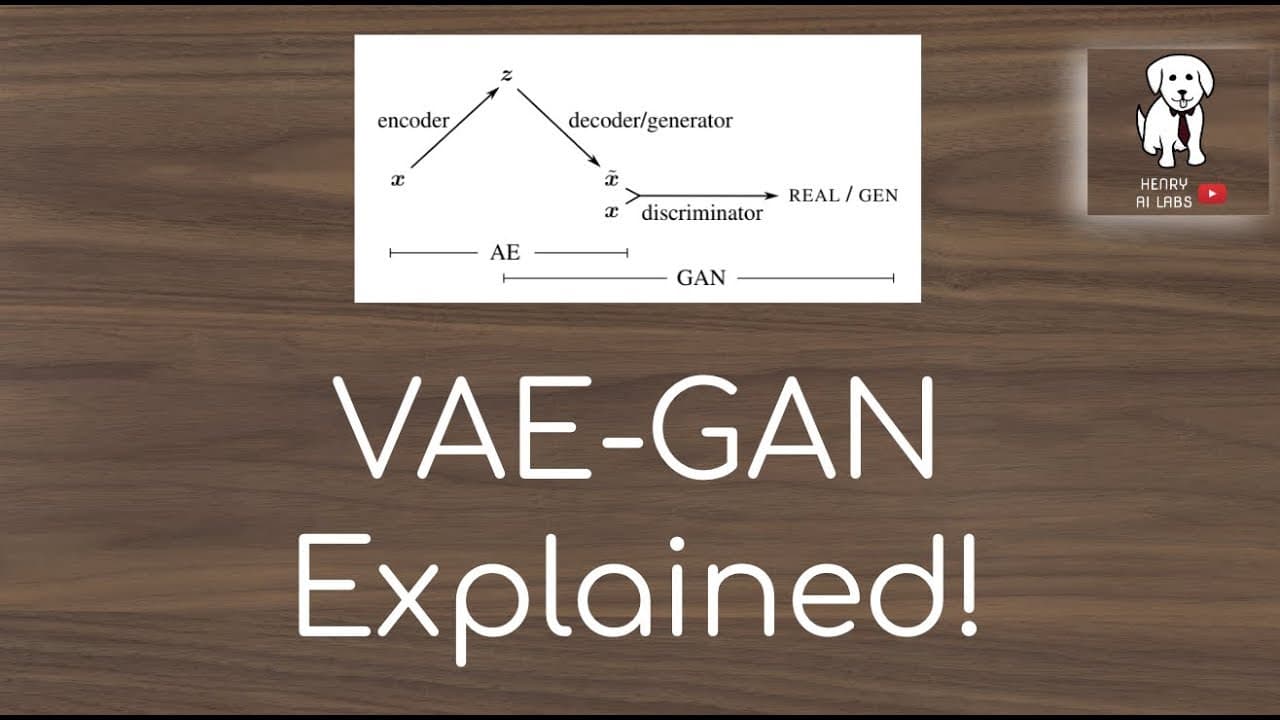
This video explains variational autoencoders and their integration with GANs.
Transcript
he's watching Henry AI labs this video will explain the variational auto encoder again known as the VA he can framework the high-level motivation is that auto encoder has taken an input image and then encode them with neural networks into a low dimensional vector representation they then have a different neuron that were called the decoder that tak... Read More
Key Insights
- 😘 Variational autoencoders encode images into low-dimensional vectors and are designed for better generative modeling compared to standard autoencoders.
- 👻 The integration of GANs allows for a more sophisticated training approach, incorporating both generative and discriminative elements to improve image reconstruction.
- 😥 The training loss functions in VAEs focus on clustering data points in latent space to promote Gaussian distribution, enhancing generative performance.
- 🏆 The CelebA dataset is particularly suitable for testing generative models due to its size and uniformity, yielding reliable results.
- 👾 The unique encoding method of VAEs enables smoother transitions and interpolation in the latent space, facilitating innovative generative applications.
- 😑 Future work on enhancing VAE architecture may involve the use of modern techniques like Siamese networks or advanced classification features from pre-trained models.
- 🥺 The study emphasizes potential trade-offs in using discriminator features, as implementing them can sometimes lead to worse performance.
Install to Summarize YouTube Videos and Get Transcripts
Explore YouTube Video Summarizer or Get YouTube Transcript Extractor
Questions & Answers
Q: What is the primary purpose of a variational autoencoder?
The primary purpose of a variational autoencoder (VAE) is to encode input images into low-dimensional vector representations while allowing for efficient reconstruction of the original images. Unlike traditional autoencoders, VAEs aim to learn a distribution over the latent space, improving generative capabilities and semantic understanding.
Q: How does the VAE framework differ from standard autoencoders?
The VAE framework differs from standard autoencoders in that it maps input images to a Gaussian space rather than a direct point in the latent vector space. It outputs parameters for a Gaussian distribution, allowing for better interpolation properties and a more structured encoding of data in low dimensional vectors.
Q: What role does the discriminator play in the variational autoencoder-generate adversarial network (VAE-GAN)?
In the VAE-GAN framework, the discriminator evaluates the generated images against original images, assisting in the training process. It helps to optimize the reconstruction through intermediate feature comparison and classifies images as real or fake, enhancing the quality of generative outputs.
Q: Can you explain the loss functions utilized during the training of VAEs?
The training of VAEs involves three primary loss functions: the prior loss which enforces the encoded latent space to align with a standard normal distribution using KL divergence; a reconstruction loss comparing original and generated images via intermediate features; and the GAN loss, which assesses the discriminator's classification of the generated images as real or fake.
Q: What advantages do variational autoencoders offer for generative modeling?
Variational autoencoders provide advantages for generative modeling through their structured latent space and the ability to sample from a distribution, enabling smoother interpolation and better capture of underlying data characteristics. This allows for the generation of new images or variations based on learned representations.
Q: What dataset was utilized to test the VAE-GAN model, and why is it appropriate?
The CelebA dataset was used to test the VAE-GAN model, primarily due to its large size and uniformity, containing 203,000 centered images of faces with binary attributes. This dataset is ideal for generative models as it simplifies the task of reconstructing and generating facial images.
Q: What potential future improvements are suggested for the VAE-GAN architecture?
The video suggests potential improvements such as replacing the intermediate feature loss with a Siamese network approach, which would require labeled data. Additionally, exploring the use of features from established models like ResNet trained on ImageNet could enhance the performance of the VAE-GAN framework.
Q: How was the performance of the VAE-GAN model compared to standard VAEs?
The performance of the VAE-GAN model was notably better than that of standard VAEs in terms of reconstruction quality. The VAE-GAN demonstrated significant improvements in reconstructing images from the test set, showcasing its enhanced generative capabilities through the adversarial training process.
Summary & Key Takeaways
-
The video provides a detailed overview of variational autoencoders (VAEs) and their function in encoding images into low-dimensional vector representations, followed by reconstruction using neural networks.
-
It introduces the enhancements brought by generative adversarial networks (GANs), which utilize a generator and discriminator framework to achieve more semantic loss functions compared to traditional pixel-wise distance metrics.
-
The discussion highlights key differences between traditional autoencoders and VAEs, focusing on the use of Gaussian space for encoding and the implications for generative modeling.
Read in Other Languages (beta)
Share This Summary 📚
Summarize YouTube Videos and Get Video Transcripts with 1-Click
Try YouTube Summary with ChatGPT & Claude or YouTube Transcript Generator
Explore More Summaries from Connor Shorten 📚
Summarize YouTube Videos and Get Video Transcripts with 1-Click
Try YouTube Summary with ChatGPT & Claude or YouTube Transcript Generator