Class 11: Generic Rigidity
TL;DR
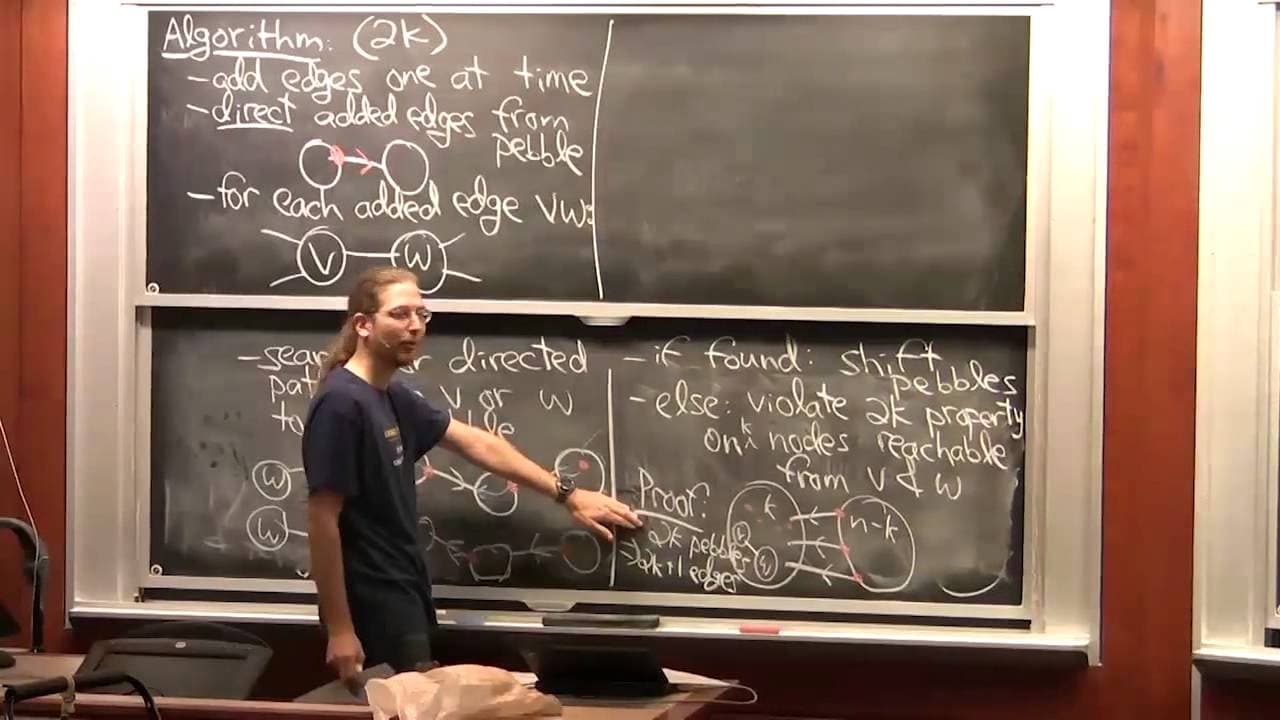
The pebble algorithm is used to determine the generic rigidity of linkages by checking the 2k property, and it can also be modified to check the 2k minus 3 property.
Transcript
PROFESSOR: All right, so lecture 11 was about generic rigidity of linkages. So we've got bars and vertices connected together in a graph. And generically, the graph is all that matters. And we characterize in two ways, Henneberg construction and Laman when graphs are generically rigid. And in particular, there was this pebble algorithm that was sup... Read More
Key Insights
- ✅ The pebble algorithm can be used to determine the generic rigidity of linkages by checking the 2k property.
- 📈 The algorithm can also be modified to check the 2k minus 3 property, which is part of Laman's Theorem for generically rigid graphs.
- #️⃣ The algorithm has a time complexity of O(ve), where v is the number of vertices and e is the number of edges in the graph.
Install to Summarize YouTube Videos and Get Transcripts
Explore YouTube Video Summarizer or Get YouTube Transcript Extractor
Questions & Answers
Q: How does the pebble algorithm determine the generic rigidity of linkages?
The pebble algorithm determines the generic rigidity by checking the 2k property, which states that every k vertices induce at most 2k edges.
Q: How does the algorithm check the 2k minus 3 property?
The algorithm can be modified to check the 2k minus 3 property by quadrupling each edge and then removing three copies, and it then checks if the remaining edges satisfy the 2k property.
Q: Can the algorithm be used for different values of k?
Yes, the algorithm can be modified to check different properties by changing the value of k in the 2k property.
Q: Are there any faster algorithms available?
The algorithm described in the lecture has a time complexity of O(ve), but there may be faster algorithms available to solve the same problem.
Summary & Key Takeaways
-
The lecture discusses the use of the pebble algorithm to determine the generic rigidity of linkages using the 2k property.
-
The algorithm involves adding edges one at a time and searching for directed paths to free pebbles to cover the edges.
-
The algorithm can be modified to check the 2k minus 3 property by adding three extra copies of each edge and then removing them if needed.
Read in Other Languages (beta)
Share This Summary 📚
Summarize YouTube Videos and Get Video Transcripts with 1-Click
Try YouTube Summary with ChatGPT & Claude or YouTube Transcript Generator
Explore More Summaries from MIT OpenCourseWare 📚


Summarize YouTube Videos and Get Video Transcripts with 1-Click
Try YouTube Summary with ChatGPT & Claude or YouTube Transcript Generator