S11.1 Simulation
TL;DR
Simulation is used to analyze probabilistic phenomena by generating random samples and evaluating statistical properties, and random number generators provide a starting point for generating random variables according to desired distributions.
Transcript
Simulation is an important tool in the analysis of probabilistic phenomena. For example, suppose that X, Y, and Z are independent random variables, and you're interested in the statistical properties of this random variable. Perhaps you can find the distribution of this random variable by solving a derived distribution problem, but sometimes this i... Read More
Key Insights
- 🔨 Simulation is a valuable tool for analyzing probabilistic phenomena when solving derived distribution problems is not possible.
- 😥 Random number generators in computers provide a starting point for generating random variables according to desired distributions.
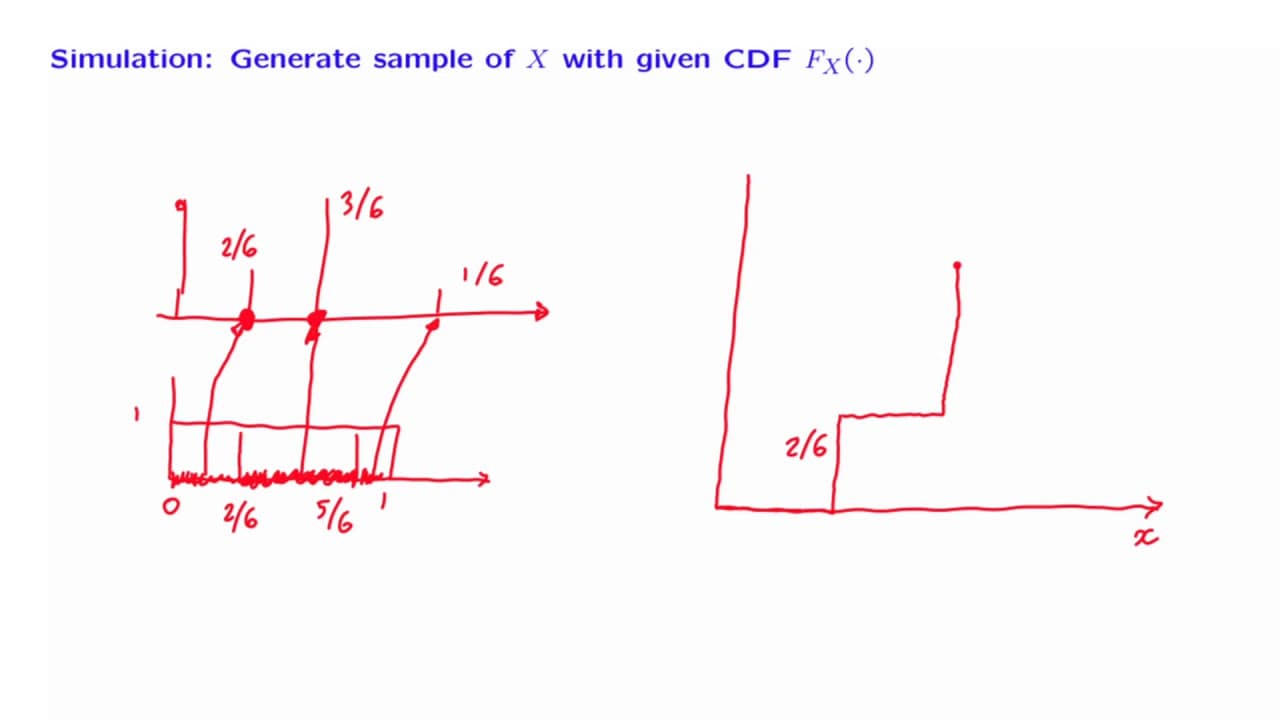
- 🧡 In the discrete case, random samples can be generated by dividing the range of the uniform random variable based on the probabilities of the discrete values.
- 🪗 In the continuous case, the inverse function of the CDF can be used to generate random variables according to a desired distribution.
- ❓ The generated random variables have the correct distribution properties as verified by their resulting CDF.
- 🥋 The formula for generating random variables from a uniform distribution varies depending on the desired distribution, such as the exponential distribution.
- 👻 Simulation allows for the evaluation of statistical properties without the need for analytical solutions.
Install to Summarize YouTube Videos and Get Transcripts
Explore YouTube Video Summarizer or Get YouTube Transcript Extractor
Questions & Answers
Q: What is the purpose of simulation in the analysis of probabilistic phenomena?
Simulation allows us to evaluate the statistical properties of a random variable when solving derived distribution problems is not feasible. By generating random samples and evaluating a function on those samples, we can gain insights into the statistical properties.
Q: What is the starting point for generating random variables according to desired distributions?
Typically, computers have random number generators that generate values drawn from a uniform distribution. These uniform random variables can be transformed into random variables according to other distributions using an appropriate function.
Q: How can random samples of a discrete distribution be generated?
To generate random samples of a discrete distribution, the range of the uniform random variable can be divided into intervals based on the probabilities of the discrete values. The corresponding value is reported based on which interval the uniform random variable falls into.
Q: How can random samples of a continuous distribution be generated?
In the continuous case, the inverse function of the cumulative distribution function (CDF) is used to generate random variables. A uniform random variable is generated, and then using the inverse function, the corresponding value is obtained on the horizontal axis.
Summary & Key Takeaways
-
Simulation is an important tool for analyzing probabilistic phenomena, especially when solving derived distribution problems is impossible.
-
To generate random samples of a known distribution, uniform random variables can be used as a starting point.
-
In the discrete case, random samples of a discrete distribution can be generated by dividing the range of the uniform random variable based on the probabilities of the discrete values.
-
In the continuous case, the inverse function of the cumulative distribution function (CDF) can be used to generate random variables according to a desired distribution.
Read in Other Languages (beta)
Share This Summary 📚
Summarize YouTube Videos and Get Video Transcripts with 1-Click
Try YouTube Summary with ChatGPT & Claude or YouTube Transcript Generator
Explore More Summaries from MIT OpenCourseWare 📚



Summarize YouTube Videos and Get Video Transcripts with 1-Click
Try YouTube Summary with ChatGPT & Claude or YouTube Transcript Generator