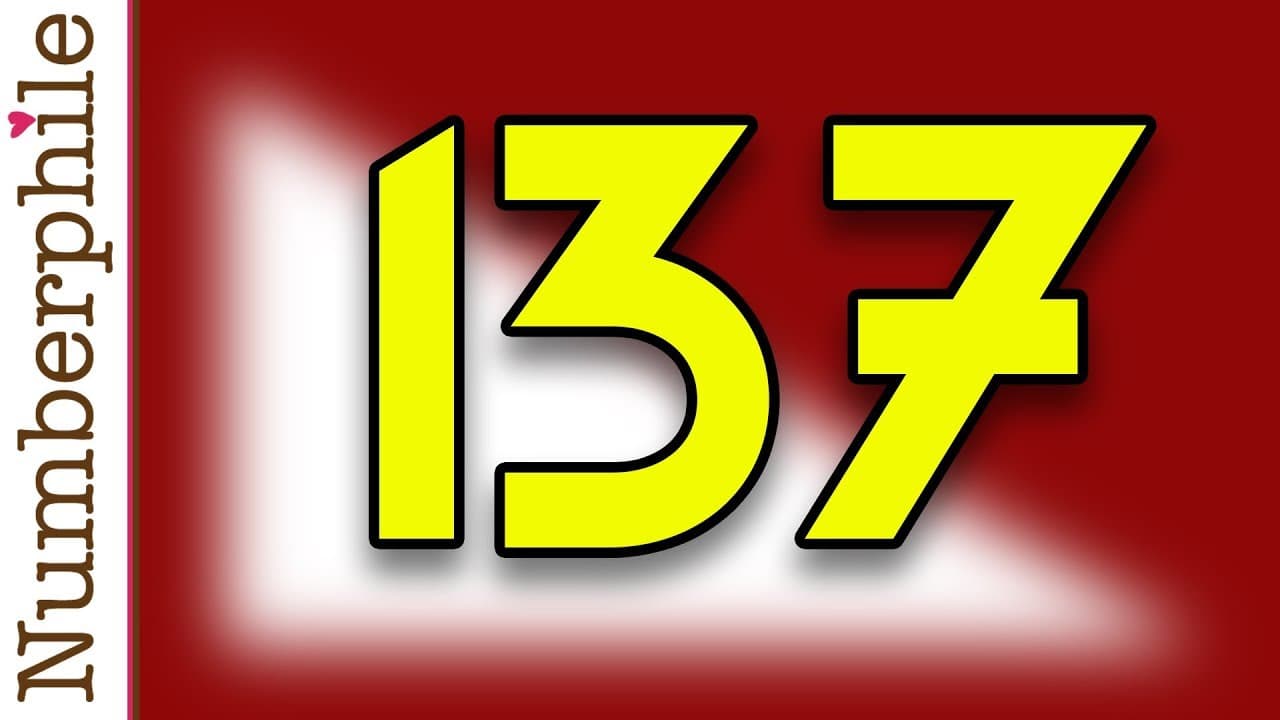
5, 13 and 137 are Pythagorean Primes - Numberphile
TL;DR
- Exploring the concept of Pythagorean primes through mathematical examples and their relation to birthdays.
Transcript
LAURENCE EAVES: Right. Well, I was born on May, which is the fifth month, and on the 13th day of May. Mathematically, that's vaguely interesting because these are both Pythagorean primes. Right, OK. Well, if we look at 5, then we can write 5 as the sum of two squares. So 1 squared plus 2 squared is equal to 5. Now if we take 13-- see if we can work... Read More
Key Insights
- 🍹 Pythagorean primes are numbers that can be represented as the sum of two squares, demonstrating mathematical patterns.
- 🖐️ The Pythagorean Theorem plays a crucial role in generating Pythagorean primes from integers.
- 💁 Certain values of 'n' result in Pythagorean primes, showcasing the specific configurations required for their formation.
- #️⃣ The fascination with the number 137 as a Pythagorean prime highlights its significance in physics and math.
- #️⃣ Understanding the concept of Pythagorean primes involves exploring number theory and unique numerical patterns.
- 💅 Pythagorean primes offer insights into the mathematical beauty and elegance found in number theory.
- 🥳 The connection between birthdays and Pythagorean primes adds a personal touch to the exploration of mathematical concepts.
Install to Summarize YouTube Videos and Get Transcripts
Explore YouTube Video Summarizer or Get YouTube Transcript Extractor
Questions & Answers
Q: How are Pythagorean primes defined and what makes them unique?
Pythagorean primes are numbers that can be expressed as the sum of two squares, showcasing mathematical patterns. They are unique due to their special mathematical properties.
Q: How does the Pythagorean Theorem relate to Pythagorean primes?
The Pythagorean Theorem states that in a right triangle, the square of the hypotenuse equals the sum of the squares of the other two sides, which ties into how Pythagorean primes are generated.
Q: What role do integers play in generating Pythagorean primes?
Integers are used to generate Pythagorean primes through specific formulas, showcasing how these primes can be derived from numerical patterns.
Q: Why do certain values of 'n' result in Pythagorean primes while others do not?
Specific values of 'n' generate Pythagorean primes, as seen with examples like 13, 17, and 137, showcasing the selective nature of the configurations for these primes.
Summary & Key Takeaways
-
The concept of Pythagorean primes is discussed, where numbers can be represented as the sum of squares, showcasing mathematical patterns.
-
The Pythagorean Theorem is explained in relation to Pythagorean primes and their generation through integers.
-
The significance of Pythagorean primes in mathematics, particularly in representing numbers uniquely, is highlighted.
Read in Other Languages (beta)
Share This Summary 📚
Summarize YouTube Videos and Get Video Transcripts with 1-Click
Try YouTube Summary with ChatGPT & Claude or YouTube Transcript Generator
Explore More Summaries from Numberphile 📚



Summarize YouTube Videos and Get Video Transcripts with 1-Click
Try YouTube Summary with ChatGPT & Claude or YouTube Transcript Generator