What Is Powell's Pi Paradox and Its Indian Solution?

TL;DR
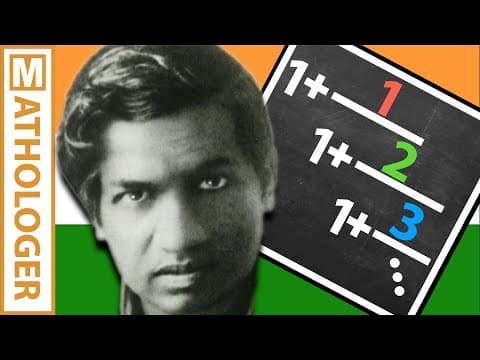
Powell's Pi Paradox illustrates that, despite summing over a million terms of a series for Pi, only a few digits match due to slow convergence. Indian mathematicians, particularly Madhava of Sangamagrama, developed correction terms that significantly enhance the series, leading to faster and more accurate approximations of Pi, thus resolving the paradox.
Transcript
Welcome to another Mathologer video. Today’s mission is to make sense of Powell’s Pi Paradox. Never heard of it? Trust me, it’s a good one:) Also, the main tools that I’ll be using to resolve this paradox are some amazing bits of half-forgotten medieval mathematics discovered by Indian mathematicians more than 600 years ago. Lots to look... Read More
Key Insights
- 🍉 Indian mathematicians, including Madhava of Sangamagrama, discovered calculus and derived correction terms for the Pi formula.
- 🍉 The correction terms greatly improved the convergence and accuracy of Pi approximations.
- 🍉 The patterns and coincidences in the digits of the Pi formula are explained by the correction terms.
- ⌛ The Indian discoveries were overlooked for a long time, but they demonstrate advanced knowledge and contributions to mathematics.
Install to Summarize YouTube Videos and Get Transcripts
Explore YouTube Video Summarizer or Get YouTube Transcript Extractor
Questions & Answers
Q: What is Powell's Pi paradox?
Powell's Pi paradox refers to the slow convergence of the Pi formula without a circle, despite adding a large number of terms.
Q: How did Indian mathematicians contribute to understanding the Pi paradox?
Indian mathematicians, such as Madhava, discovered patterns and correction terms that significantly improved the convergence of the Pi formula and explained the paradox.
Q: Why were the Indian discoveries overlooked for a long time?
The Indian discoveries were overshadowed by later Western mathematicians like Leibniz and Newton, and the original Indian texts were lost or not widely recognized.
Q: How did Madhava and his disciples derive the correction terms?
Madhava and his disciples used intricate calculus techniques, including power series expansions and advanced derivatives and integrals, to derive the correction terms.
Q: How did the correction terms affect the approximations of Pi?
The correction terms greatly improved the accuracy of Pi approximations, allowing for better agreement with Pi's digits and faster convergence.
Q: Are there infinite correction terms?
While the Indian mathematicians discovered a sequence of correction terms, only the first few were documented, possibly because they provided the simplest and most beautiful Pi formulas.
Q: How did the correction terms relate to the paradoxical behavior of Pi?
The correction terms accounted for the patterns and coincidences observed in the digits of the Pi formula, explaining why some digits repeated and others deviated.
Q: What is the significance of the Indian mathematicians' discoveries?
The Indian mathematicians' discoveries predated similar Western developments in calculus by hundreds of years, demonstrating their advanced knowledge and contributions to mathematics.
Summary & Key Takeaways
-
The Pi formula without a circle can be derived from the odd numbers, but its slow convergence is disappointing.
-
Ancient Indian mathematicians, including Madhava of Sangamagrama, discovered calculus and patterns in the Pi formula, leading to faster convergence.
-
The correction terms derived from the Indian discoveries greatly improve the approximations of Pi and explain the paradoxical behavior.
Read in Other Languages (beta)
Share This Summary 📚
Summarize YouTube Videos and Get Video Transcripts with 1-Click
Try YouTube Summary with ChatGPT & Claude or YouTube Transcript Generator
Explore More Summaries from Mathologer 📚




Summarize YouTube Videos and Get Video Transcripts with 1-Click
Try YouTube Summary with ChatGPT & Claude or YouTube Transcript Generator