Meta Pseudo Labels
TL;DR
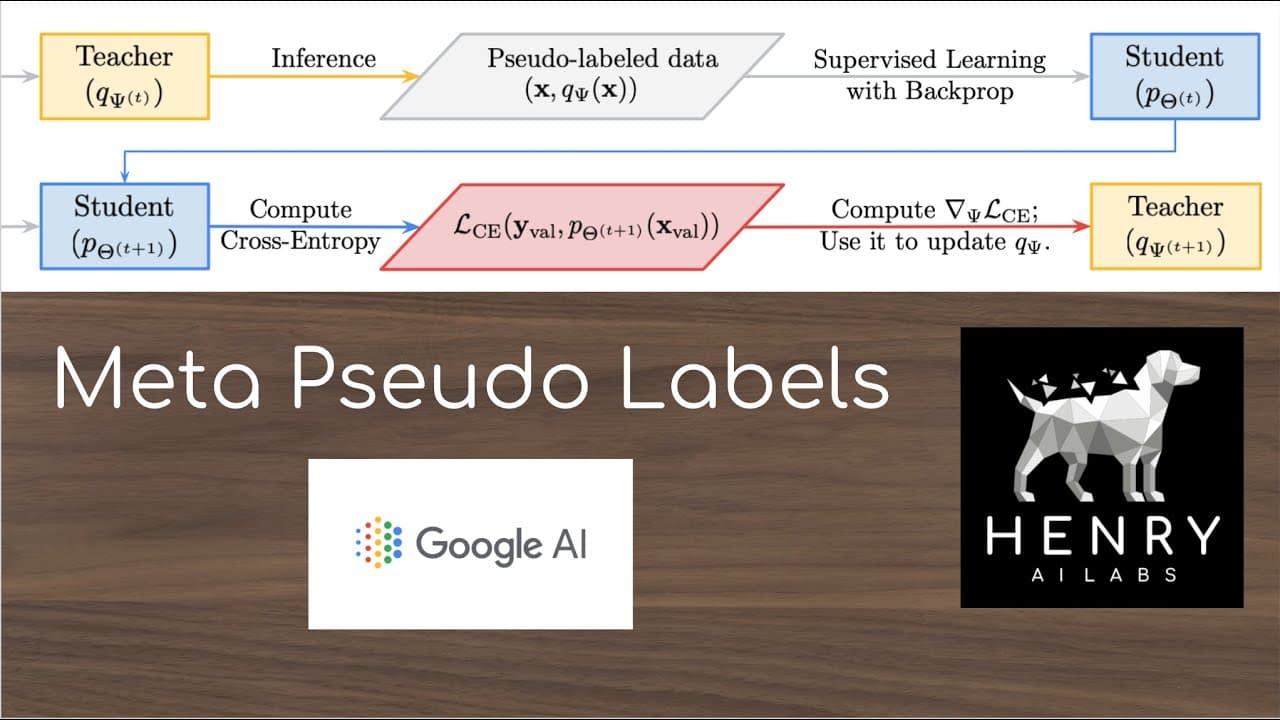
Meta pseudo labels improve neural network training through adaptive label distribution from a teacher model.
Transcript
supervised learning updates the parameters of a neural network to match predicted class labels with the ground truth labels the construction of these ground truth class vectors is typically done with one hot encoding but other techniques such as label smoothing and knowledge distillation have been developed to overcome the limitations of one hot en... Read More
Key Insights
- 🏷️ Meta pseudo labels redefine the relationship between ground truth and model predictions, allowing for more flexibility in label distribution during training.
- 🧑🎓 The teacher-student paradigm helps to create adaptive learning scenarios that continuously refine the understanding of class distributions.
- ❓ Employing techniques like gradient through a gradient enables sophisticated training methods that can optimize model parameters in complex neural networks.
- 🤗 The reduction of memory bottlenecks opens pathways for using powerful networks in a more efficient manner, enhancing practical applications of meta learning.
- 👻 The ability to dynamically adjust target distributions allows models to perform better in both labeled and unlabeled settings, addressing real-world data challenges.
- 🤘 Experiments showed significant accuracy improvements on datasets like CIFAR-10 and ImageNet, underlining the effectiveness of the meta learning approach.
- 🤘 Meta pseudo labels represent a novel intersection of techniques in both supervision and unsupervised learning, showcasing versatility in handling diverse data problems.
Install to Summarize YouTube Videos and Get Transcripts
Explore YouTube Video Summarizer or Get YouTube Transcript Extractor
Questions & Answers
Q: What is the role of the teacher network in meta pseudo labels?
The teacher network generates pseudo label distributions based on the training data, which the student network learns from. The teacher adapts the labels during training to reflect the student's understanding, ultimately aiming to maximize the accuracy of the student on validation data. This dynamic adjustment helps mitigate overconfidence issues seen in one-hot encoding by allowing more nuanced predictions.
Q: How does label smoothing help in training neural networks?
Label smoothing introduces uniform weights across all possible class labels, preventing the model from making overconfident predictions. By applying a small penalty for predicting unlikely classes, it encourages the model to maintain probabilistic responses rather than hard, definitive class predictions, which can lead to overfitting and reduced generalization capabilities.
Q: Why is memory consumption a concern in the meta pseudo labels framework?
Training two high-capacity models – the teacher and student networks – simultaneously can lead to significant memory demands. To address this, the framework suggests initially training a larger teacher model and then switching to a smaller model for ongoing label adjustments, thereby optimizing memory usage while still leveraging the benefits of a complex model for classification tasks.
Q: What are the advantages of applying meta pseudo labels in semi-supervised learning?
Meta pseudo labels enhance semi-supervised learning by effectively using large amounts of unlabeled data. By generating meaningful pseudo labels, the framework maximizes the utility of both labeled and unlabeled data, improving model accuracy. It particularly shines in scenarios with noisy or out-of-distribution data, demonstrating considerable gains in performance over traditional methods.
Summary & Key Takeaways
-
Meta pseudo labels utilize a teacher-student framework, where a teacher network generates pseudo labels that guide the student network during training, improving class distribution accuracy.
-
The framework addresses limitations of one-hot encoding in supervised learning by dynamically adjusting target distributions using techniques like label smoothing and knowledge distillation.
-
High performance on standard datasets like ImageNet is achieved through adapting to pseudo labels, enabling semi-supervised learning strategies alongside leveraging unlabeled data effectively.
Read in Other Languages (beta)
Share This Summary 📚
Summarize YouTube Videos and Get Video Transcripts with 1-Click
Try YouTube Summary with ChatGPT & Claude or YouTube Transcript Generator
Explore More Summaries from Connor Shorten 📚
Summarize YouTube Videos and Get Video Transcripts with 1-Click
Try YouTube Summary with ChatGPT & Claude or YouTube Transcript Generator