What Is the Sum Product Problem in Geometry?
TL;DR
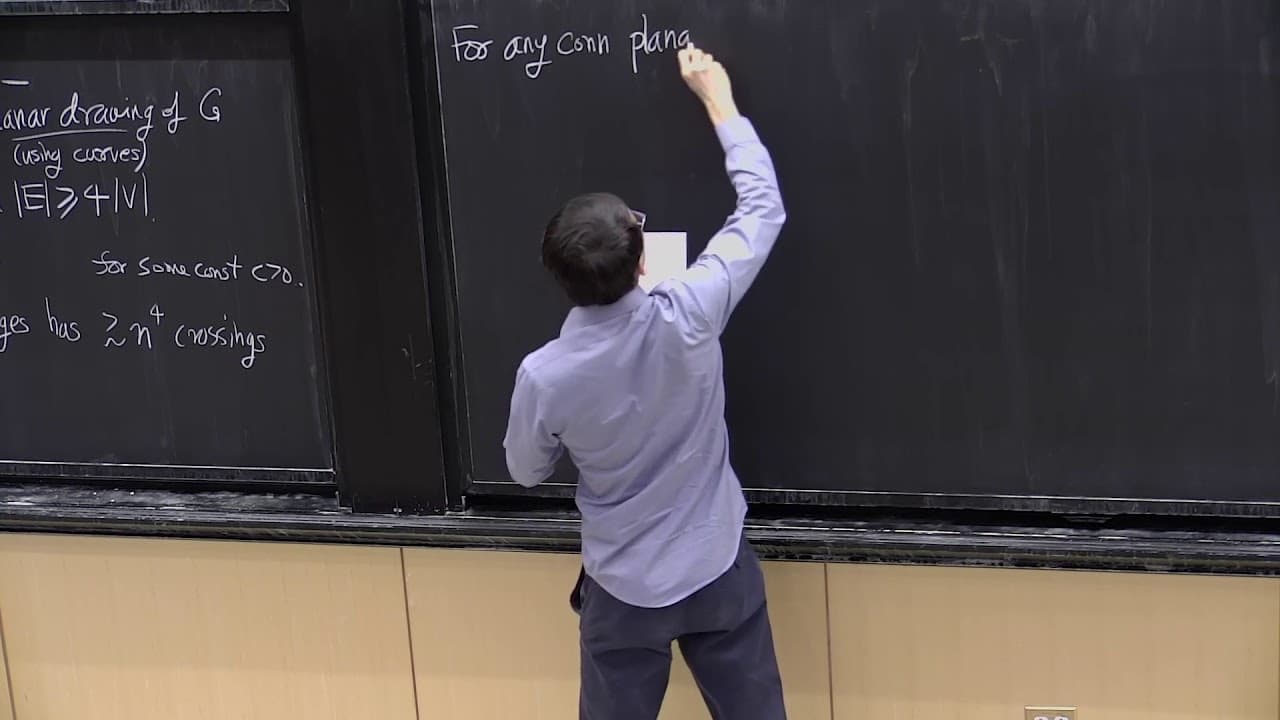
The Sum Product Problem explores how sets behave under addition and multiplication. It posits that either the sum set or the product set of a finite set of real numbers must approach quadratic size, as speculated by the Erdos similarity conjecture. Tools such as the crossing number inequality and Szemeredi-Trotter theorem are key in analyzing this problem.
Transcript
YUFEI ZHAO: Today we want to look at the sum product problem. So for the past few lectures, we've been discussing the structure of sets under the addition operation. Today we're going to throw in one extra operation, so multiplication, and understand how sets behave under both addition and multiplication. And the basic problem here is, can it be th... Read More
Key Insights
- 😵 The sum product problem can be approached using tools from incidence geometry, such as the crossing number inequality and Szemeredi-Trotter theorem.
- 😘 Lower bounds for the sum product problem can be obtained by analyzing the multiplicative energy of a set.
- 🤗 The Erdos similarity conjecture is still an open problem in the field.
- 🥺 The connections between graph theory, additive combinatorics, and other areas of mathematics are significant and lead to deep results.
Install to Summarize YouTube Videos and Get Transcripts
Explore YouTube Video Summarizer or Get YouTube Transcript Extractor
Questions & Answers
Q: What is the Erdos similarity conjecture?
The Erdos similarity conjecture states that for all finite sets of real numbers, either the sum set or the product set must be close to quadratic size.
Q: How does the crossing number inequality apply to incidence geometry problems?
The crossing number inequality provides a lower bound estimate for the number of crossings in a planar graph, which can be used to prove the Szemeredi-Trotter theorem and analyze the number of incidences between points and lines in the plane.
Q: What is the Szemeredi-Trotter theorem?
The Szemeredi-Trotter theorem gives an upper bound on the number of incidences between points and lines in the plane, based on the size of the sets involved.
Q: How can the multiplicative energy of a set be used to lower bound the sum product problem?
By analyzing the multiplicative energy, one can obtain a lower bound on the sum set size times the product set size of a set, which provides a lower bound for the sum product problem.
Summary & Key Takeaways
-
The Sum Product Problem involves the behavior of sets under both addition and multiplication.
-
The Erdos similarity conjecture states that for all finite sets of real numbers, either the sum set or the product set must be close to quadratic size.
-
The crossing number inequality provides a lower bound estimate for the number of crossings in a planar graph, which can be used for incidence geometry problems.
-
The Szemeredi-Trotter theorem gives an upper bound on the number of incidences between points and lines in the plane.
-
A lower bound for the sum product problem can be obtained by analyzing the multiplicative energy of a set.
Read in Other Languages (beta)
Share This Summary 📚
Summarize YouTube Videos and Get Video Transcripts with 1-Click
Try YouTube Summary with ChatGPT & Claude or YouTube Transcript Generator
Explore More Summaries from MIT OpenCourseWare 📚



Summarize YouTube Videos and Get Video Transcripts with 1-Click
Try YouTube Summary with ChatGPT & Claude or YouTube Transcript Generator