VidLanKD
TL;DR
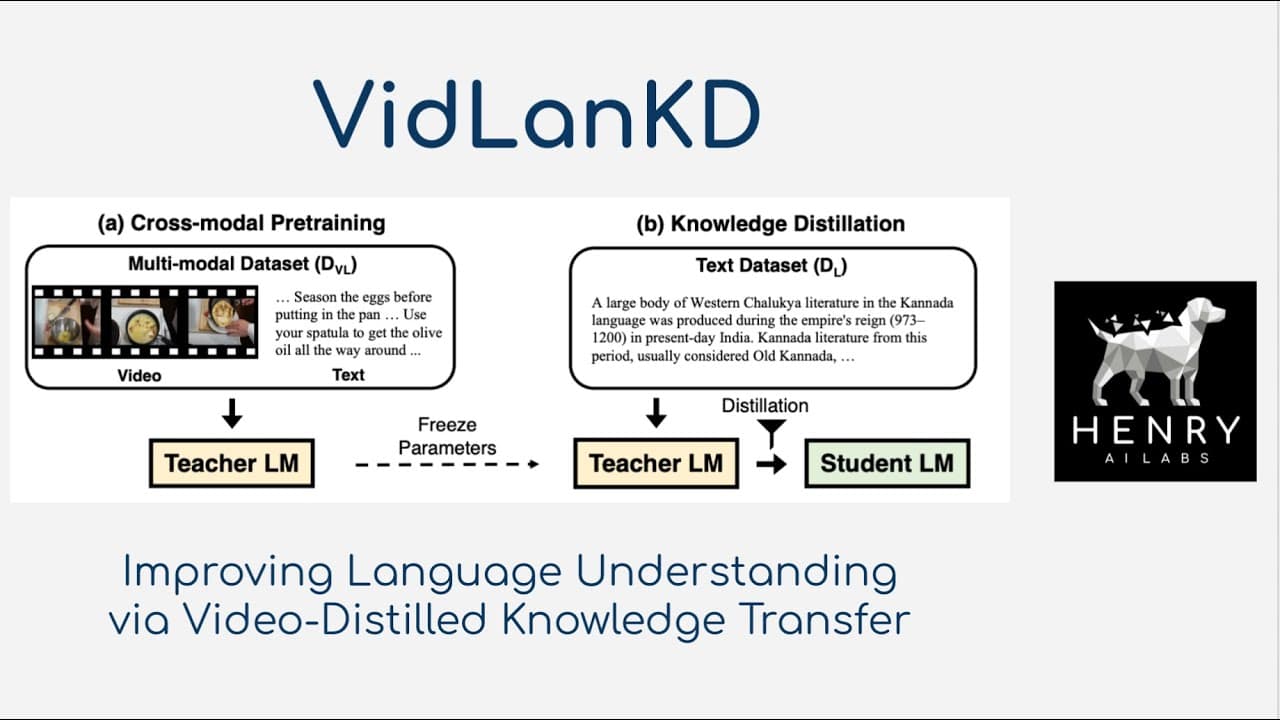
This content discusses improving language understanding through video knowledge transfer and multimodal learning techniques.
Transcript
this video will explain the paper vidland kd improving language understanding via video distilled knowledge transfer here's a quick overview of the presentation of this paper we'll start off with some general improvements in video modeling different architectures like the time s former model different self-supervised learning strategies like the vi... Read More
Key Insights
- 🤗 The integration of multimodal learning—combining video, audio, and language—has opened new avenues for advancing natural language understanding technologies.
- ✋ Techniques like self-supervised learning and contrastive learning are critical in efficiently modeling high-dimensional video data.
- 😒 The use of substantial datasets such as the "how to 100 million" provides a solid foundation for developing and training sophisticated video-based models.
- 🛟 Neuron selectivity transfer represents an innovative approach to knowledge distillation by preserving the critical activation patterns in neural networks.
- 💁 Visual grounding enhances language learning by contextualizing words and phrases with corresponding visual information, improving understanding and reasoning.
- 💝 Architectural innovations like late fusion and attention-based models contribute significantly to processing complex multimodal datasets effectively.
- 🖐️ Distillation objectives, including soft labeling and maximum mean discrepancy, play crucial roles in aligning student and teacher models for improved learning outcomes.
Install to Summarize YouTube Videos and Get Transcripts
Explore YouTube Video Summarizer or Get YouTube Transcript Extractor
Questions & Answers
Q: What are some architectural advancements in video modeling discussed in the content?
The video covers innovations such as the time s-former, which utilizes attention mechanisms across time and space, and late fusion approaches that combine separate video frame processing with advanced self-supervised learning strategies. These advancements aim to handle the high dimensionality of video data more effectively, ultimately improving language understanding.
Q: How does the "how to 100 million" dataset contribute to video learning?
This dataset contains a vast collection of video clips paired with natural language descriptions. With approximately 134,000 hours of video segmented into 136 million clips, it allows researchers to explore various visual tasks and equips models with diverse examples to strengthen their understanding of language in context, thus enhancing performance in multi-modal learning.
Q: What is the significance of visual grounding in this research?
Visual grounding links language understanding to visual inputs, enhancing the model's ability to reason about physical phenomena illustrated in videos. By leveraging video data, models can develop a deeper contextual comprehension of language concepts, as seen in tasks requiring physical reasoning based on visual observations.
Q: Can you explain the difference between the vulcanization technique and the vidlan kd algorithm?
The vulcanization technique uses visual supervision to associate image tokens with classification labels, aimed at improving natural language task performance. In contrast, the vidlan kd algorithm builds upon this by employing knowledge distillation to enhance language models through video data, tackling limitations such as finite label vocabularies while increasing the diversity and richness of language learning.
Q: What are neuron selectivity transfer and its role in knowledge distillation?
Neuron selectivity transfer focuses on transferring activation patterns from teacher to student models during knowledge distillation. It aims to replicate the teacher model's attention distributions on specific features, enhancing the student's ability to learn more meaningful representations while preserving essential patterns highlighted by the teacher.
Q: How does the contrastive representation distillation objective work?
This objective compares the similarity between the representations of the student and teacher models, enhancing the student's feature learning while contrasting against a selection of negative samples. By not relying solely on traditional cross-entropy loss, this approach efficiently captures deeper relationships in the data and improves representation learning.
Summary & Key Takeaways
-
The presentation outlines recent advancements in video modeling and self-supervised learning, emphasizing techniques such as time s-former and vimpac strategy that leverage video data for language understanding.
-
It explores visual grounding concepts, using examples like the vulcanization paper, highlighting how visual representations can bolster language processing tasks and thereby improve natural language understanding.
-
The discussion includes the significant "how to 100 million" dataset, showcasing its large-scale statistics and the role of visual and textual data in enhancing multimodal learning efficiency.
Read in Other Languages (beta)
Share This Summary 📚
Summarize YouTube Videos and Get Video Transcripts with 1-Click
Try YouTube Summary with ChatGPT & Claude or YouTube Transcript Generator
Explore More Summaries from Connor Shorten 📚
Summarize YouTube Videos and Get Video Transcripts with 1-Click
Try YouTube Summary with ChatGPT & Claude or YouTube Transcript Generator