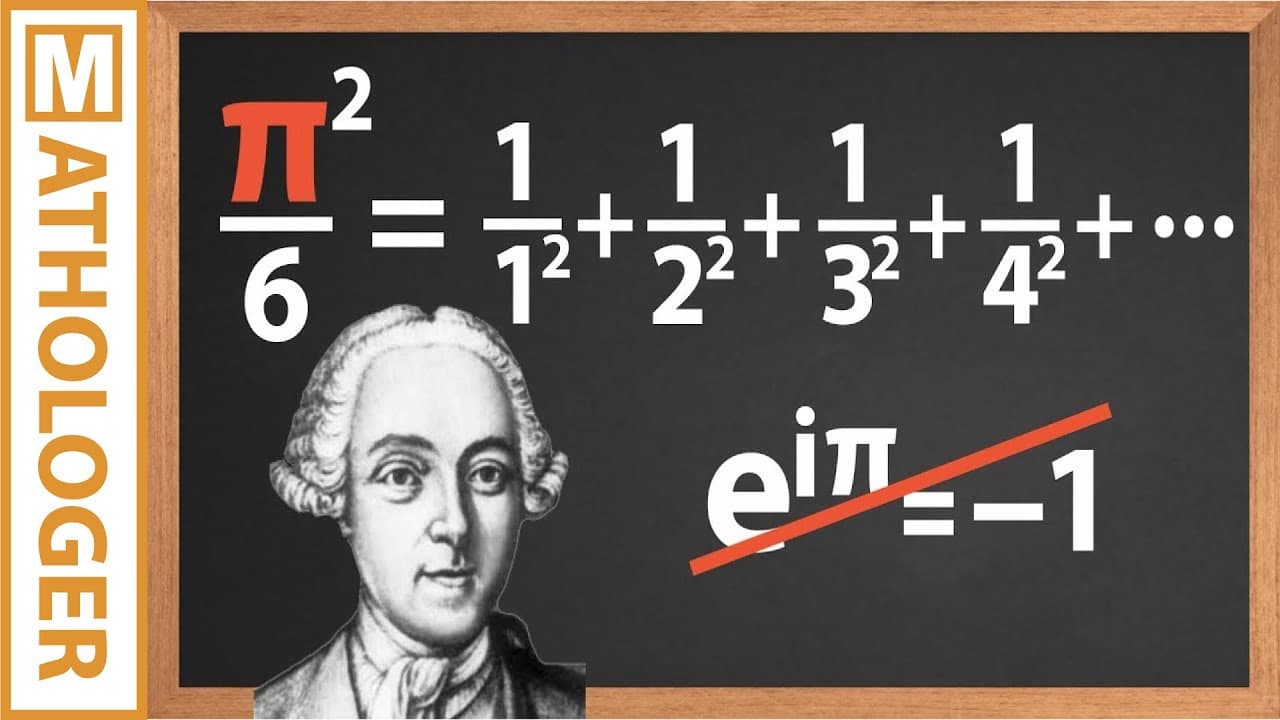
Euler's real identity NOT e to the i pi = -1
TL;DR
Euler's real identity involves the infinite sum of the reciprocals of squares, which helped him solve a problem that many mathematicians had failed to answer. The sum is also related to the Riemann zeta function and has connections to other mathematical identities.
Transcript
Welcome to another Mathologer video. Everybody who watches these videos knows Euler's identity e to the I pi is equal to minus one except it's not really Euler's identity. The mathematician Roger Cotes already wrote about it in 1714 when Euler was only seven years old. I actually find it a bit sad that people associate the math super hero Euler wit... Read More
Key Insights
- 🧍 Euler's real identity, involving the infinite sum of the reciprocals of squares, was a breakthrough in mathematics and solved a long-standing problem.
- 🤨 Euler's identity is aesthetically pleasing and involves the famous circle constant pi.
- 🖐️ The Riemann zeta function, which Euler's identity is connected to, plays a central role in the unsolved Riemann hypothesis.
- 👷 Euler's identity and method of constructing infinite polynomials provide insights into the nature of functions and their approximations with polynomials.
Install to Summarize YouTube Videos and Get Transcripts
Explore YouTube Video Summarizer or Get YouTube Transcript Extractor
Questions & Answers
Q: What is Euler's real identity?
Euler's real identity states that pi squared over six is equal to the infinite sum of the reciprocals of the squares.
Q: What problem did Euler's identity solve?
Euler's identity answered the question of whether the infinite sum of the reciprocals of the squares adds up to a nice value.
Q: What are the connections between Euler's identity and the Riemann zeta function?
Euler's identity involves the Riemann zeta function evaluated at even numbers. The Riemann zeta function is also related to the famous unsolved problem known as the Riemann hypothesis.
Q: Are there any other mathematical identities related to Euler's identity?
Yes, Euler's identity has connections to other mathematical identities, such as the Leibniz formula and the Maclaurin series of trigonometric functions.
Summary & Key Takeaways
-
Euler's real identity states that pi squared over six is equal to the infinite sum of the reciprocals of the squares.
-
Euler's identity solved a problem that many mathematicians had struggled with - determining whether the infinite sum on the right adds up to anything nice.
-
The result of Euler's identity is not only aesthetically pleasing, but it also has important connections to the Riemann zeta function and other mathematical identities.
Read in Other Languages (beta)
Share This Summary 📚
Summarize YouTube Videos and Get Video Transcripts with 1-Click
Try YouTube Summary with ChatGPT & Claude or YouTube Transcript Generator
Explore More Summaries from Mathologer 📚
Summarize YouTube Videos and Get Video Transcripts with 1-Click
Try YouTube Summary with ChatGPT & Claude or YouTube Transcript Generator