Forced Vibrations Numerical 2 - Forced Single Degree of Freedom Vibratory System
TL;DR
Solving for damping coefficient and amplitude in forced vibrations with and without a damper.
Transcript
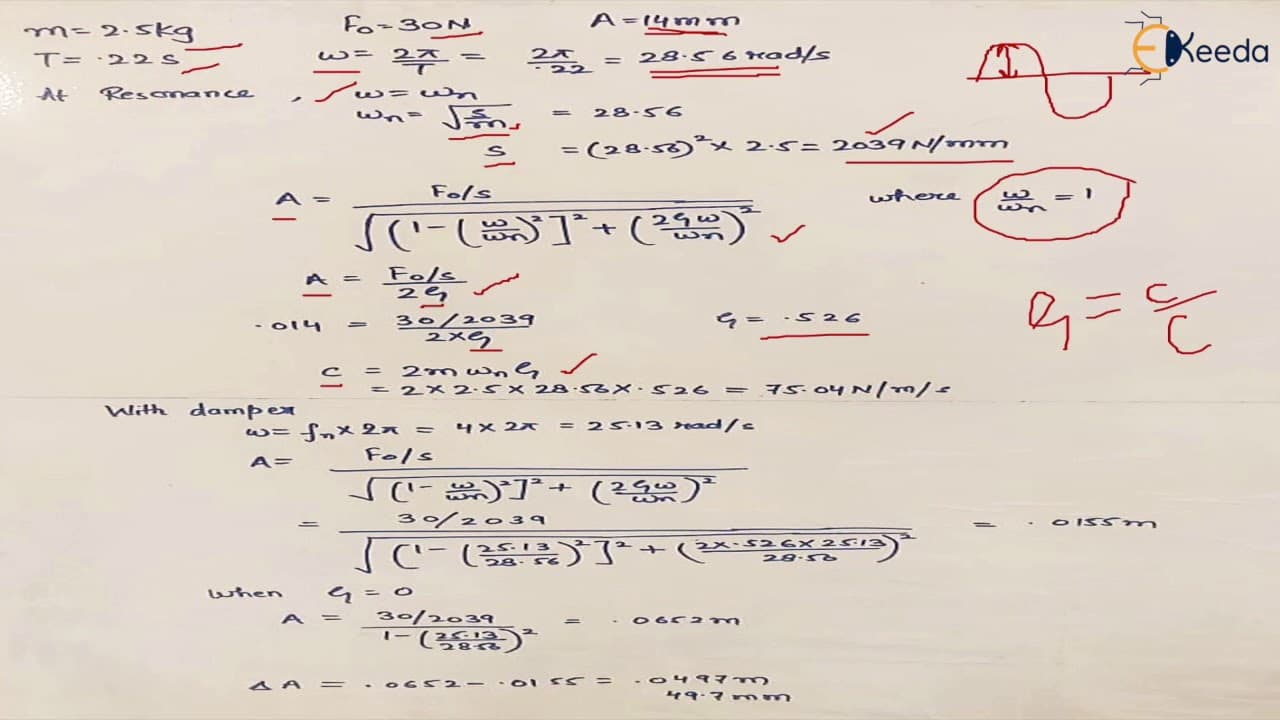
hello everyone in this video we'll discuss a numerical on forced vibration the question says that a machine part which has got a mass of 2.5 kilogram it vibrates in a viscous medium and the harmonic exciting force of 30 newton it acts on the part and causes a resonant amplitude of 14 mm with a period of 0.2 0.22 seconds so we have to find the dampi... Read More
Key Insights
- 📳 Forced vibration numerical analysis involves calculating the damping coefficient and amplitude with given parameters.
- 📳 Understanding resonance conditions helps determine specific values for vibration analysis in forced systems.
- 🖐️ Damping coefficients play a crucial role in characterizing the damping effects on system vibrations.
- 📳 The removal of a damper can significantly change the dynamics and amplitude in forced vibration systems.
- 💆 Spring stiffness, mass, and exciting forces are fundamental parameters in forced vibration analysis.
- 💼 Differentiating between damped and undamped cases provides insights into how damping affects vibration amplitudes.
- 📳 Natural frequency and excitation frequency relations impact the behavior of forced vibration systems.
Install to Summarize YouTube Videos and Get Transcripts
Explore YouTube Video Summarizer or Get YouTube Transcript Extractor
Questions & Answers
Q: How is the damping coefficient calculated in forced vibrations?
The damping coefficient in forced vibrations is determined using the formula zeta = 2mωn, where m is the mass and ωn is the natural frequency, obtained from the given parameters.
Q: What factors influence the amplitude of forced damped vibrations?
The amplitude is affected by the excitation force, natural frequency, damping coefficient, and mass of the system, all of which interact in the forced damped vibration equation.
Q: What is the significance of the resonance condition in forced vibrations?
The resonance condition occurs when the working frequency equals the natural frequency, leading to maximal vibration amplitudes and specific parameters for calculation in forced vibration analysis.
Q: How does the removal of a damper impact the amplitude in forced vibration systems?
Removing the damper changes the system's dynamics, altering the natural frequency and damping effects, resulting in a different amplitude for forced vibrations without damping.
Summary & Key Takeaways
-
Calculate damping coefficient and amplitude in forced vibration with given mass, force, and period.
-
Derive formulas for amplitude in forced damped vibrations and find damping coefficient using calculated values.
-
Determine change in amplitude when damper is removed based on calculations for two scenarios.
Read in Other Languages (beta)
Share This Summary 📚
Summarize YouTube Videos and Get Video Transcripts with 1-Click
Try YouTube Summary with ChatGPT & Claude or YouTube Transcript Generator
Explore More Summaries from Ekeeda 📚




Summarize YouTube Videos and Get Video Transcripts with 1-Click
Try YouTube Summary with ChatGPT & Claude or YouTube Transcript Generator