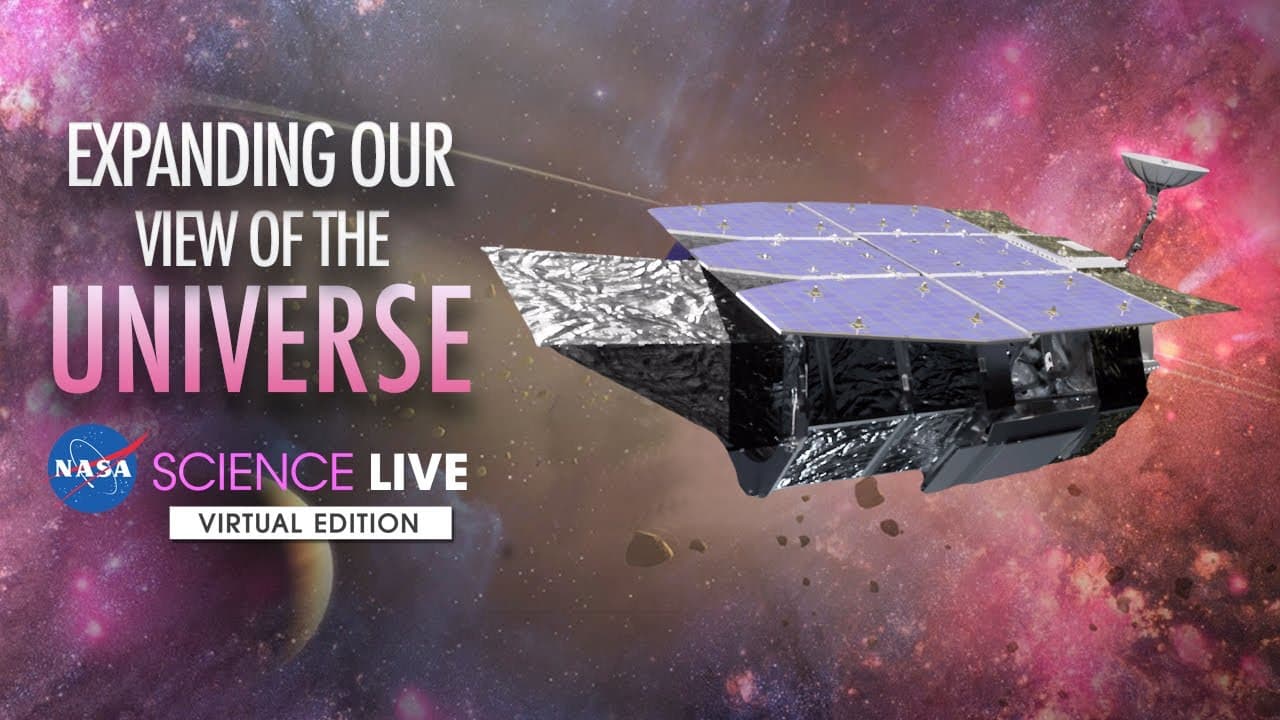
NASA Science Live: Expanding Our View of the Universe
TL;DR
NASA announces the renaming of the WFIRST mission after astronomer Nancy Grace Roman, whose contributions to the field made her a pioneer in space science. The mission will study dark energy, dark matter, and exoplanets, using a wide-field instrument and coronagraph to capture images of galaxies and planets.
Transcript
HELLO, AND WELCOME TO ANOTHER VIRTUAL EPISODE OF "NASA SCIENCE LIVE." I'M AMBER STRAUGHN, AN ASTROPHYSICIST AT NASA. ON TODAY'S EPISODE, WE'RE GONNA BE MAKING HISTORY WITH A VERY SPECIAL ANNOUNCEMENT ABOUT AN UPCOMING MISSION AT NASA, SO DON'T GO ANYWHERE. TODAY WE'RE GONNA TALK ABOUT ONE OF MY FAVORITE TOPICS, UNSOLVED MYSTERIES OF OUR UNIVERSE... Read More
Key Insights
- 🇷🇴 The Nancy Grace Roman Space Telescope is named after Nancy Grace Roman, a visionary astronomer and leader at NASA who played a crucial role in the development of the Hubble Space Telescope.
- 🕶️ The telescope will study dark energy and dark matter, which account for 95% of the universe, and search for exoplanets using advanced techniques such as microlensing and coronagraphy.
- 🏑 With its wide-field instrument, the telescope will capture images of billions of galaxies, providing valuable insights into the structure and evolution of the universe.
Install to Summarize YouTube Videos and Get Transcripts
Explore YouTube Video Summarizer or Get YouTube Transcript Extractor
Questions & Answers
Q: Who is Nancy Grace Roman, and why is the WFIRST mission being renamed after her?
Nancy Grace Roman was the first Chief of Astronomy at NASA and played a critical role in planning the Hubble Space Telescope. She was a visionary and leader in astronomy and space science. The WFIRST mission is being renamed after her to honor her significant contributions and as a recognition of her advocacy for space-based astronomy.
Q: What are the main science goals of the Nancy Grace Roman Space Telescope?
The telescope will primarily focus on the study of dark energy and dark matter, revealing their mysteries and understanding their effects on the universe. It will also search for exoplanets using the microlensing technique, directly image Neptune-sized planets, and analyze dusty disks that form planetary systems.
Q: How will the Nancy Grace Roman Space Telescope contribute to our understanding of the universe?
The wide-field instrument of the telescope will allow its images to cover a sky area 100 times larger than that of the Hubble Space Telescope. By studying billions of galaxies and their positions, distances, and shapes, the telescope will provide valuable insights into the structure and evolution of the universe. It will also expand our knowledge of exoplanets and their formation, improving our understanding of planetary systems.
Q: How will the renaming of the WFIRST mission inspire future generations, especially girls, in science and space?
Nancy Grace Roman's achievements, perseverance, and trailblazing work serve as an inspiration to young girls and aspiring scientists. By renaming the mission after her, NASA highlights her remarkable contributions, encouraging young girls to pursue careers in science, astronomy, and space exploration. Her legacy will continue to inspire generations to come.
Summary & Key Takeaways
-
NASA is renaming the WFIRST mission as the Nancy Grace Roman Space Telescope in honor of astronomer Nancy Grace Roman, who played a significant role in the development of the Hubble Space Telescope and advocated for astronomy missions from space.
-
The Nancy Grace Roman Space Telescope will study dark energy and dark matter, which make up 95% of the universe, and explore planetary arrangements like our own solar system.
-
Equipped with a wide-field instrument and a coronagraph, the telescope will capture high-resolution images of galaxies, measure their distances and positions, and also search for exoplanets orbiting other stars.
Read in Other Languages (beta)
Share This Summary 📚
Summarize YouTube Videos and Get Video Transcripts with 1-Click
Try YouTube Summary with ChatGPT & Claude or YouTube Transcript Generator
Explore More Summaries from NASA 📚
Summarize YouTube Videos and Get Video Transcripts with 1-Click
Try YouTube Summary with ChatGPT & Claude or YouTube Transcript Generator