Voltage drops | Synchronous Motors | Synchronous machine | Lec-15
TL;DR
This session covers armature reaction in synchronous motors, focusing on load effects and vector diagrams.
Transcript
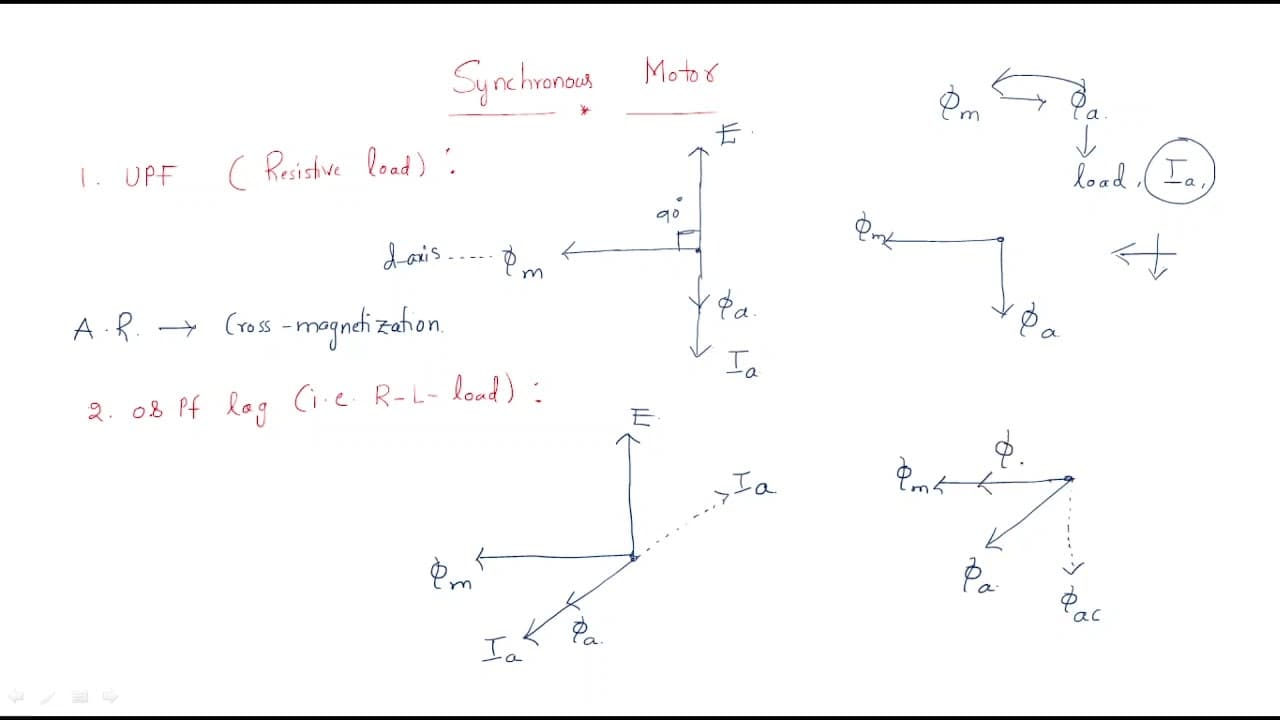
hello everyone in the last session we discussed about the armature reaction in the synchronous motor in the we have discussed about the three different different types of loads resistive load and pure inductive load and pure capacitive load now we will discuss about the synchronous motor for the synchronous motor how the armature reaction is possib... Read More
Key Insights
- 🧑🦼 The armature reaction is crucial in determining the performance of synchronous motors, especially under different loading conditions.
- ✊ Power factor significantly influences armature reaction effects, distinguishing between unity and lagging conditions.
- 💦 Voltage drops in synchronous machines are a combination of resistive, leakage reactance, and armature reaction impacts, collectively resulting in the synchronous impedance.
- 🧑🦼 The concept of synchronous reactance helps to understand the overall behavior of synchronous motors under operational conditions.
- ⚡ Understanding the vector diagram of alternators is essential for visualizing the relationships among induced EMF, terminal voltage, and load impacts.
- ✊ Synchronous motors do not generate power loss directly from armature reactions, but these reactions affect the voltage levels necessary for operation.
- 🧑🏭 The session highlights the necessity of analyzing load factors to optimize synchronous motor applications in practical environments.
Install to Summarize YouTube Videos and Get Transcripts
Explore YouTube Video Summarizer or Get YouTube Transcript Extractor
Questions & Answers
Q: What is armature reaction in a synchronous motor?
Armature reaction refers to the effect of the armature flux on the main field flux within a synchronous motor. It causes distortion in the main field and is dependent on the load current. The armature reaction can either demagnetize or enhance the flux, thus affecting motor performance.
Q: How does the load type affect armature reaction?
The armature reaction varies with the type of load connected to the synchronous motor. For a unity power factor load, it results in cross-magnetization, whereas a lagging power factor load leads to partial demagnetization and cross magnetization, impacting the motor's efficiency.
Q: What are the components of voltage drop in synchronous machines?
In synchronous machines, the voltage drop comprises three main components: resistive drop due to armature resistance, drop due to leakage reactance, and drop due to armature reaction. These collectively affect the terminal voltage and are essential for calculating the synchronous impedance.
Q: How does armature reaction influence terminal voltage?
Armature reaction influences terminal voltage by generating drops in voltage due to its interaction with the main field flux. The generated EMF must compensate for all voltage drops, including resistive and reactive components, resulting in modifications to the terminal voltage under load conditions.
Summary & Key Takeaways
-
The session discusses the armature reaction in synchronous motors, explaining how it interacts with different types of loads, including resistive, inductive, and capacitive loads.
-
It emphasizes that the armature reaction causes voltage drops and affects the main field flux direction, which can vary depending on the load power factor.
-
The content will also cover synchronous machine impedance, including expressional relationships for EMF, terminal voltage, and voltage drops due to armature current and reactance.
Read in Other Languages (beta)
Share This Summary 📚
Summarize YouTube Videos and Get Video Transcripts with 1-Click
Try YouTube Summary with ChatGPT & Claude or YouTube Transcript Generator