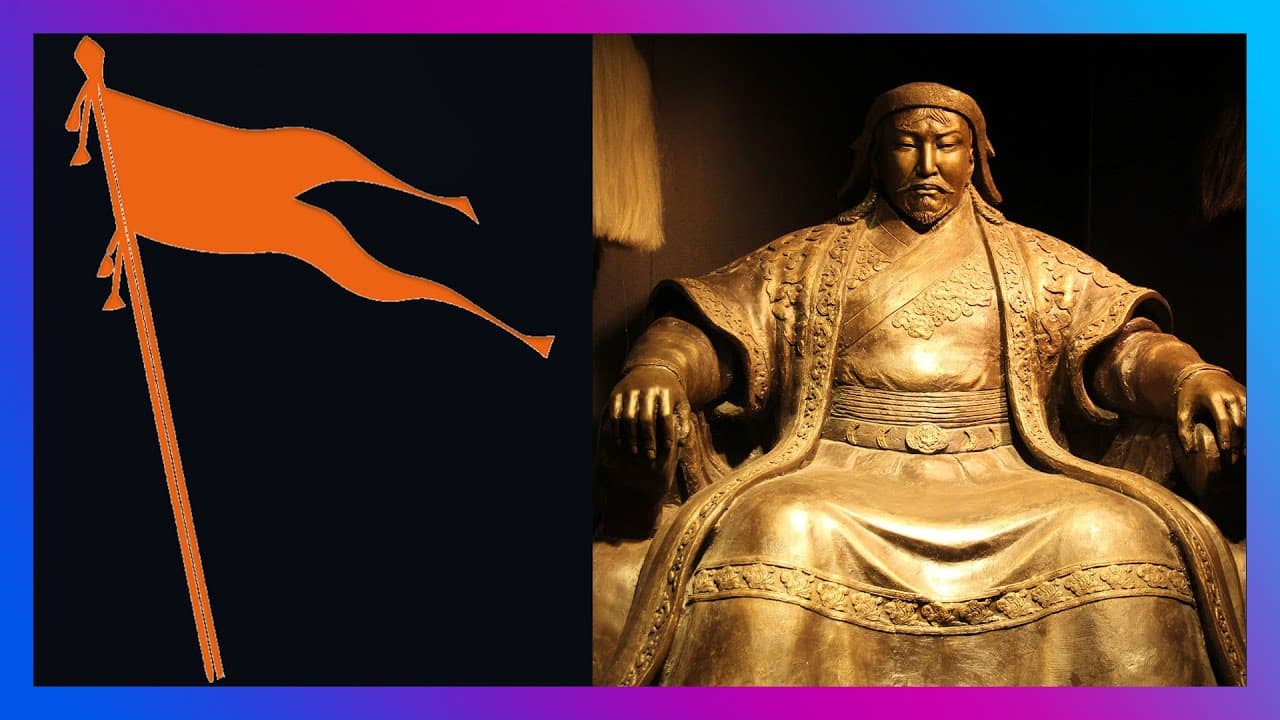
Why Genghis Khan Refused To Invade India
TL;DR
Genghis Khan chose not to invade India due to a combination of strategic reasons and potential cultural affinity, rather than being driven solely by wealth and power.
Transcript
799 years ago in the year 1221 the great mongol conqueror chinggis khan stood victorious on the western bank of the river indus with fifty thousand soldiers he had just defeated jalal deen the shah of khwaraz jalal dean's army was completely destroyed in this battle which took place near the town of kalabagh in present-day punjab across the river l... Read More
Key Insights
- ✊ Genghis Khan's invasion choices were largely driven by retaliation for perceived wrongs, rather than pure conquest for wealth and power.
- 👾 His decision not to invade India was influenced by the need to address the Chinese betrayal, lack of provocation from the ruling Mamluk dynasty, and the diminished threat from Jalaluddin.
- 😫 Genghis Khan's disregard for wealth and his prioritization of power and principles set him apart from other conquerors.
- 👹 Historical biases have contributed to the misrepresentation of Genghis Khan as a savage monster, while glorifying other conquerors.
Install to Summarize YouTube Videos and Get Transcripts
Explore YouTube Video Summarizer or Get YouTube Transcript Extractor
Questions & Answers
Q: Why did Genghis Khan choose not to invade India?
Genghis Khan's decision not to invade India was likely influenced by several factors, including the need to address the Chinese betrayal, the absence of provocation from the ruling Mamluk dynasty, and the diminished threat posed by Jalaluddin. Additionally, cultural affinities and a possible aversion to inflicting collateral damage on the Indian population may have played a role.
Q: Was Genghis Khan motivated by wealth and power?
Genghis Khan regarded wealth as a means to an end rather than an end in itself. He prioritized power and revenge, seeking to avenge perceived injustices and protect his newly unified nation. While his conquests resulted in plunder and tribute, these resources were primarily used for administration and governing the Mongol Empire.
Q: How is Genghis Khan's portrayal by historians biased?
Historians have often depicted Genghis Khan as a bloodthirsty and savage barbarian, while elevating other conquerors like Alexander, Caesar, and Napoleon. This bias stems from Western historians' discomfort with a non-European surpassing their favored leaders, as well as Islamic historians' resentment towards a non-Muslim dominating the Islamic world. India's biased historians have also marginalized Genghis Khan due to his lack of impact on the Indian subcontinent.
Q: What can we learn from Genghis Khan's life and career?
Genghis Khan's life teaches us about the power of resilience, the pursuit of justice, and the importance of understanding historical figures in context. By examining his motivations and decisions, we gain insights into leadership, national interest, and the complexities of historical narratives.
Summary & Key Takeaways
-
Genghis Khan, the great Mongol conqueror, stood victorious by defeating Jalaluddin, the Shah of Khwaraz, near the town of Kalabagh in present-day Punjab.
-
Despite the opportunity to conquer the richest country in the world, India, Genghis Khan chose to retreat and return to Mongolia.
-
Historians have speculated about the reasons behind his decision, including religious beliefs, the hot climate, and his preference for retaliatory invasions.
Read in Other Languages (beta)
Share This Summary 📚
Summarize YouTube Videos and Get Video Transcripts with 1-Click
Try YouTube Summary with ChatGPT & Claude or YouTube Transcript Generator
Explore More Summaries from Abhijit Chavda 📚


Summarize YouTube Videos and Get Video Transcripts with 1-Click
Try YouTube Summary with ChatGPT & Claude or YouTube Transcript Generator