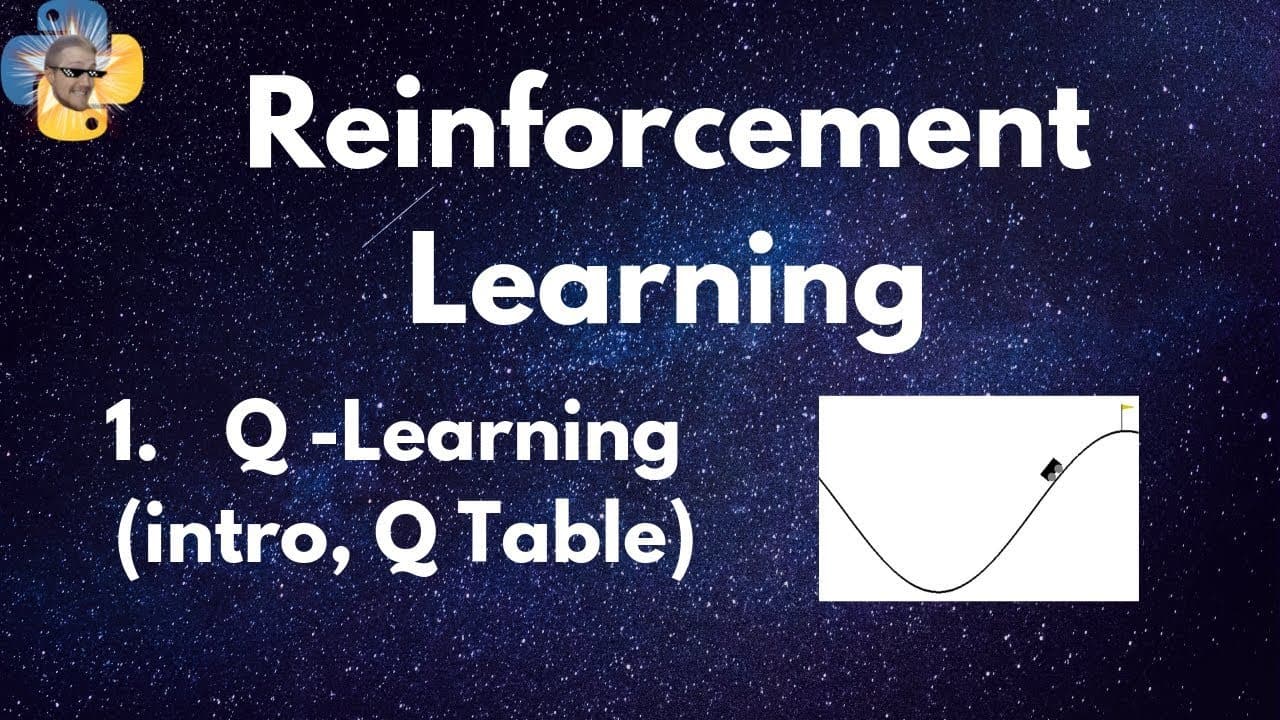
Q Learning Intro/Table - Reinforcement Learning p.1
TL;DR
Introduction to cue learning for reinforcement learning, covering cue values, rewards, and building a cue table for basic environments.
Transcript
what is going on everybody and welcome to a reinforcement learning tutorial series in this video we're going to be starting off with cue learning now every time I do a new series people are like what are the prerequisites really for any of the series there aren't any just anytime we hit a concept or topic you don't understand look it up in this cas... Read More
Key Insights
- ⛑️ Cue learning assigns cue values to actions in states for goal-directed behavior.
- 🥶 Model-free cue learning is adaptable to various environments, making it versatile.
- 👻 Initialization of the cue table with random values allows for exploration and learning.
- 👾 Discretizing observation space aids in managing memory and optimizing computation.
- ⌛ Understanding the reward structure is essential for updating cue values over time.
- 😆 Cue tables store Q values for state-action pairs to guide decision-making.
- 🥺 Exploration phase involves random actions, leading to exploitation of learned policies.
Install to Summarize YouTube Videos and Get Transcripts
Explore YouTube Video Summarizer or Get YouTube Transcript Extractor
Questions & Answers
Q: What is cue learning in reinforcement learning?
Cue learning assigns cue values to actions in a state, enabling an agent to navigate an environment towards a long-term goal. It is model-free and adaptable across different environments.
Q: How is a cue table used in reinforcement learning?
A cue table stores cue values for every possible combination of state and action, guiding the agent's decision-making process. It helps in selecting actions with the highest expected rewards.
Q: Why is initialization of the cue table important in cue learning?
Initializing the cue table with random values is crucial for exploration in the early stages of learning. Over time, the table's values are updated through agent interactions to improve decision-making.
Q: How is continuous observation data converted to discrete values in cue learning?
Continuous observation data is segmented into discrete buckets to manage memory and computation. By discretizing state values, the cue learning algorithm works efficiently in complex environments.
Summary & Key Takeaways
-
Introduction to cue learning for reinforcement learning.
-
Cue values are assigned to actions in a state to achieve long-term goals.
-
Model-free cue learning allows application across various environments.
Read in Other Languages (beta)
Share This Summary 📚
Summarize YouTube Videos and Get Video Transcripts with 1-Click
Try YouTube Summary with ChatGPT & Claude or YouTube Transcript Generator
Explore More Summaries from sentdex 📚
Summarize YouTube Videos and Get Video Transcripts with 1-Click
Try YouTube Summary with ChatGPT & Claude or YouTube Transcript Generator