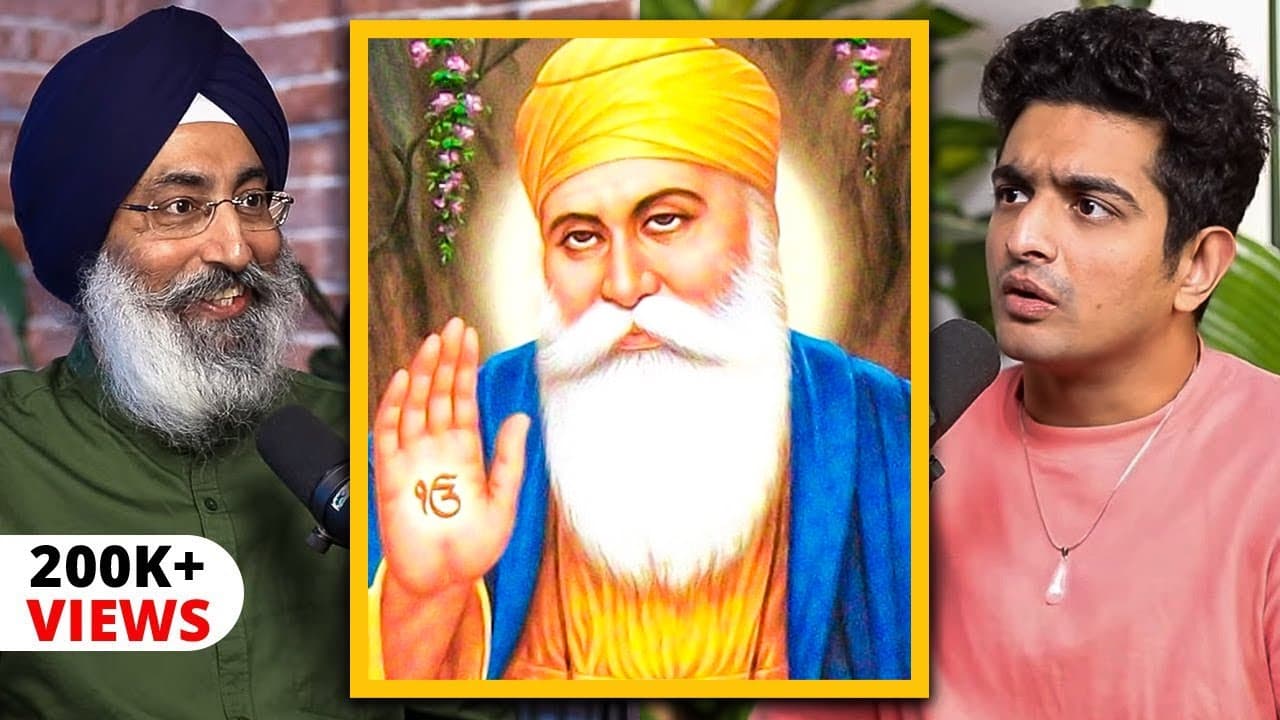
Why Guru Nanak Created A New Religion - History Of Sikhi Explained
TL;DR
Guru Nanak's revolutionary ideas reshaped spirituality and social justice in 15th-century Punjab.
Transcript
your friends are scrolling through short content but you my friend you're here to learn welcome to the honest Clips the story of sikhi begins with Guru namak here is 1469 it's a confrontation of what we now call Hinduism in Islam in Punjab those are the two dominant religions and confrontation in terms of ideas in terms of even battles in terms of ... Read More
Key Insights
- 🧔 Guru Nanak was born amidst religious conflict, which influenced his perspective on spirituality and social harmony in Punjab.
- 🛟 His foundational community in Kartarpur served as a model for equality and inclusivity, emphasizing collective spiritual and social growth.
- 🫡 Nanak’s dialogues with leaders of different faiths showcased his commitment to bridging divides and fostering mutual respect.
- 😀 He protested against injustices faced by marginalized groups, advocating for truth and social reform within the political and religious landscape of his time.
- 🤔 Guru Nanak's approach to questioning rituals encouraged critical thinking and dialogue, moving beyond mere adherence to tradition.
- 🖐️ His teachings challenging racism and sexism laid the groundwork for Sikhism's commitment to equality and social justice.
- ❓ By combining spiritual insight with political awareness, Guru Nanak established the notion of Miri Piri, advocating for spiritual and political responsibility in leadership.
Install to Summarize YouTube Videos and Get Transcripts
Explore YouTube Video Summarizer or Get YouTube Transcript Extractor
Questions & Answers
Q: What were the main circumstances surrounding Guru Nanak's birth and early life?
Guru Nanak was born in 1469 in a tumultuous period characterized by religious confrontations in Punjab, where Hinduism and Islam were the dominant faiths. This era marked the rise of the Mughal dynasty, with conflicts and invasions from the Middle East, including Babar's incursions. His early life was influenced by these dynamics, which shaped his spiritual journey and inclination toward questioning societal norms.
Q: What revolutionary ideas did Guru Nanak introduce during his time?
Guru Nanak introduced transformative ideas centered on the concepts of equality and community living. He openly questioned cultural and religious practices, advocating for a dialogue instead of conflict. His emphasis on understanding the purpose behind ceremonies and rituals challenged existing norms. He aspired to build a society where all individuals were seen as equal, irrespective of caste or gender, fundamentally altering the social landscape of his time.
Q: How did Guru Nanak's founding of Kartarpur contribute to the Sikh faith?
Guru Nanak founded Kartarpur as a community where principles of equality and spirituality were practiced. This new city served as a hub for his followers, emphasizing the importance of living according to divine teachings. It maintained a focus on mentorship and training, which shaped the early Sikh community and institutionalized his teachings, ultimately leading to the formal recognition of Sikhism.
Q: How did Guru Nanak confront the political landscape of his time?
Guru Nanak navigated the complicated political landscape by addressing injustices and advocating for social reforms. He protested against Mughal atrocities and the oppression experienced by various groups, including women. His dialogue with political figures, like Babar, demonstrated a unique blend of spiritual authority and political insight, emphasizing that leadership should combine moral clarity with governance.
Q: In what ways did Guru Nanak challenge traditional religious practices?
Guru Nanak challenged traditional religious practices through his critical questioning of rituals and societal norms. For example, during his initiation ceremony, he questioned why certain practices were excluded for his sister. His approach was not one of rejection but rather of inquiry, encouraging others to think critically about their beliefs, thereby fostering a more inclusive and reflective community.
Q: What were the implications of Guru Nanak’s dialogues with leaders of different faiths?
Guru Nanak's dialogues with leaders from various faiths, such as yogis and Muslims, demonstrated his commitment to understanding and bridging differences. These interactions highlighted the need for respect and unity among different religions. By engaging in such conversations, he laid the groundwork for a more inclusive spiritual landscape, promoting the idea that wisdom can be found across diverse traditions.
Q: How did Guru Nanak's teachings address social injustices like racism and sexism?
Guru Nanak explicitly addressed social injustices by advocating for zero tolerance towards racism and sexism. His teachings emphasized that every individual is a product of divine creation, which established a foundation for equality. Through his community in Kartarpur, he modeled these principles in practice, aiming to create an environment where everyone was respected and valued, regardless of their gender or social standing.
Q: What legacy did Guru Nanak leave for future generations?
The legacy of Guru Nanak lies in his foundational teachings that established the principles of Sikhism. He emphasized the integration of spirituality with social justice, fostering a community that challenged discriminatory practices. His life and work inspired future Sikh leaders to continue the pursuit of equality and justice, ensuring that his vision endures in the values cherished by Sikhs today.
Summary & Key Takeaways
-
Guru Nanak, born in 1469, challenged dominant religious practices of Hinduism and Islam by fostering dialogue over conflict in Punjab during the Mughal era.
-
He founded Kartarpur to create a community based on equality, addressing issues like racism and sexism, thus establishing the roots of Sikhism.
-
His teachings emphasized the integration of spirituality and politics, advocating for social justice and reform amidst the tumultuous political landscape of his time.
Read in Other Languages (beta)
Share This Summary 📚
Summarize YouTube Videos and Get Video Transcripts with 1-Click
Try YouTube Summary with ChatGPT & Claude or YouTube Transcript Generator
Explore More Summaries from TRS Clips 📚



Summarize YouTube Videos and Get Video Transcripts with 1-Click
Try YouTube Summary with ChatGPT & Claude or YouTube Transcript Generator