What Are London Dispersion Forces and How Do They Work?
TL;DR
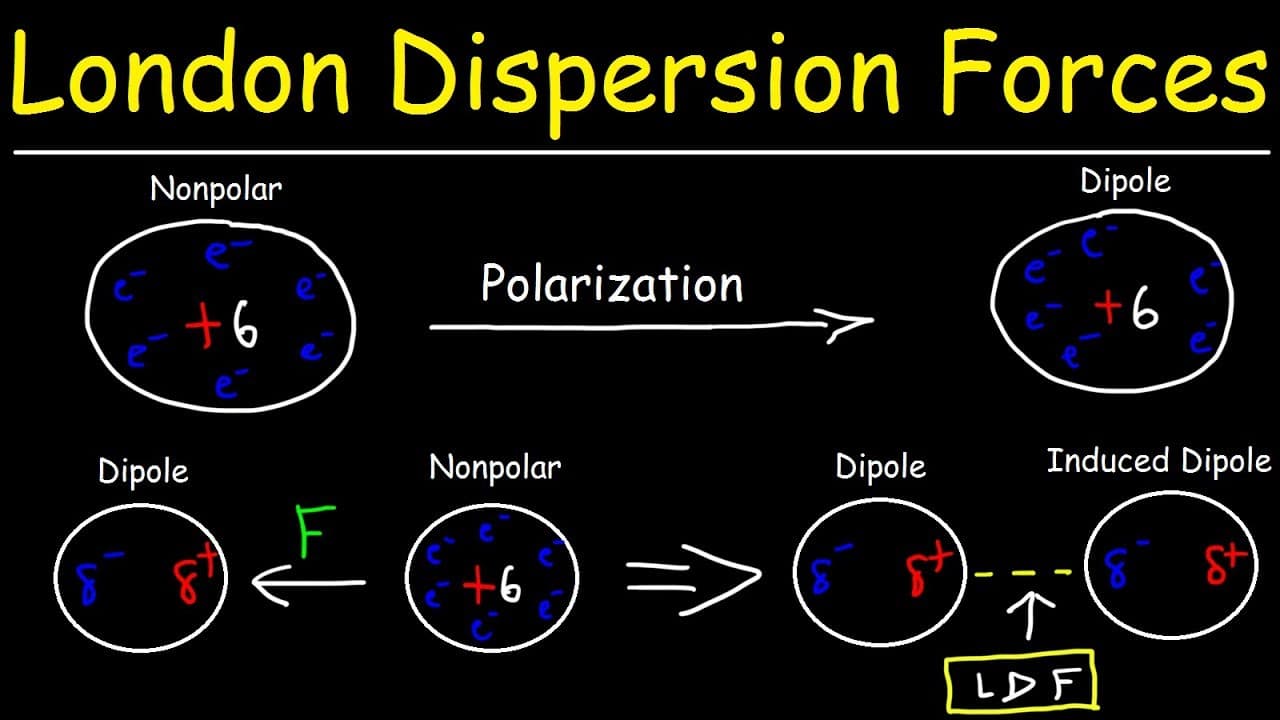
London dispersion forces are temporary dipole-induced dipole interactions prevalent in nonpolar molecules, arising from uneven electron distribution. Their strength increases with the number of electrons and polarizability; larger molecules exhibit stronger dispersion forces, leading to higher boiling points.
Transcript
in this video we're going to talk about london dispersion forces these are forces that are found in every type of atom every type of molecule however they are the predominant force found in nonpolar molecules so let's say if we have an atom with a nucleus with a positive charge and there are electrons around the atom now this atom is nonpolar the e... Read More
Key Insights
- ❓ London dispersion forces are temporary dipole-induced dipole interactions found in nonpolar molecules.
- 🥺 Electron distribution in nonpolar molecules can temporarily become polarized, leading to temporary dipoles.
- 📶 The strength of London dispersion forces depends on the number of electrons and polarizability of the molecules involved.
- 💪 Larger molecules with more electrons have stronger dispersion forces.
- 😥 The boiling point of a substance increases as the strength of London dispersion forces increases.
- 🫢 The boiling points of noble gases increase with the number of electrons, demonstrating the effect of dispersion forces.
- 😥 Molecules with greater surface area have higher boiling points due to increased dispersion forces.
Install to Summarize YouTube Videos and Get Transcripts
Explore YouTube Video Summarizer or Get YouTube Transcript Extractor
Questions & Answers
Q: What are London dispersion forces and where are they found?
London dispersion forces are temporary dipole-induced dipole interactions found in all types of atoms and every type of molecule. However, they are most prevalent in nonpolar molecules.
Q: How are London dispersion forces created in atoms?
London dispersion forces occur when the random motion of electrons in an atom causes an uneven distribution of electrons, creating temporary polarization or temporary dipoles.
Q: What determines the strength of London dispersion forces?
The number of electrons in an atom or molecule determines its polarizability, which affects the strength of London dispersion forces. Larger atoms or molecules with more electrons are more polarizable and have stronger dispersion forces.
Q: How do London dispersion forces affect boiling points?
The presence of London dispersion forces increases the boiling point of a substance. As the number of electrons, polarizability, and surface area of the molecules increase, the strength of the dispersion forces increases, resulting in a higher boiling point.
Summary & Key Takeaways
-
London dispersion forces are present in all atoms and molecules, but are predominant in nonpolar molecules.
-
They arise due to the temporary polarization of electron distribution, creating a dipole-induced dipole interaction.
-
The strength of these forces depends on the number of electrons, polarizability, and surface area of the molecules involved.
Read in Other Languages (beta)
Share This Summary 📚
Summarize YouTube Videos and Get Video Transcripts with 1-Click
Try YouTube Summary with ChatGPT & Claude or YouTube Transcript Generator
Explore More Summaries from The Organic Chemistry Tutor 📚



Summarize YouTube Videos and Get Video Transcripts with 1-Click
Try YouTube Summary with ChatGPT & Claude or YouTube Transcript Generator