L13.5 Charged particles in EM fields: Schrodinger equation
TL;DR
The Schrodinger equation in quantum mechanics is modified with a replacement of the momentum operator and the wave function is also transformed when the electromagnetic potentials change according to gauge invariance.
Transcript
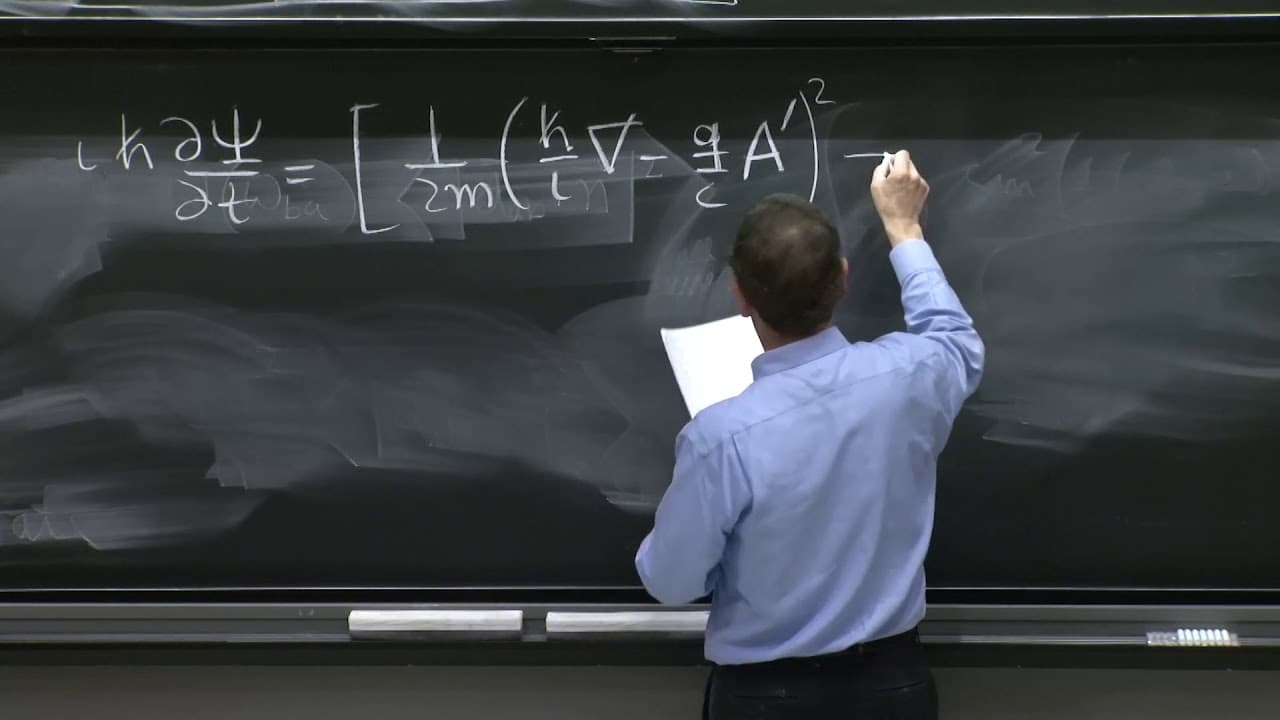
PROFESSOR: OK. So what is our Schrodinger equation? Therefore, our Schrodinger equation is ih bar d psi dt is equal to 1 over 2 m. H bar over i grad-- that's p-- minus q over c a squared plus q phi on psi. We're going to motivate that next time. But let's look at it for a little while, at least. There's several things we've done here. We've replace... Read More
Key Insights
- 👶 The Schrodinger equation is modified by replacing the momentum operator with a new quantity involving the electromagnetic potentials.
- 👶 The new quantity can be related to the velocity operator in the Heisenberg equations of motion.
- 👋 Gauge invariance requires that both the wave function and the potentials undergo transformations when the electromagnetic potentials change.
- 👋 The transformation of the wave function under gauge invariance involves multiplying it by a phase factor that depends on the spatial and temporal coordinates.
- 💱 This phase factor does not change the physics significantly, but only introduces a subtle change through the complex phase.
- 🥶 The statement of gauge invariance is that the Schrodinger equation with the new potentials should imply the Schrodinger equation with the old potentials if the wave function also undergoes the appropriate transformation.
- 👋 Operators that are gauge invariant are suitable for calculating expectation values in the transformed wave function.
Install to Summarize YouTube Videos and Get Transcripts
Explore YouTube Video Summarizer or Get YouTube Transcript Extractor
Questions & Answers
Q: How is the Schrodinger equation modified when the electromagnetic potentials change?
The momentum operator in the Schrodinger equation is replaced with a new quantity that involves the electromagnetic potentials, resulting in a different form of the equation.
Q: Is the new quantity equivalent to the classical momentum?
No, the new quantity is not intuitively equal to the classical momentum. It can be related to the velocity operator in the Heisenberg equations of motion, but it is not the same as the classical momentum.
Q: What is the significance of gauge invariance in the Schrodinger equation?
Gauge invariance requires that the physics obtained with one set of potentials should be the same as the physics obtained with a gauge-equivalent set of potentials. This means that both the wave function and the potentials must undergo transformations.
Q: How is the wave function transformed under gauge invariance?
The wave function is multiplied by a phase factor of e to the i q over hc lambda, where lambda is the same parameter used to transform the potentials. This phase factor represents the change in the wave function due to the gauge transformation.
Summary & Key Takeaways
-
The Schrodinger equation is modified by replacing the momentum operator with a new quantity that involves the electromagnetic potentials.
-
The new quantity is not equivalent to the classical momentum, but it can be related to the velocity operator in the Heisenberg equations of motion.
-
Gauge invariance requires that when the electromagnetic potentials change, both the wave function and the potentials themselves undergo transformations.
Read in Other Languages (beta)
Share This Summary 📚
Summarize YouTube Videos and Get Video Transcripts with 1-Click
Try YouTube Summary with ChatGPT & Claude or YouTube Transcript Generator
Explore More Summaries from MIT OpenCourseWare 📚



Summarize YouTube Videos and Get Video Transcripts with 1-Click
Try YouTube Summary with ChatGPT & Claude or YouTube Transcript Generator