Bar graph | Students Enrollments | DI | Reasoning | Part - 20 | Bharath Kumar
TL;DR
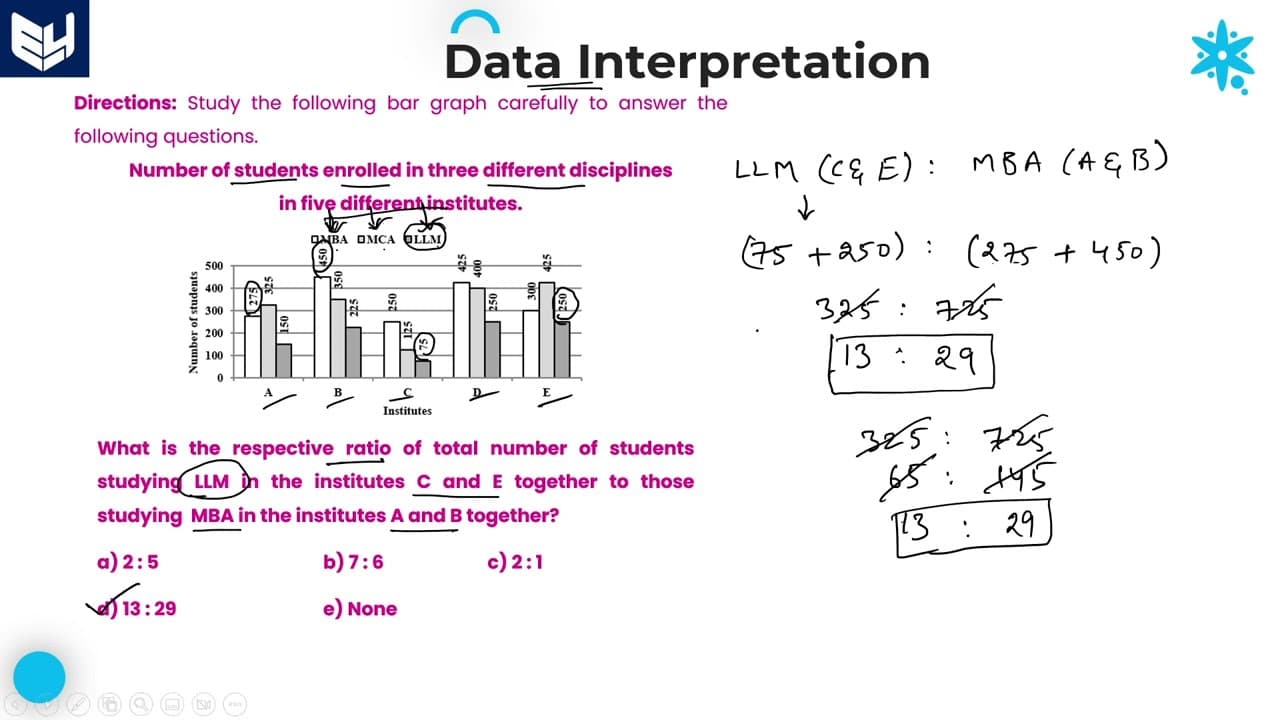
This content guides through solving bar graph data interpretation problems related to student enrollment.
Transcript
hi everyone welcome to the session in this session I am continuing bar graph data interpretation first let us look at the information which is provided in the given bar graph and then we need to solve the questions according to the given information see the information first number of students enrolled in three different disciplines in five differe... Read More
Key Insights
- 🉐 The bar graph represents student enrollments in MBA, MCA, and LLM across five distinct institutes, facilitating straightforward data interpretation.
- 🥳 Quick calculations are paramount in competitive settings, encouraging strategies like rounding and utilizing common denominators to simplify ratios and percentages.
- 💄 The process of deriving answers through structured steps helps ensure accuracy and clarity, making complex questions manageable.
- 🉐 Understanding the context of data presentation is crucial; visual aids like bar graphs can significantly enhance comprehension and analysis.
- 🥳 Ratios compare enrollments between disciplines, helping assess popularity and focus areas for academic programs.
- 🦻 Transparency in the calculation process bolsters confidence and aids in learning effective problem-solving strategies.
- 👥 Percentages provide insight into the relative size of groups within the total population, crucial for strategic academic planning.
Install to Summarize YouTube Videos and Get Transcripts
Explore YouTube Video Summarizer or Get YouTube Transcript Extractor
Questions & Answers
Q: What is the significance of calculating ratios in this session?
Calculating ratios allows for comparison between different disciplines and institutes, providing a clear understanding of the relationships between student enrollments. It helps in analyzing the data systematically and enables effective decision-making based on the enrollment trends observed in the graph.
Q: How do you find the total number of students enrolled in a given discipline across all institutes?
To find the total number of students enrolled in a discipline, sum the number of students from all institutes for that discipline. For example, to calculate the total MBA students, add the figures from each institute: 275 (A) + 450 (B) + 250 (C) + 425 (D) + 300 (E) to derive the total.
Q: Why is it important to approximate percentages in data interpretation?
Approximating percentages simplifies calculations and speeds up the interpretation process, especially in competitive examinations. Precision can be less critical when options in multiple-choice questions don't closely align, allowing for quick decision-making based on rounded estimates.
Q: What methods can you use to speed up calculations during data interpretation?
Utilize shortcuts such as canceling common factors, working with rounded numbers for estimates, and practicing mathematical operations to improve speed. Being familiar with ratio properties and percentage calculations can also enhance efficiency during examinations.
Summary & Key Takeaways
-
The session focuses on interpreting a bar graph representing student enrollment in MBA, MCA, and LLM across five institutes, providing clear visuals for better understanding.
-
Several questions are presented that require calculating ratios and percentages based on the enrollment numbers from the graph, emphasizing the need for quick mathematical calculations.
-
The content details step-by-step solutions to each question, illustrating methods for deriving ratios, calculating total enrollments, and finding approximate percentages effectively.
Read in Other Languages (beta)
Share This Summary 📚
Summarize YouTube Videos and Get Video Transcripts with 1-Click
Try YouTube Summary with ChatGPT & Claude or YouTube Transcript Generator