What Is the Law of Iterated Expectations in Probability?
TL;DR
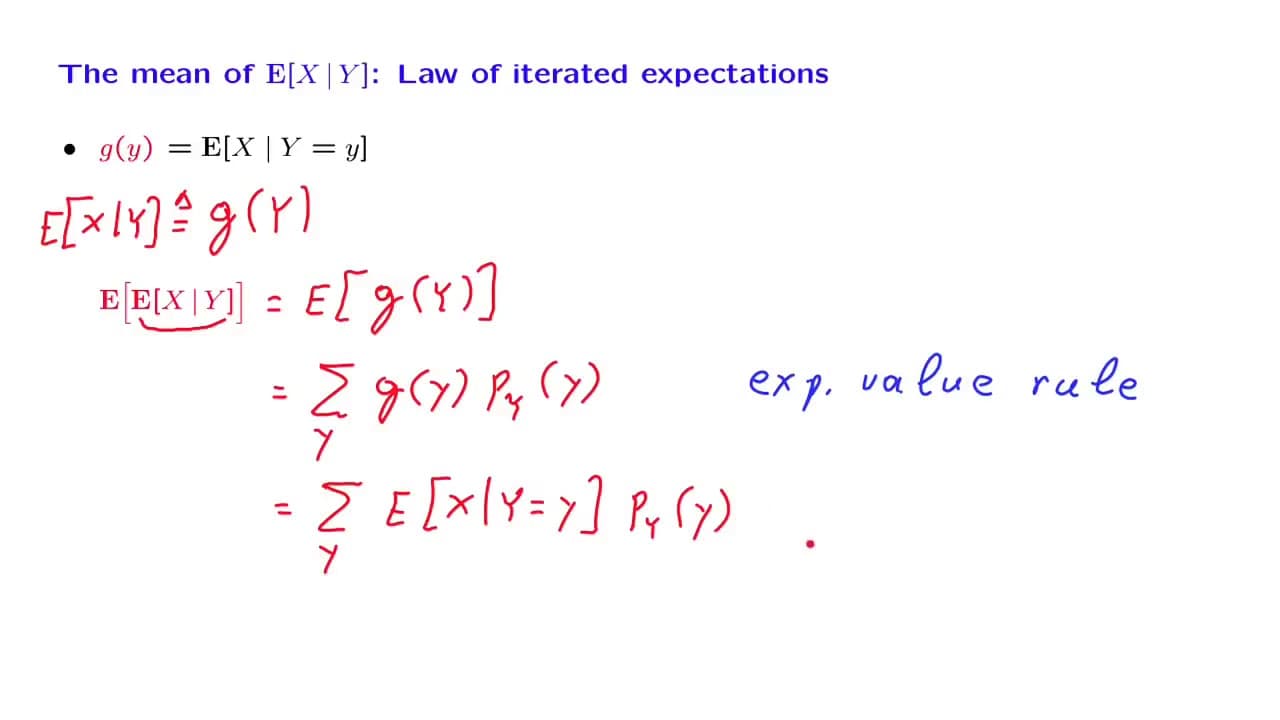
The Law of Iterated Expectations states that the expectation of a conditional expectation equals the unconditional expectation, regardless of whether the random variable is discrete or continuous. This principle can be proven using the Total Expectation Theorem, highlighting that conditional expectations are themselves random variables with defined means.
Transcript
We have previously defined the abstract conditional expectation of one random variable given another random variable. And we discussed that it is, by itself, a random variable. In particular, it has an expectation, or mean, of its own. What is this mean? This is what we want to find out. Let us recall our development. We look at the conditional exp... Read More
Key Insights
- ❓ Conditional expectation is a random variable that has its own mean.
- ❓ The function g(y) defines the numerical value of the conditional expectation for a particular value of y.
- 🟰 The Law of Iterated Expectations states that the expectation of a conditional expectation equals the unconditional expectation.
- 👍 The Total Expectation Theorem can be used to prove the Law of Iterated Expectations.
- ❓ The Law of Iterated Expectations is an abstract version of the Total Expectation Theorem.
- ❓ It is applicable to both discrete and continuous random variables.
- 💼 The proof for the Law of Iterated Expectations is the same for both discrete and continuous cases.
Install to Summarize YouTube Videos and Get Transcripts
Explore YouTube Video Summarizer or Get YouTube Transcript Extractor
Questions & Answers
Q: What is the definition of conditional expectation?
Conditional expectation refers to a random variable that represents the expected value of one random variable given a specific numerical value of another random variable.
Q: How is the function g(y) related to the conditional expectation?
The function g(y) provides the numerical value of the conditional expectation for a particular value of y. It is a well-defined function of y.
Q: How is the Law of Iterated Expectations defined?
The Law of Iterated Expectations states that the expectation of a conditional expectation is equal to the unconditional expectation. In other words, taking the expectation of a conditional expectation yields the same result as taking the expectation of the original random variable.
Q: Can the Law of Iterated Expectations be applied to both discrete and continuous random variables?
Yes, the Law of Iterated Expectations holds true for both discrete and continuous random variables. In the continuous case, an integral and probability density function (PDF) would be used instead of a sum and probability mass function (PMF).
Summary & Key Takeaways
-
Conditional expectation is a random variable that depends on a specific numerical value of another random variable.
-
The function g(x) defines the numerical value of the conditional expectation for a specific value of y.
-
By applying the Total Expectation Theorem, the expectation of a conditional expectation is proven to be the same as the unconditional expectation.
Read in Other Languages (beta)
Share This Summary 📚
Summarize YouTube Videos and Get Video Transcripts with 1-Click
Try YouTube Summary with ChatGPT & Claude or YouTube Transcript Generator
Explore More Summaries from MIT OpenCourseWare 📚



Summarize YouTube Videos and Get Video Transcripts with 1-Click
Try YouTube Summary with ChatGPT & Claude or YouTube Transcript Generator