Custom xAPI Statements in Articulate Storyline - First Impressions
TL;DR
Articulate Storyline update allows customization of xAPI statements without coding, but limitations exist.
Transcript
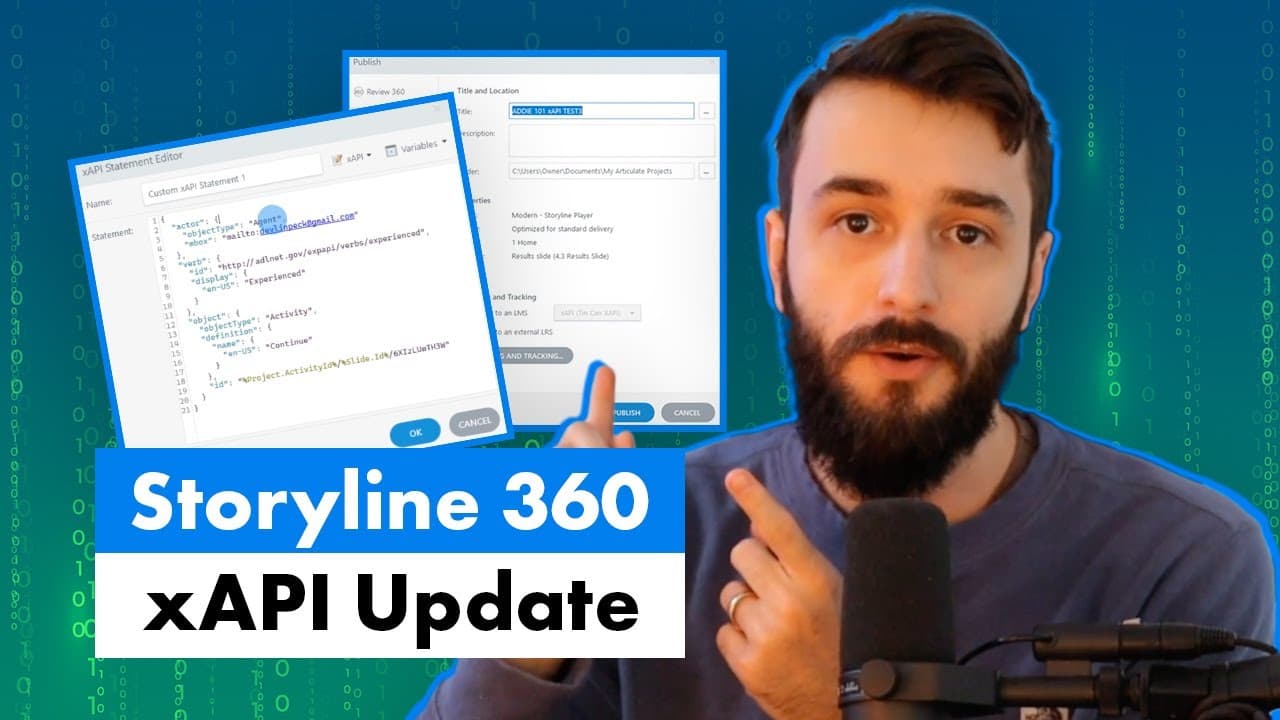
Hello, my friends! Articulate Storyline just had a big, long awaited update that lets you send custom xAPI statements without using any code. Now in this video, we'll go through some of my first impressions. It doesn't look like this functionality is there yet. So I probably will not be using it right now, but it is really exciting what... Read More
Key Insights
- 👤 Custom xAPI statements in Articulate Storyline offer the potential for detailed tracking of user interactions in eLearning courses.
- 🖤 Despite the exciting possibilities, limitations such as duplicate statements, lack of customization, and reporting challenges exist.
- 🛃 The current functionality of custom xAPI statements may require technical proficiency and further development to fully realize its capabilities.
- 😌 The distinction between xAPI and SCORM lies in the ability to collect granular data on user interactions within eLearning experiences.
- 💁 Challenges such as integrating actor information, configuring learning record stores, and avoiding duplicate statements highlight the complexities of utilizing custom xAPI features.
- 🕸️ The limitations of default reporting options and the inability to upload to web servers may necessitate additional development for custom xAPI projects.
- 👤 Feedback from users on the functionality of custom xAPI statements will be crucial for improving and expanding their usability in Articulate Storyline.
Install to Summarize YouTube Videos and Get Transcripts
Explore YouTube Video Summarizer or Get YouTube Transcript Extractor
Questions & Answers
Q: What is xAPI, and how does it differ from SCORM?
xAPI is a technical specification for detailed data collection in eLearning, surpassing SCORM's limited tracking capabilities by using an actor-verb-object format.
Q: What challenges did the content creator encounter with Articulate Storyline's custom xAPI statements?
The creator faced issues with duplicate statements being sent, lack of customization options, and difficulty in omitting default reporting functions.
Q: How did the content creator attempt to resolve the issues with custom xAPI statements?
The creator experimented with hard-coding actor information, configuring learning record stores, and testing various trigger configurations within Articulate Storyline.
Q: What potential impact could custom xAPI statements have on the eLearning industry?
Custom xAPI statements offer the potential for detailed tracking of user interactions, leading to valuable insights for instructional designers and learning management systems.
Summary & Key Takeaways
-
The new Articulate Storyline update enables users to create custom xAPI statements without code.
-
Despite exciting possibilities, the functionality currently has limitations in customization and functionality.
-
The ability to track detailed interactions within eLearning courses could revolutionize data collection and analysis.
Read in Other Languages (beta)
Share This Summary 📚
Summarize YouTube Videos and Get Video Transcripts with 1-Click
Try YouTube Summary with ChatGPT & Claude or YouTube Transcript Generator
Explore More Summaries from Devlin Peck 📚






Summarize YouTube Videos and Get Video Transcripts with 1-Click
Try YouTube Summary with ChatGPT & Claude or YouTube Transcript Generator